


 Francais
 Deutsch
 Italiano

Refine Your Search
United States 1982 stock footage and images
- Showing 1315 to 1320 of 34981 results more
 Hide
Color Sound
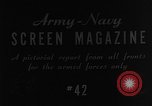
J.Edgar Hoover describes the problem of enemy agents and Nazi sympathizers in the United States in 1940.
Director of the U.S Federal Bureau of Investigation (FBI), J.Edgar Hoover, addresses Americans in military service in 1940. He speaks about enemy agents sent to the United States to undermine the war effort. Scene shifts to a 1940 nighttime view of New York City with lights on in its buildings. Sound of Benny Goodman's orchestra in background. Glimpse of water displays at the New York World's Fair. Brooklyn Dodgers Baseball team playing a game at Ebbets Field. A large field of wheat being harvested by a mechanical reaper, in an American western state. American soldiers putting on civilian clothes for weekend passes. Views of various American cities and towns with cars driving on parkways, shoppers and pedestrians walking in business districts. Closeup of a German agent, ostensibly being apprehended while beaming information to Germany via shortwave radio. German documents are on his desk. A submarine periscope tracks across surface of water. A torpedo races through the water leaving a trail of bubbles. An American ship, ostensibly being torpedoed in the Caribbean. Letters being mailed to so-called "mail drops" in Spain and South America. An intercepted letter with military information being highlighted. A brick house, outside Los Angeles, where an unidentified man is seen, whom narrator (J.Edgar Hoover) describes as " This self-appointed Dictator, who set himself up in the business of promoting Nazism." A picture of Adolf Hitler is seen on his wall. Near Chicago, a wooden sign reads, "Camp Hindenburg., Two miles." American Nazi youth are seen parading there. A newspaper shows a picture of Nazi youth at Camp Nordland, in New Jersey where young American Nazi girls are seen parading. In Yaphank, on long Island, New York, American Nazis are seen parading. The head of the German-American Bund, Fritz Kuhn, is seen at an outdoor podium giving a speech, while surrounded and guarded by uniformed Bund members. He is enthusiastically applauded by members of the audience. Several women with babies in carriages, cross at a corner in New York City. Some receive notices being passed out by a young man, announcing a "Mass Demonstration for true Americans" (to be held at Madison Square Garden). A swastika appears on each notice. View from a high point overlooking a crowd of 22 thousand American Nazis gathered in Madison Square Garden, on Feb. 20, 1939. An honor guard parades as drummers play from the stage. A mass of men holding American flags, and one holding a banner showing a swastika and words in German. Audience members all render the Nazi salute and shout "Heil." Files in the FBI offices labeled "German Agents." The file of Walter Kappe, one of the leaders of the Chicago Free Society of Teutonia and German American Bund is shown. Narrator, Hoover, says, " he was a Lieutenant in the German Army and the Leader of German sabotage in the United States." View of a vast array of desks and files in the FBI where men and women work on fingerprints. A man projects fingerprints on a screen, as Hoover speaks of the files revealing that "innocent appearing persons, applying for work in United States war plants, had been convicted of espionage in the last world war."Two men look over an FBI chart showing the location of every key spy and mail drop in North and South America
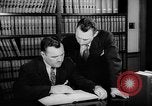
Federal Bureau of Investigation officers discuss German and Japanese agents and their activities in the United States.
The director of the Federal Bureau of Investigation (FBI) John Edgar Hoover talks about enemy agents and spies in the U.S. at the time of World War II. Two officers sit in an office. German and Japanese suspects in the United States. A German agent on a street. A Japanese spy takes photographs from a bridge. Purported Nazi German agents arriving as tourists in the United States. German and Japanese diplomats greeting one another and exchanging a Nazi salute. The conference room of the Federal Bureau of Investigation. Officers discuss the activities of Nazi German secret agents and Imperial Japanese agents operating in South America. Nazi signs on an animated map show the advance of German agents in areas such as Patagonia. Narrator states that Nazi German and Imperial Japanese agents setup radio listening posts in multiple locations in South America to track and report on U.S. shipping in the world's oceans. Animated map shows settlements northward migration through Brazil of "more than 300,000 Japanese colonists". Animation shows expansion of German airline services through South America from Argentina to Colombia.
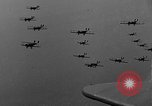
Bomber aircraft Keystone LB-5 and Curtiss-Martin NBS-1 in flight in formation in United States.
Aircraft in flight during United States Air Corps Demonstrations at Command Schools in United States. U.S. Army Air Corps bomber aircraft Keystone LB-5 in flight. Planes in formation. Several U.S. Army Air Corps Curtiss-Martin bomber aircraft NBS-1 in flight in formation. Aerial view of the land below.
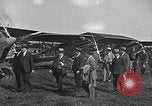
Inspection of aircraft equipment by Congressmen and other Government officials in United States.
Air Corps Demonstrations team during tour of Command Schools United States. Inspection of aircraft equipment by Congressmen and other Government officials. United States Assistant Secretary of War for Air F. Trubee Davison talks to U.S. Brigadier General Benjamin Foulois and other staff. Men stand together in front of the aircraft parked on a field. Bombs lying on the ground. Two men arrange them. A sign near the bombs read 'Danger'. Two men fuse bombs in an aircraft. U.S. Army Air Corps attack aircraft Curtiss A-3 Falcon in flight. The planes frag bomb on targets. Smoke rises up due to explosions.
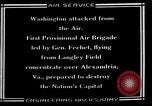
U.S. AAS 1st Provisional Air Brigade Airco DH4 prepare to attack during practice maneuver drills over Washington DC
Practice maneuvers of United States Army Air Service 1st Provisional Air Brigade commanded by Brigadier General James Fechet in the United States. The brigade from Langley Field, flying over Alexandria, prepares a mock attack targeted at the United States capital city of Washington DC. U.S. Army Air Service Airco DH4 aircraft in flight. The mock attackers reach the Lincoln Memorial in spite of the heavy rain. Rows of Navy buildings near the memorial. The DH4 aircraft above the area. The attack group in formations over Washington DC. Views of the Potomac River Bridges including the Aqueduct Bridge near newly built Key Bridge. The pursuit group attacks the enemy fleet from above and below at the same time.
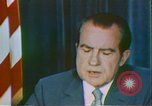
U.S. President Richard Nixon works for peaceful end of Vietnam War, improves domestic conditions and controls drug traffic.
U.S. President Richard Nixon speaks about aftermath of immediate withdrawal from the Vietnam War. U.S. military prisoners of war held by North Vietnam stand before press reporters in Vietnam. President confers with U.S. Secretary of State Dr. Henry Kissinger at his office. Vietnam War draftees being selected by traditional lottery system. Men stand in front of machines that churn out numbered balls for new draft lottery system. Nixon transforms budget expenditure on human needs. Criminals caught by police walk, some covering their faces from the media, as they are led away by police and investigators. Illegal drugs seized by efforts of Nixon administration. View of seized heroin manufacturing equipment. Nixon speaks about the opium farming in Turkey during one of his speeches and mentions agreement with the Turkish government in Ankara to cease all opium poppy production. Customs officers check illegal drug traffic on the border of Mexico and America. Drug enforcement officials search cargo hold of a ship for illegal drugs. Views of drug control officers finding illegal stashed hidden drugs in hiding places in cars and vehicles. Nixon speaks about increased budget to control illegal drug traffic and rehabilitation of drug abusers and drug addicts. He creates the office of Drug Abuse Enforcement and he speaks saying "We must wage what I have called Total War against public enemy number one in the United States: The problem of dangerous drugs." From a pro-Nixon "documentary" called "The Nixon Years: Change Without Chaos" covering President Richard Nixon's first four years in office. Released during his 1972 reelection campaign.
CRITICALPAST.COM: About Us | Contact Us | FAQs - How to Order | License Agreement | My Account | My Lightboxes | Shopping Cart | Advanced Search | Featured Collections | Website Terms & Conditions | Privacy Policy ©2026 CriticalPast LLC.
License Agreement |
Terms & Conditions |
Privacy Policy
©2026 CriticalPast LLC.