


 Francais
 Deutsch
 Italiano
Refine Your Search
United States 1982 stock footage and images
- Showing 13663 to 13668 of 26492 results more
more Hide
Hide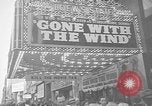
People sign petitions protesting a proposed movie tax in front of theaters in Times Square, New York.
Demonstrators protest against a proposed movie tax in New York, United States. Protestors in front of Lowe's State theater. Marquee sign reads 'Gone With The Wind'. A banner reads 'Kill The 5% Movie Tax'. An usher encourages patrons to sign a petition against the movie tax. A sign on a petition table : 'Ask Your City Councilman to Help Kill 5% Threatened New York City Movie Tax! Sign Petition Here'. People sign as they pass. At the Criterion theater, a banner reads ' Help Fight The 5% Movie Tax'. The marquee reads, 'Jane Russell in The French Line, 3D' Traffic and crowds on the road in front of the theater. View of Times Square with neon lights and signs. Signs advertise 'Chevrolet' and the movie 'Elephant Walk'.
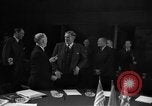
James F Byrnes, Anthony Eden and Vyacheslav Molotov gathered for Potsdam Conference in Potsdam, Germany during World War II.
Representatives of Allied nations gathered for Potsdam Conference at Schloss Cecilienhof Palace (Im Neuen Garten, 14469 Potsdam, Germany) in Potsdam, Germany during World War II. Interiors of the conference room. United States Secretary of States James Francis Byrnes speaks with Minister of War, Anthony Eden of Great Britain. He shakes hands with other representatives. Byrnes takes his seat at conference table. Soviet People's Commissar for Foreign Affairs Vyacheslav Mikhailovich Molotov enters and shake hands with Byrnes and staff. Representatives take their seats around the conference table. Document files kept on the table in front of them.

Civilians purchase lottery tickets at the Chase Manhattan Bank after legalization of gambling by lottery in New York City.
Legalization of gambling by lottery in New York City, United States. View of the buildings along a street. Civilians purchase lottery tickets at the Chase Manhattan Bank after New York State legalized gambling by lottery. Civilians fill in the details and drop the tickets in a box.
Troops march past and dignitaries seated in car moves for the John F Kennedy presidential inauguration ceremony in Washington DC.
Presidential inauguration ceremony of U.S. President John Fitzgerald Kennedy in Washington DC. A building decorated with flags. A large crowd of spectators gathered on streets. A military band plays and marches on streets. Troops march holding rifles. John Fitzgerald Kennedy, former U.S. President Harry S. Truman and Major General Harry H. Vaughan seated in their car move through streets for the Presidential inauguration ceremony. Troops march holding flags. Civilians gathered cheer the marching troops. United States Secretary of State David Dean Rusk seated in a car.
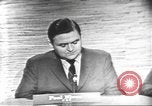
Presidential election debate in Washington DC. Richard Nixon, debating John F. Kennedy, speaks about the spread of Communism.
The second Kennedy-Nixon Presidential Debate in Washington DC, United States. Moderator Frank McGee introduces the candidates - Republican candidate U.S. Vice President Richard M. Nixon and Democratic candidate Senator John F Kennedy. The Moderator tells the rules to the candidates regarding questioning by the reporters. The reporters include Paul Niven, Edward P. Morgan, Alvin Spivak, and Harold R. Levy. Paul Niven asks Nixon to comment on whether Truman Administration was responsible for the loss of China to the Communists. Nixon answers and says that he disagrees with Senator Kennedy's statement that Cuba is lost and certainly China was lost because of Truman Administration. He talks about the decrease in the number of dictators in Southern and Central America in the past years. He speaks about Kennedy's book 'The Strategy for Peace' which prohibits the Americans from interfering in internal affairs of any other state. Kennedy presents his views and says that he never suggested that Cuba was lost. He criticized Nixon because in his press conference in Havana in 1955, he praised the competence and stability of the Batista dictatorship. He criticized the failure of the administration to use its great influence to persuade the Cuban government to hold free elections. He hopes that some day Cuba would rise if the U.S. changes its policies towards it.
During a presidential election debate in Washington DC, Kennedy mentions the reasons for the decline of U.S. power and prestige.
The second Kennedy-Nixon Presidential Debate in Washington DC, United States. Paul Niven of CBS asks Democratic candidate Senator John F Kennedy whether he blames President Eisenhower and Vice President Nixon for the decline of American power and prestige in the last eight years. Kennedy disagrees with Nixon's statements regarding increase in American power and prestige. He talks about Nixon's experience in the administration and inability of the administration in not meeting its responsibilities which has led to decline in American power against that of the Communists. Republican candidate U.S. Vice President Richard M Nixon states that he has participated in discussions leading to decisions in his administration. He compares his programs with those of Kennedy. He also compares the economic progress of the U.S. in the Truman Administration with that of in the Eisenhower Administration. He concludes and asks Kennedy to differentiate his own programs from programs adopted by the Truman Administration
CRITICALPAST.COM: About Us | Contact Us | FAQs - How to Order | License Agreement | My Account | My Lightboxes | Shopping Cart | Advanced Search | Featured Collections | Website Terms & Conditions | Privacy Policy ©2026 CriticalPast LLC.
License Agreement |
Terms & Conditions |
Privacy Policy
©2026 CriticalPast LLC.