


 Francais
 Deutsch
 Italiano

Refine Your Search
United States 1982 stock footage and images
- Showing 133 to 138 of 34981 results more
 Hide
Color Sound
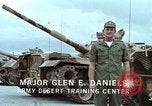
U.S. troops, armored vehicles, tanks and helicopters transported by U.S. Air Force Military Airlift Command aircraft.
Major Glen E Daniels of the Army Desert Training Centre in California. He stands in front of U.S. tanks and talks about movement of large units to combat zones by C-5 Galaxy aircraft of the U.S. Air Force Military Airlift Command. Soldiers load Cobra helicopters into a C-5. MAC C-5 Galaxy aircraft Interior of a C-5 showing two rows of M113 armored personnel carriers stowed inside. The troops accompanying them are seen climbing stairs to an upper deck of the C-5 where they will travel. Quick closeup view of a C-5 headed toward the camera during landing. Paratroopers jumping from MAC C-141 and C-130 aircraft. First Sergeant William Lawrence Jr, of the U.S. Army 82nd Airborne Division, stands in front of a camouflaged C-130 aircraft and talks about his experience in 20 years of parachute jumping. He extols MAC's efficiency in transporting paratroopers and comments on resulting improvement of drop zone times.
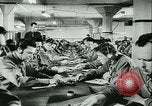
U.S. Army Signal Corps officers train at Fort Monmouth and production of signal communication items in the United States.
The role and contribution of the U.S. Army Signal Corps in combat and war. U.S. Army Signal Corps officers train at the Signal Corps Officer Candidate School (OCS) Fort Monmouth, New Jersey. Officers train at telegraph machines under the supervision of an instructor. Officers seated at desks in a classroom. Instructors take classes with the help of charts, diagrams and black boards. Officers seated atop electric poles for training. Two officers train in hand-to-hand combat at the OCS. Officers learn to use Radio Relay. Students listen to an instructor as he demonstrates the process. A U.S. soldier lays field wire across a hilly terrain to establish wire communications in the European Theater during World War II. Soldiers on the hill. Soldiers set up a sending station at the point where the wire can't go forward. A receiver is set up at the point from where the wire can go forward again. A soldier receives a photograph of a map through facsimile. Items of signal communication including radio relays, receivers, walkie-talkies, radio boxes and fuses to be produced and distributed by the USA Signal Corps to all other ground forces, navy and the Allies. New, modern, improved efficient signal communication equipment. A soldier displays two old type fuses and their counterparts.
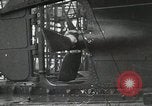
Launching of a U.S. Coast Guard cutter in the United States.
Propeller of a U.S. Coast Guard cutter to be launched. Another ship in water at the port. Two uniformed U.S. Coast Guard officers talk. (The one on the left is possibly U.S. Coast Guard Commandant Frederick C. Billard). Two dock workers use a two-man saw to cut away holding timbers. The Coast Guard cutter slides over track and enters water. Men at port watch the cutter move in water. The ship turns to the starboard.
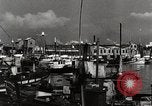
Fishermen of Japanese descent work on boats and United States destroyer ships at dock nearby in the United States
Fishermen of Japanese descent at work at a port in the west of the U.S.. Boats stand in water at a dock. Men work on docks and deal with fish. Group of United States Navy destroyers stands nearby at port. Japanese fishermen pull fishing net. Footage circa 1941-1942 near time of opening of Japanese relocation centers and internment camps in the U.S. during World War 2.
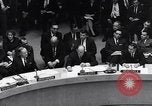
U.S. Ambassador Adlai Stevenson informs UN about steps taken in meeting of Organization of Consultation in United States.
Ambassador Adlai Stevenson addresses United Nations Assembly about United Sates action against Cuba and Russia, during timeframe of Cuban Missile Crisis. Ambassador Stevenson hopes and prays for peace. He tells Soviet Union to end their actions against United States. He refers to the initiative of President John F Kennedy to quarantine war. He informs about the Organization of Consultation meeting, which is a part of the Organization of American States. He then talks about the resolutions in 19 paragraphs adopted by them. First is immediate dismantling of offensive metals from Cuba. Second, he refers to article 6 and 8 and all necessary measure including use of arms against any offensive attempt on U.S. Third, is to inform security council of UN under article 54 of U.S. charter about the resolution, and the same information to be given to Cuba.

U.S. Federal Marshals frisk men and women around AIM (American Indian Movement) occupant area in United States.
Activities of United States Federal Marshals around AIM (American Indian Movement) occupant area in United States. Men women and children, some Native American Indian, stand besides a bus. U.S. marshals frisk men and women. They sit on bus. A marshal stands with a man, removing shoe for searching.
CRITICALPAST.COM: About Us | Contact Us | FAQs - How to Order | License Agreement | My Account | My Lightboxes | Shopping Cart | Advanced Search | Featured Collections | Website Terms & Conditions | Privacy Policy ©2026 CriticalPast LLC.
License Agreement |
Terms & Conditions |
Privacy Policy
©2026 CriticalPast LLC.