


 Francais
 Deutsch
 Italiano

Refine Your Search
United States 1982 stock footage and images
- Showing 1423 to 1428 of 34981 results more
 Hide
Color Sound
Coast Guard Rescue Stations along the Eastern and Southern coasts of the United States
After extensive slate of historical information, this film shows U.S. Coast Guard personnel launching a large dory (life boat) from the U.S. Coast Guard Gloucester Station in Gloucester, Massachusetts (Old House Cove, westerly side Gloucester Harbor). They slide the boat down rails, launching it directly into the water. Coast Guardsmen in foul weather gear are seen rowing a large lifeboat in rough waters near rocky shores. Eight men row, sitting in four pairs side-by-side on fixed thwarts (benches) and one stands in the stern (a coxwain) steering with a 16’ oar. A powered life boat is seen briefly, in extremely rough waters. Remainder of the film shows an animated map of the East and South coasts of the United States with dots identifying Coast Guard Stations on those coasts. At this point, the film concentrates on Rescue Stations in the Boston Division. A beached two-masted sailing ship is shown. A large steamship emitting black smoke from her funnel, is seen beached and listing on a shore. Aerial view of Light House on Block Island, off Rhode Island. Aerial view of a freighter run aground just off shore. Aerial view of a Coast Guard Station with a highway running past it. Aerial view of another Coast Guard Station located where narrator says is a dangerous point.

Aerial views of several U.S. Army Air Corps aircraft: C-47 dropping paratroopers, Vultee A-19, Martin B-26 Marauder bomber
United States Army paratroopers jump from a formation of U.S. Army Air Corps Douglas C-47 Skytrains (DC-3) in flight during exercises. White parachutes fill the sky. Aerial view of formation of Army Air Corps Vultee A-19 aircraft in flight. Aerial view of a formation of U.S. Army Air Corps Martin B-26 Marauder aircraft. Snowy mountain peak in the background.
Evolution of oil drilling and its various uses since prehistoric times in United States.
Dramatized documentary titled, 'The Evolution Of The Oil Industry'. Shows the evolution of oil drilling and refining in United States. Shows prehistoric man digging a field. An early water wheel in operation. Discovery of crude oil in a field. Babylonians light torches dipped in crude oil. Chinese men manually operate an oil rig in a field. Native American Indian woman applies oil on the back of a boy. A man sells oil bottle to a large crowd. Shows application of oil as axle grease in wheels and in oil lamps. Workers dig oil in a swamp. Hand shows an oil bottle. An early derrick in an oil field in Pennsylvania. Retired railroad constructor in front of the derrick. Shows uncle Billy Smith at work inside the derrick. Steam engines power up the drilling machine. Uncle Billy dips a tester inside the drill oil and discovers oil. Uncle Bill and associates shout in jubilation. View of derricks and other drilling methods to drill oil in United States. Two men examine land near a river. Crude oil being collected at drilling sites. Horse wagons transport crude oil barrels across a river bed. Oil barrels being loaded on a raft. Oil pipelines being laid across a field. View of an oil refinery. Undesired product, gasoline, being discarded by workers. Shows use of oil for light. An early model gasoline driven car. Map shows expansion of oil industries in United States. View of an oil refinery, derricks and oil rigs.
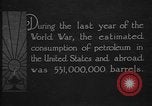
Water flows over the Niagara Falls and a globe with nine circular parallel lines along the equator rotates in the U.S.
The total consumption of petroleum of the U.S. and the world outside of the United States for the year 1918 is compared. Animation is used for this. Per capita consumption is also compared. Water flows over the Niagara Falls. A globe with nine circular parallel lines along the equator rotates. The 9 circular lines denote that if the per capita consumption of petroleum had increased as rapidly abroad as in the U.S. the world's petroleum requirement in 1922 would have been 10 times the actual requirement and if this volume had been loaded into tank cars of the capacity of 10,000 gallons each it would have made a solid train extending around the world at the equator 9 times.
U.S. soldiers receive training on enemy camouflage during World War II.
A film underlines the importance of tactical exploitation and counteraction of shadows and use of nets, underbrush and other camouflage during World War II. The film shows camouflaged aerodromes which are covered with chicken wire and feathers in jungles of the Solomon Islands. A man opens a window of an Italian hot dog stand which was actually a German pillbox. A German pillbox camouflaged as a farmhouse. A U.S. Army soldier handles mats of a matted house. A soldier looks at windows painted on a pillbox. A German pillbox camouflaged as an entertainment outlet. A dummy building which hides a bridge. A German airfield disguised as a decoy village in Belgium. Buildings in the village. A jeep drives on a road in the village. Men move a sliding wall of a phony building. Helmets and shirts on branches to appear as dummy soldiers. A man near a dummy soldier. Vehicles roll past in France. An artillery piece hidden in thick vegetation. U.S. soldiers watching the film in a theater in the United States.

President Truman and Hollywood stars promote the sale of war bonds in the United States (WW2)
War bonds being sold in the United States during World War II. U.S. President Harry S. Truman opens a bond drive as he buys a war bond from Secretary of Treasury Fred M. Vinson. U.S. Army General Jonathan Wainwright with Governor Edward Martin of Pennsylvania during a ceremony to promote the sale of war bonds in Philadelphia. Wainwright's family at the ceremony. A bond rally at former President Franklin D. Roosevelt's home in Hyde Park. In a drive organized by the War Activities Committee of the Motion Pictures Industry, Hollywood stars sell war bonds. Mrs. Eleanor Roosevelt seated in a chair. Hollywood celebrities including Merle Oberon receives applications to register for the Roosevelt bond.
CRITICALPAST.COM: About Us | Contact Us | FAQs - How to Order | License Agreement | My Account | My Lightboxes | Shopping Cart | Advanced Search | Featured Collections | Website Terms & Conditions | Privacy Policy ©2026 CriticalPast LLC.
License Agreement |
Terms & Conditions |
Privacy Policy
©2026 CriticalPast LLC.