


 Francais
 Deutsch
 Italiano
Refine Your Search
United States 1982 stock footage and images
- Showing 15511 to 15516 of 26492 results more
more Hide
Hide
President Truman with Cabinet members on Yacht. Admiral Halsey promoted. Treasury Secretary, Henry Morgenthau, Jr. resigns
President Harry S. Truman along with members of his cabinet aboard his new yacht Williamsburg at Washington Navy Yard in United States. Among those seen on the yacht are: Secretary of Agriculture, Clinton P. Anderson; Secretary of Commerce, Henry A. Wallace; Secretary of Interior, Harold L. Ickes; Attorney General, Tom C. Clark; and Secretary of Labor, Lewis B. Schwellenbach; In separate segment, Secretary of the Navy, James V. Forrestal, presents Admiral William F.Halsey , who is about to retire, with certificate of promotion to Five Star rank of Fleet Admiral. Witnessing are Chester W. Nimitz, Chief of Naval Operations, and Fleet Admiral Ernest J. King. In a third segment, President Truman is seen pinning a medal on Henry Morgenthau, who has just resigned as Secretary of the Treasury. The President also presents and award to another official.

Models display Milady's handbags at Saint Regis in New York
A newsreel titled 'Handbag harmony' shows fashion models displaying Milady's handbags and purses at the Saint Regis Hotel in New York City, United States. Women models show a variety of handbags. A model dances with a man as she holds a handbag. They appear to kiss, but view of the kiss is blocked by a handbag.

Japanese cyclotron and other atomic equipment being destroyed by American occupation troops in Japan
A newsreel titled "Jap atomic equipment destroyed" shows United States occupation troops looking at Japanese atomic research equipment in Japan a few months after the end of World War II. U.S. Army officers and soldiers tour the Nishina Laboratory of the Institute of Physical and Chemical Research, better known as the RIKEN Research Institute, at Komagome, in Tokyo, Japan. Laboratory director Dr. Yoshio Nishina is seen in the lab with the American forces. American soldiers are seen dismantling, destroying, and disposing of the the atom smasher cyclotron equipment. Occupation troops in an outdoor field rig demolition charges to some of the equipment and blow it up.
Printing press operations at U.S. 6th Psychological Operations Battalion headquarters in Saigon, Vietnam
United States 6th Psychological Operations Battalion headquarters in Saigon, Vietnam. A soldier pushes a roll of the printing paper from the warehouse to the press. Paper being fed into the machine and then tape is put onto its edge. A man works on controls. Printing being done by an operational press. A soldier goes through plates. (Vietnam War period).
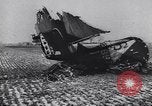
Remains of U.S. 8th Air Force aircraft shot down by German fighter aircraft and flak. U.S.flier POWs during World War II.
Tail and crushed wings of American B-17 bomber, one of several shot down over the Germany-Holland border, during World War 2. Bodies of two U.S. airmen lying on the ground next to the debris. Remains of crashed B-17, Serial number 42-39822, of the U.S. 333rd Bomb Squadron, 94th Bombardment Group, which was shot down by German FW-190s while returning from a mission to Brunswick (Braunschweig), Germany, on January 11, 1944. A fuselage from downed allied warplane being hauled away on a truck. A junkyard filled with American warplane parts, stacked by type, engines in one pile, tails in another, etc. One vertical fin, marked with the 'triangle A' of the 91st Bomb Group, is from B-17G, tail number 42-37737, named "Tennessee Toddy" of the 401st Bomb Squadron. It crash landed after losing two engines, on 10 October 1943, at Brocklanderweg, near Apeldoorn, Holland. Two U.S. Army Air Corps prisoners being interrogated by a German officer. Group of United States airmen prisoners of war, apparently showing personal identifications (dog tags) to a German interrogator.
The Repair Squadron of the 81st Air Depot group in Brisbane, Australia assembles a CG-4A glider.
United States CG-4A, a cargo military glider being assembled by repair squadron of 81st Air Depot group in Brisbane, Australia. Men assemble CG-4A glider. Old type tie rods are being removed. Clevis pin from old type tie rods is being removed. Comparison of new tie rod clevis pins with old ones.
CRITICALPAST.COM: About Us | Contact Us | FAQs - How to Order | License Agreement | My Account | My Lightboxes | Shopping Cart | Advanced Search | Featured Collections | Website Terms & Conditions | Privacy Policy ©2026 CriticalPast LLC.
License Agreement |
Terms & Conditions |
Privacy Policy
©2026 CriticalPast LLC.