


 Francais
 Deutsch
 Italiano

Refine Your Search
United States 1982 stock footage and images
- Showing 1621 to 1626 of 34981 results more
 Hide
Color Sound

Group of United States Army soldiers engaged in bayonet exercise on training grounds of an American Army base
Group of United States Army soldiers engaged in bayonet exercise and rifle drills on training ground in the United States. The soldiers exercise with rifles in hand.
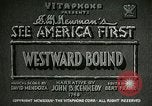
Scenes from 1934 film about westward expansion of United States in last quarter of 19th Century.
Scenes from a 1934 film documentary on the westward expansion of the United States in the 19th Century. The Marias River flows through the mountains in Montana. Goats and bears in the forest area of Camp Disappointment, the northernmost campsite of the Lewis and Clark Expedition. View of the Camp Disappointment monument erected by the Great Northern Railroad to commemorate Lewis and Clark. Engraved stone reads 'Farthest Point West on Captain Lewis trip up Marias River'. Car drives into portico of the Peace Arch situated near the westernmost point of the Canada–United States border between the communities of Blaine, Washington and Surrey, British Columbia. 'Children of a Common Mother' written on top of a monument. Engraved picture shows Lewis and Clark pointing towards land with boats next to them. View of the Columbia River flowing between mountains and a bridge. Aerial view of city of Portland. Steamer leaves harbor of Portland.
U.S. Army Air forces pilots learn about the Republic P-47 Thunderbolt airplane
From a U.S. Army Air Force Training film, "How to Fly the P-47. Pilot Familiarization." United States pilot seated on table writes a postcard to his mother, "Mrs D.Q. Hopkins. 1024 Clay Avenue, Pelham, New York" Board in the background with 'Daily Assignment of today' written on it. Scene shifts to forward view from cockpit of a Republic P-47 aircraft flying low over the flight line at an Air Base. Momentary glimpse of the pilot and his post card in the office. Back again, to forward view from cockpit of a P-47, but this time it is on final approach to the runway. Scene shifts to ground view of a P-47 landing. It taxis to the ramp and parks. The crew chief stands on the wing as the pilot completes and signs the aircraft's Form 1 (record of any problems). Five pilots walk past the flight line. The pilot, wearing a seat pack parachute, climbs down from the cockpit. The five pilots, seen earlier, approach, and one introduces them to the P-47 pilot (Captain Hopkins). They are Lieutenants assigned to his training flight. He greets them and shakes hands with all. The group ask questions about the P-47. Then they all go to the pilots room. As Captain Hopkins takes off his flight gear he tells them the P-47 is designed to operate at high altitude. He describes the P-47, referencing a large illustration of it on the wall. (World War II; WW II; World War 2; World War Two)
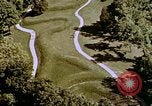
Various Buildings, Monuments and Landmarks of United States.
Views of various projects depicting man's creative engineering skills across the United States, including: The Indian Serpent Mounts, Ohio; Phoenix Mutual Life Insurance Headquarters, Connecticut; Mackinac Bridge, Michigan; Green Bank Radio Astronomy Antenna, West Virginia; Tanker "Manhattan" in the Northwest Passage; Chicago's Marina Towers, Illinois; NASA launch complex 39 in Cape Canaveral, Florida with a rocket in place; Watts tower, California; John Hancock Building, Illinois; Washington Monument; Dworshak Dam while under construction, Idaho; Newport Bridge, Rhode Island; U.S. Steel building, Pennsylvania; Mt. Glory Arch Bridge under construction in Wyoming; Johnson Wax Headquarters building, Wisconsin; Boeing 747 Factory Building Complex, Seattle Washington; A model of the proposed New Orleans Super Dome in Louisiana; Chesapeake Bay Bridge Tunnel; Dulles International Airport, Virginia; Tyrone Guthrie Theatre, Minnesota; Westinghouse Headquarters building, Pennsylvania; Rio Grande Gorge Bridge, New Mexico; Gulf Life Tower, Florida; Annunciation Greek Orthodox Church, Wisconsin; a paddle style River boat on the Ohio River; an artist depiction of the under construction Mobile River Highway Tunnel, Alabama; the Westinghouse Desalinization Plant, Florida; Model of master plan for the city of Gary, Indiana; Gulf Oil's "Big Brutus" crane at work on a dig site (The 160-foot tall coal shovel known as the 1850-B was designed and built by Bucyrus-Erie in Hallowell Kansas, for the Pittsburg & Midway, or P&M Coal Mining Company. It is the only one of its kind ever built. The mining company was purchased by Gulf Oil in 1963, and subsequently went under The Chevron Mining umbrella); Knights of Columbus headquarters building, Connecticut.
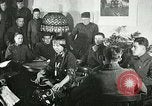
U.S. soldiers watching the performance of Tsianina Redfeather (a.k.a. Tsianina Blackstone), during World War I .
Tsianina Redfeather (also known as Tsianina Blackstone), a famous Creek-Cherokee Native American Indian mezzo-soprano, plays the Hawaiian guitar and sings for U.S. soldiers in YMCA- sponsored entertainment for the troops in a canteen, 1917-1918, during World War 1. (Historic note: While sailing to Europe in 1918 as a member of the American Expeditionary Forces, her vessel, the HMS Carmania, was struck by a torpedo. She continued the journey, entertained thousands of troops, and received a commendation for her service. Her interest in entertaining the troops, according to her autobiography, rested in the fact that so many American Indian soldiers were fighting overseas-- around 17,000. After her return to the U.S. her career continued to escalate. This clip perhaps represents the only surviving footage of this truly remarkable individual.)
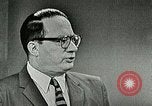
Philip Hauser briefs George Stone on U.S. census from 1820 to 1931 in USA; also some Wall Street depression scenes
George Stone and Dr Philip Hauser at the presentation of U.S. census around 1960. A slide of U.S. map appears on the screen. 1820 and population figures are marked on part of the map inhabited at that time. The reasons for the increase in the population are discussed by George Stone and Dr Philip Hauser. In the next slide census figures of 1830 appears. Concern for the handicapped lead to including of deaf, dumb and blind category in this census is shown. Dr Philip Hauser shows cartoons appearing in newspapers of that time to George Stone. In the next slide, census figures of 1850 and 7 classes of occupation of people are seen. A percentage representation of various occupations in the population is given in the next slide. The stress on accuracy of 1850 census is seen in the next slide. A comparison of number of occupations of males and females from 1840 to 1870 is shown in the next slide. Census of 1930 is mentioned in the next slide. 1931 is shown as a Special Unemployment Census. Newspaper headlines about stock market crash is seen. Around clip timecode 8:13 are images of Wall Street New York Stock Exchange floor near time of stock market crash. Wall Street region in New York City filled with people and views of lines or queues for homeless, unemployed, or food relief during the Great Depression.
CRITICALPAST.COM: About Us | Contact Us | FAQs - How to Order | License Agreement | My Account | My Lightboxes | Shopping Cart | Advanced Search | Featured Collections | Website Terms & Conditions | Privacy Policy ©2026 CriticalPast LLC.
License Agreement |
Terms & Conditions |
Privacy Policy
©2026 CriticalPast LLC.