


 Francais
 Deutsch
 Italiano

Refine Your Search
United States 1982 stock footage and images
- Showing 1909 to 1914 of 34981 results more
 Hide
Color Sound

Ready room officer talks with pilots in ready room aboard USS Philippine Sea (CVA-47) in United States.
United States pilots sit in ready room aboard USS Philippine Sea (CVA-47) in United States. Flight gear hung against bulkhead. Pilots sit and talk. Several pilots smoke. Pilots look at a map and confer. Ready room officer talks with pilots.

The Commanding Officer and the Deck Officer seated on the bridge of aircraft carrier USS Wasp (CVS-18) in the United States.
United States Navy aircraft carrier USS Wasp (CVS-18) in the United States. The Commanding Officer of USS Wasp seated in his chair on the bridge. He hangs up his telephone. He gives orders to O.O.D.(Officer Of the Deck). He picks up another telephone. He hangs the telephone back after talking on the telephone. He leans over to speak to the O.O.D. The Commanding Officer speaks over a telephone on the bridge. He hangs the telephone and turns back around.
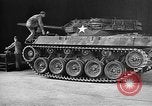
A Gun Motor Carriage M-18 is partially disassembled to show the various units of the suspension system in the United States.
Basic principles of torsion bar suspension used on army track vehicles are explained in the United States. United States tank destroyer 76 mm Gun Motor Carriage M-18 is partially disassembled to show the various units of the suspension system. Several mechanics remove the weight from torsion bar and lift the wheels. The vehicle suspension uses a torsion bar as the main weight bearing spring. Torsion bar and suspension arm in view. The spindles, shock absorbers, bumpers and compression links in view. A man points at the torsion bar retainer.
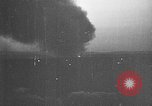
Views of ammunition depot allegedly sabotaged by Germans within the United States during World War I.
The United States of America in 1917. Scenes of Lyndhurst, New Jersey after January 11, 1917 explosion in the Canadian Car and Foundry Company in Kingsland. Suspected cause of explosion was sabotage, allegedly committed by Germans during World War I. Smoke from buildings on fire at night after an ammunition depot explodes. Flames rise high from the buildings. Widespread destruction. Debris on a railroad track the next day. People pick through devastated buildings and barren area flattened by blast. Views of crater filled with artillery shells after the explosion. Damaged window panes of buildings and a railroad car at D.L.&W (Delaware, Lackawanna & Western) Railroad Shops building at Kingsland (later Lyndhurst). DL&W railroad train car 605 parked. Railroad Shops with broken glass everywhere from explosions. Men point to shell that is embedded in the side of a railroad car. View of artillery shell lodged in a door. Next scene is from a different time and place, in Perth Amboy, in October of 1918 after an explosion at the T.A. Gillespie Shell Loading Plant made many families homeless. was called the Morgan Depot Explosion. Homeless women, children, and men sit in a town common area. The refugees eat. U.S. Army soldiers patrolling on Smith Street in Perth Amboy in front of stores damaged in the explosion. Entrance to Michaels & Co. shop among damaged stores on Smith Street.
A man explains about the functioning and operation of an A-N Gun Camera in Armament Camera Department in the United States.
Operation and installation of the A-N Gun Camera, or Army-Navy aircraft Gun Camera, in the United States. A North American AT6 USAAF ( United States Army Air Force ) plane in flight. A pilot in the cockpit. In the Armament Camera Department a man explains about the functioning and operation of an A-N Gun Camera. He gives details about the lenses, filters, operating speed, light conditions and oiling. He explains about the parts of the gun camera like heat wire, motor, driving gear and relays. Few instruction tags on the camera.
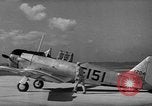
Aromere explains the loading and installing of an A-N Gun Camera in a North American AT6 USAAF plane in the United States.
Operation and installation of an Army-Navy aircraft Gun Camera in a North American AT6 USAAF ( United States Army Air Force ) plane in the United States. Aromere in the cockpit explains about the mounting and loading of the A-N Gun camera using cables, connectors and triggers. He gives details about the adjustments of lenses, filters,operating speed and light conditions. He mounts and installs the camera by making the electrical connections.
CRITICALPAST.COM: About Us | Contact Us | FAQs - How to Order | License Agreement | My Account | My Lightboxes | Shopping Cart | Advanced Search | Featured Collections | Website Terms & Conditions | Privacy Policy ©2026 CriticalPast LLC.
License Agreement |
Terms & Conditions |
Privacy Policy
©2026 CriticalPast LLC.