


 Francais
 Deutsch
 Italiano
Refine Your Search
United States 1982 stock footage and images
- Showing 19357 to 19362 of 26492 results more
more Hide
Hide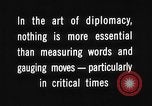
U.S. State Department operations and statement from Cordell Hull as tensions with Germany increase before World War 2
Exterior night time shot of U.S Capitol dome in late 1930s. Sign 'Division of Communications and Records' above a State Department office door. Officer at desk. Men working in office and typing. Door sign 'Secretary of Department of State'. Cordell Hull at desk. Hull speaking. He reads a statement urging peace and security rather than armed conflict in Europe. State Department workers typing out memos and interpreting coded dispatches. A close up of a page decoding a secret coded dispatch. Newspaper headlines indicate orders dispatched for American ambassador to return from Germany (shortly before outbreak of World War 2). Sign for 'Carlton Hotel' on the hotel building. Secretary Hull seated in his office as he studies reports. Pictures of Hull in various newspapers of different languages. Seal of the U.S. on an entrance of a U.S. Embassy. A door closing with sign "American Embassy" on it.
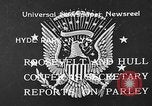
U.S. President Franklin Roosevelt and Secretary of State Hull meet in the Summer White House in Warm Springs, Georgia, U.S.
U.S. President Franklin Roosevelt and Secretary of State Cordell Hull confer in the Summer White House in Warm Springs, Georgia. U.S. President Franklin Roosevelt and Secretary of State Cordell Hull seated on chairs outside the Summer White House in Warm Springs. The officials confer. The officials shake hands and smile. The President signs on the report of the results of London Economic Conference. The Secretary of State seated beside him.
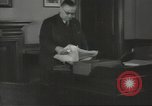
British Secretary of State for Foreign Affairs Ernest Bevin works inside office in Europe during World War II.
British Secretary of State for Foreign Affairs Ernest Bevin in Europe during World War II. An official places important papers inside a bag. British Secretary of State for Foreign Affairs Ernest Bevin reads a document seated at desk. Official arrives with a file and keeps it in front of Ernest Bevin. Ernest Bevin signs documents. The State Secretary dictates a letter to his secretary and speaks over phone. Ernest Bevin opens a box.
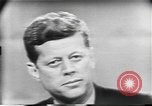
Kennedy states the reasons of failure of passing of Congress bills during a presidential election debate in Chicago, Illinois.
The first Kennedy-Nixon Presidential Debate in Chicago, Illinois. Sander Vanocur from NBC News asks Democratic candidate Senator John F Kennedy about the failure in passing the Congress bills on medical aid to the aged, minimum hourly wage bill and federal aid to education. Kennedy answers and states that his bill to provide a dollar twenty-five cent minimum wage failed because the House of Representatives did not pass it and the House failed by eleven votes. He states the reasons for the the failure of the federal aid to education bill and medical aid to aged bill in the Senate due to lack of votes and U.S. President's Veto power. Republican candidate U.S. Vice President Richard M. Nixon presents his views and disagrees with the statements made by Kennedy regarding action of the House Rules Committee and veto power of the President. He states that the majority of the members of the Congress agreement to the proposals leads to the clearance of a bill. He says that the reason for the failure of these bills was not the President but the people who were against it. He talks about his alternative proposals.
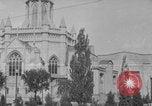
The Minnesota State Capitol in Saint Paul and the Minnesota Athletic Club in 1910s
The exteriors of the First Presbyterian Church in Minneapolis, Minnesota. The Minnesota State Capitol (Minnesota State Capitol, 75 Rev Dr Martin Luther King Jr Boulevard., St Paul, MN 55155) in Saint Paul, Minnesota. The dome of the landmark state capitol building. Pedestrians walking and cars parked in front of the Minneapolis Athletic Club (the location is now occupied by Hyatt Centric Downtown Minneapolis, 615 2nd Ave S, Minneapolis, MN 55402).
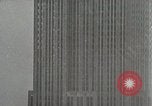
Empire State Building official opening in New York City.
View of the Empire State Building (20 W 34th St., New York, NY 10001) in New York City. People take a tour of the building after its official opening in Manhattan. Plane flies around the skyscraper tower. Officials on roof of the Empire State Building. Workmen walking on high edges without ropes.
CRITICALPAST.COM: About Us | Contact Us | FAQs - How to Order | License Agreement | My Account | My Lightboxes | Shopping Cart | Advanced Search | Featured Collections | Website Terms & Conditions | Privacy Policy ©2026 CriticalPast LLC.
License Agreement |
Terms & Conditions |
Privacy Policy
©2026 CriticalPast LLC.