


 Francais
 Deutsch
 Italiano

Refine Your Search
United States 1982 stock footage and images
- Showing 1933 to 1938 of 34981 results more
 Hide
Color Sound
A NAM meeting and U.S. naval and air forces advance in preparation for World War II.
The United States on alert in the beginning of World War II. A National Association of Manufacturers (NAM) meeting. The NAM President talks addresses the group. He talks about the national defense requirements and ways to meet the mass production. The Pratt & Whitney aircraft engine plant in Hartford, Connecticut. Workers in line arrive for work. Men work to manufacture engines for American bomber and fighter aircraft. Manufactured engine parts stacked in stands. U.S. Navy Curtiss-Wright CW-22Bs in flight. A naval task force underway at sea below. The ships advance amidst explosions.
An officer shows safety precautions and control tower communication for flying a B-17 aircraft is carried out in the U.S.
A U.S. Army Air Forces ( USAAF ) training film on instructions to fly USAAF Boeing B-17 Flying Fortress aircraft in the United States. An officer turns on a radio switch. Trainees wear head phones. Men check fuel pressure gauge. Governor control is operated to get desired revolutions per minute ( RPM). The RPM gauge shows readings. A system engineer communicates with men in aircraft. A gauge shows flap position. The flaps are turned down. A dial shows zero flap position. A compass chord, a hydrolic pressure gauge and a suction gauge show readings. A trainee turns a vacuum pump switch. He checks for oxygen cylinder pressure. An officer checks filter warning lights. A trainee turns on an output switch. A pilot communicates with a man in a control tower. A crew man gives hand signals to a man on the ground. The man removes wheel chokes. Switches and handles are operated as the aircraft taxis. The pilot locks the tail wheel. The aircraft taxis past other parked aircraft. Th pilot turns on the automatic control switch. The tail wheel is unlocked.
President Franklin D. Roosevelt advocates National Conscription and supports the Atlantic Charter in the United States.
The President of the United States Franklin Delano Roosevelt addresses the nation in the United States. President Roosevelt advocates National Conscription (military draft) for material reasons and for reasons of morale. He defends the principles of the Atlantic Charter. He summons the United Nations to protect their own sanctity and that of small nations as well. Men wearing head phones listen to the speech.
Seamen stand in queues and sign Maritime Commission papers in the United States.
Merchant seamen sign Maritime Commission papers in the United States. The seamen standing in several queues. United States Merchant Marine personnel sitting at a table. The seamen sign Maritime Commission papers. They leave the queues after signing.
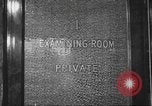
A doctor checks height, ears, blood pressure and undertakes dental and body check up of seamen in the United States.
Physical examination of U.S. Merchant Marine seamen in the United States during World War 2. A sign on a door: 'Examining Room Private'. Interior of the room. A doctor measures the height of the seaman. He checks blood pressure. Man receives dental check up and ear check. Respiration and lung check up is done with a stethoscope. Cars parked outside a building. A sign on the building: 'Standard Shipping Office'.
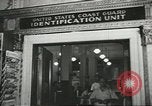
U.S. Coast Guard screens all ships and persons arriving at American ports, docks, and other waterfront installations.
A man seen walking out of doorway marked: "United States Coast Giard Identification Unit." Inside uniformed Coastguardsmen are seen talking with individuals who require access to docks, piers, and other waterfront facilities. Closeup of a Coastguardsman checking the credentials of a man in uniform seeking a pass. Men showing their passes to Coast Guard inspectors as they enter a port. A small work boat tying up to a large ship. Its occupants board the ship and show their passes to uniformed Coastguardsmen. A boat containing a Coast Guard boarding party is seen moving in a harbor. Closeup of officers from U.S. Customs & Immigration; Public Health Service; and Coast Guard , comprising a boatding party.. The officers are seen on the deck of an arriving ship, before she docks. The boarding officer interviews members of the main branches of the crew. (World War II; WW II; World War 2; World War Two)
CRITICALPAST.COM: About Us | Contact Us | FAQs - How to Order | License Agreement | My Account | My Lightboxes | Shopping Cart | Advanced Search | Featured Collections | Website Terms & Conditions | Privacy Policy ©2026 CriticalPast LLC.
License Agreement |
Terms & Conditions |
Privacy Policy
©2026 CriticalPast LLC.