


 Francais
 Deutsch
 Italiano
Refine Your Search
United States 1982 stock footage and images
- Showing 19777 to 19782 of 26492 results more
more Hide
Hide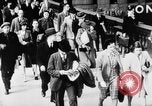
The state of British citizens including children during the war and reduced ration supplies in Great Britain.
Conditions of people and children in Great Britain during World War II. British people, who have been on short ration for two years due to the war, on the streets. Children given food, more than the ration of an adult. The young children drink milk. They appear to be in a group center, likely for children evacuated for their protection. A boy paints on a large paper. A girl sleeps.
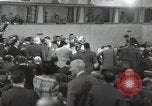
559th United Nations Security Council Meeting in Flushing Meadows, New York
59th meeting of UN Security Council at Flushing Meadows, New York. Views of the meeting chamber with council members at the table and reporters and various international observers, seated in the chamber. Several are wearing headsets to listen to simultaneous translations of proceedings.
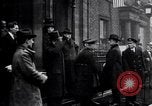
U.S. President and Mrs. Woodrow Wilson visiting various places during their State visit to England in 1918.
President Woodrow Wilson leaves No.10 Downing Street, in London. He enters an automobile. Among others present are: Lloyd George, Arthur Balfour, and Arthur Henderson. Mrs. Wilson is escorted, by The Duke of Connaught, carrying an umbrella, to a different automobile. The Wilsons and several other cars proceed through a light rain past Windsor Castle. Spectators line the sidewalks, many holding umbrellas. Spectators with umbrellas gather around the Crown and Mitre Hotel in Carlisle, England, where a reception was being held for President and Mrs. Wilson. (President Wilson's mother was born in Carlisle, England, and he wanted to visit there, accordingly.) (World War i; World War 1; WWI; WW1)
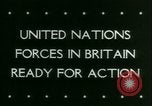
United Nations forces in Britain ready for action and the Allied Generals see new equipment in action.
Chiefs of Allied Invasion Command at the headquarters in England. American General Dwight D Eisenhower meets the soldiers. Military supplies put into action. Trucks, Jeeps and mechanized equipment are assembled. General Montgomery, Deputy Commander General Arthur Tedder and General Eisenhower see new equipment in action. Artillery fired. Aircraft in flight. Paratroopers in sky. General Montgomery, Master of air tactics, General Arthur Tedder and Liberator of North Africa, General Eisenhower. (World War II period).
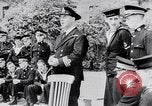
British sailors taught to deal with the enemy kicking or attacking from behind at a training program in United Kingdom.
A training program for the sailors of British Navy teaches them methods of hand to hand combat attack and counterattack. A British Navy officer and other sailors. Two sailors demonstrate the methods. The sailor who poses as the opponent moves forward with a weapon in his hand. The other sailor protects himself with the edge of his arm and delivers a punch in the tummy. The two sailors demonstrate what to do when enemy comes forward to kick. Both sailors move towards each other. The opponent raises his leg to kick. The sailor holds it, sweeps it and causes the opponent to fall on the ground. The sailor hits at the shin of the enemy with his boots. The two sailors move towards each other and both roll on the ground. The other sailors look. The two sailors show how to protect one self when the enemy attacks from behind. The sailor stands with a gun. The opponent comes from behind and grabs the sailor. The sailor jerks back his head and uses his left leg to protect himself. The opponent comes from behind and grabs the sailor with his forearm. The sailor grabs his arm with both his hands, kneels down and hauls him over. The opponent attacks the sailor from behind and grabs his neck with his hands. The sailor holds the hands of the enemy and hauls him over. (World War II period).
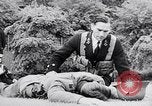
British Navy training program teaches sailors the methods to control a prisoner, United Kingdom.
A training program for the sailors of British Navy demonstrates how to tie up a prisoner. Two sailors demonstrate the method. The sailor who poses as the opponent lies face down on the ground. Using a cord the other sailor secures the thumbs at the back, one at a time. The sailor bends the right leg of the opponent and places the ankle of this leg behind the knee of the left leg. Then he lifts the left leg up and secures this leg and the thumbs together. A Navy officer. Other sailors and officers look carefully. The sailor ties the wrists one at a time and secures them to the legs after arranging the legs as done earlier. He passes the rope around the opponent's neck. The opponent all tied up on the ground. The sailor turns the opponent face down on the ground and sits on his back facing towards the opponent's legs. He arranges the leg as done earlier, lifts the left leg and pulls at it. (World War II period).
CRITICALPAST.COM: About Us | Contact Us | FAQs - How to Order | License Agreement | My Account | My Lightboxes | Shopping Cart | Advanced Search | Featured Collections | Website Terms & Conditions | Privacy Policy ©2026 CriticalPast LLC.
License Agreement |
Terms & Conditions |
Privacy Policy
©2026 CriticalPast LLC.