


 Francais
 Deutsch
 Italiano
Refine Your Search
United States 1982 stock footage and images
- Showing 19879 to 19884 of 26492 results more
more Hide
Hide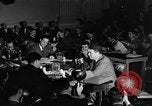
Emmet Lavery, President of the Screenwriters Guild of Los Angeles, is questioned by the HUAC members
Questioning of the President of the Screenwriters Guild of Los Angeles, Mr. Emmet Lavery, by members of the House un-American Activities Committee, including J Parnell Thomas and Robert Stripling, in October 1947. Mr. Lavery speaks into a microphone and answers questions of the Committee. He opens by saying he will break the suspense and states that he is not a Communist and has never been one (even before he is asked.) This elicits laughter from those present in the hearing. In testimony, Emmet Lavery states that he is "a Democrat who in my youth was a Republican, and if the Committee wants to know why I changed..." He is cutoff with response "No we don't want to know..." and again there is laughter. Mr Lavery concedes that there are probably communists in the Guild, but he doesn't know who, by name. He expresses concern that the questioning by the Committee may negatively affect the Guild elections that are approaching. He states that no individuals have control of the Guild. The Committee asks if Trumbo (Dalton Trumbo of the Hollywood Ten) has control of the Guild. Lavery says no. Lavery states that he agrees with J Edgar Hoover of the FBI that it would be wrong to outlaw the Communist party, especially in a time of peace.
Spanish journalist talks about the Cuban Missile Crisis
A Spanish-speaking journalist reports on the developments of the 1962 Cuban Missile Crisis. Words read "Cuba: Peligro Rojo" ("Cuba: Red Danger") beside the journalist. The journalist talks about the missile confrontation in Cuba inside a conference room of the Organization of American States (OAS) in Washington DC. The reporter reads from his report while holding a microphone. Nameplates bearing the names of countries from the Organization of American States such as Uruguay, Brazil, Costa Rica and Chile. The journalist reads from his report while a janitor cleans the conference room behind him. The journalist interviews a man who just arrived in the conference room. The man, a representative from the Organization of American States, talks about the ongoing Cuban Missile Crisis. The camera shows the seal of the Organization of American States in Spanish (“Organización de los Estados Americanos”).

French President De Gaulle, Ladybird Johnson, and Minister Golda Meir after John F. Kennedy's burial in Washington DC.
President De Gaulle speaking with Lady Bird Johnson and then shaking hands with Golda Meir, Foreign Minister of Israel. A translator from the U.S. State Department assists in the conversations. A French language interpreter of the State Department with the French President and First Lady. De Gaulle moves through the large room, shakes hands with the Foreign Minister of Israel Golda Meir. The French Ambassador in Washington is present at the event. Dignitaries served refreshments in the State Dining Room adjacent to the Jefferson Room. Policemen and civilians crowd outside the doors of a hall.
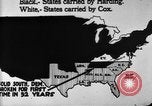
Warren Harding and James Cox in the U.S. Presidential elections
A map shows American states colored in black and white. Black States carried by Warren Harding and White States carried by James Cox in the U.S. Presidential election of 1920. President-elect and Mrs. Warren G. Harding read congratulatory messages lying in front of them. The losing opponent, James Middleton Cox, stands with women supporters and shakes hands with one. Women wear fashionable hats.
The uses and the importance of colored grenades in a combat (WWII)
'Colored smoke grenades: their use in combat' shows the types, uses and importance of colored smoke grenades during combat in WW2. Colored smoke grenades burst. An orange smoke grenade burns. Grenades piled up in a crate. A soldier picks up a grenade from the crate and removes the outer can. He throws it on the ground and orange smoke rises from it. An aerial views of an area along a coast. Units advance in a field. An aircraft in flight. Different units burst different colored smoke grenades to pass on the information about their position to their Commander. The aircraft drops a colored grenade to get some information from the unit on advance. The unit sets off a purple grenade as an answer. (World War II period).

A 1974 Triumph Spitfire car runs out of gas on a rural highway, female driver asks two men for help, highway patrolman finds female driver unconscious in forest.
A red sports car, a 1974 Triumph Spitfire convertible, driving fast on rural highway. Windshield wipers running. The driver, a woman, turns on the radio. The gas gauge indicates the car’s fuel is almost empty. Car passes by sign “No gas for next 23 miles fill-up here”. The 1974 Triumph Spitfire convertible stops at road near forested area. Woman tries to turn on car engine, which died because the car ran out of gas. Woman's foot stepping on car gas pedal. Woman's hand turning keys trying to start car. Woman sighs in frustration. POV from back seat two men driving on highway. Woman turns on her transistor radio. The car with two men, a blue1974 Gran Torino Elite, pulls in front of the sportscar. Woman looking from inside her car and says, with two crossed fingers, "Hello rescue squad...let's hope you have a siphon." Woman gets out of her 1974 Triumph Spitfire and approaches the blue1974 Gran Torino Elite from the rear. The woman leans into the driver side window and asks the two men for assistance, saying, "Am I ever glad to see you guys, I was beginning to think I was going to be stuck here for my whole vacation. I ran out of gas. You think you could help me out?" Alabama State Trooper gets out of his patrol car. State trooper reaches into driver window of car and examines wallet and purse inside, and turns of transistor radio that is playing. State Trooper walks off road into forest next to road. View of trooper entering woods. View of body of woman lying unconscious and her shirt pulled up, presumably raped by the two men.
CRITICALPAST.COM: About Us | Contact Us | FAQs - How to Order | License Agreement | My Account | My Lightboxes | Shopping Cart | Advanced Search | Featured Collections | Website Terms & Conditions | Privacy Policy ©2026 CriticalPast LLC.
License Agreement |
Terms & Conditions |
Privacy Policy
©2026 CriticalPast LLC.