


 Francais
 Deutsch
 Italiano
Refine Your Search
United States 1982 stock footage and images
- Showing 20203 to 20208 of 26492 results more
more Hide
Hide
American women in military service during World War II
U.S. Navy commissioned Women officer nurses stand in formation, dressed in summer white uniforms, as they are inspected by senior officers during World War 2. Closeups of several nurses. Several women nurses, in uniforms of various armed services, pose for the camera. Closeups of some of them. Scene shifts to the first director of the Women's Army Corps (WAC), Colonel Oveta Culp Hobby, seen standing in front of an Army recruiting poster, and at her desk in Washington, DC. Women volunteers seen in a recruiting station, applying to join the new WAC. Colonel Hobby walking along sidewalk of the Arlington Memorial Bridge, across the Potomac River, in Washington, DC. She stops and poses for the camera. Next she is seen approaching two army officers on the bridge, who both come to attention and salute as she comes close enough for them to see the Colonel's eagles on her uniform shoulders. She returns their salute, smartly, and continues on her way. Next, four armed WAC members in field garb, stand on the side of a mountain as two of them consult a map and the others use binoculars. Below them, on a dirt path, women of a WAC motorcycle corps unit ride their Harley Davidson motorcycles. They also ford a stream on their motorcycles.
The function of motion picture cameras and projectors is explained in detail.
Working of motion pictures is explained. Close up of film projector running. A montage shows varied film events, including dancers in Hawaii, a smoking volcano, biplane aircraft flying over the pyramids in Egypt, Coronation crowning of King George VI in England, United Kindgom; the Hindenburg disaster, World War I era tanks driving over hills, Franklin Delano Roosevelt at a baseball game cheering from the stands, iron smelting, a woman talking to a grocery man, and zoom in on AC generators at Hoover dam. A family watches projection of a home movie. The home movie shows a boy playing with his dog. Devices demonstrating optical illusion include a bird in the cage illusion. Demonstration of a Mutoscope-Kinetoscope flip-card projector. Thomas Edison shown in a flip card moving image. A cartoon animator at work, showing his character move as he flips pages. Parts of a movie projector are shown in detail, including lens, shutter, and exciter lamp. A cameraman operating a 35mm motion picture camera. Film being perforated during manufacture. Production of an optical sound track is explained, showing the narrator at his microphone and sound mixer using sound board and loading audio mag recorders. Animated diagrams show the functioning of a photoelectric cell in producing a variable intensity sound track. Wide shot of Hollywood movie film set and an action stunt scene being filmed. Lead actor might be James Cagney. Hollywood premiere of movie showing flood lights, cinema theater marquee, and people buying tickets at the movie theater box office. Close-up shots of faces of men and women audience members in movie theater reacting to fight scene in movie and then applauding and smiling. Scene with many hands applauding. Demonstration of the creation of 16mm film shows size comparison between 35mm and 16mm motion picture film. Montage shows many film projectors running at the same time.

Montage of scenes depicting U.S. military weapons in the Korean War era.
Segment of U.S. Army public information television program called, "The Big Picture." Army cameraman records firing of a Nike missile. Atomic cannon fires shell creating atomic explosion and classic mushroom cloud. Army troops exit Sikorsky YH-19 helicopters. Infantrymen climb a hill while firing rifles in unison. Animated rotating world globe. Sergeant Stuart Queen emphasizes that, in spite of new weapon systems, the individual soldier is the essential element of the Army. Technicians in missile launch control blockhouse observe launch of a missile from steel tower. View from inside the structure of missile rising, and then of smoke as it heads skyward. Radar units and cameras tracking the missile. Views from a missile, of the ground below, as it accelerates upwards. More tracking cameras. A Matador missile being launched. A Viking missile being launched. Test of anti-aircraft missile launched horizontally, striking nearby target with explosion. A thermonuclear weapon test explosion. A Corporal missile being launched. Sophisticated electronic tracking equipment employed at desert test site. Convair experimental XFY Pogo seen in vertical takeoff during trials. Anti-aircraft missile, fired from Navy ship, strikes drone target aircraft, which falls in flames. Technician stands before a virtual wall of electronic equipment. Army Signal Corps television cameraman captures field maneuvers of Landing Vehicles Tracked (LVTs) and an M4 Sherman tank. A High-flying warplane fires an air-to-air missile destroying a drone aircraft target that falls in flames. Aerial view of the Pentagon, Arlington, Virginia. America's top military leaders sit around a table. At the head, is Chairman of the Joint Chiefs of Staff, Admiral Arthur William Radford. To his right are: General Nathan F. Twining, USAF, and Admiral Robert B. Carney, Chief of Naval Operations (back to camera). To Radford's left are General Lyman Lemnitzer, Army chief of Staff, and General Lemuel C. Shepherd, Jr. Commandant of the Marine Corps. Views of U.S. Navy warships firing heavy guns. A South Dakota Class Battleship firing her 16-inch guns. Navy aircraft being catapulted from the USS Ranger (CV-61). Gun camera view from aircraft firing guns. A USAF B-52 bomber in flight. Bombs falling from open bomb bay of bomber in flight and carpeting the ground with explosions. Low flying USAF aircraft demonstrating ground-support bombing techniques, dropping napalm and explosive bombs.
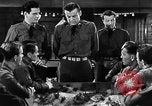
A Rifle Squad officer briefs the Sergeants about the Squad Column, Skirmish Line and Open Squad Formation in U.S. (WW2)
The advantages of the battle formations during World War II. The U.S. Army Sergeants seated at a desk and discuss the model. A Rifle Squad officer talks about the Battle Formations made by the smallest unit the Rifle Squad. He holds a stick in his hand. The model shows the two basic formations first the Squad Column and second the Skirmish Line. The officer also talks about Squad Wedge formation. He speaks about the usage of different formations. The officer explains the details of the formations that is how and when they are used. He first talks about the Squad Column which is the basic and easiest way of formation to control the fire. The troops hold each other's belt during the squad formation. He also speaks that always use Squad Column at night. Next is the Open Squad Column which is useful in crossing the open terrain where there is no cover. The Rifle platoon during the Open Squad Column formation. The officer asks the Sergeant about the questions regarding the Squad Column. The Squad Wedge which can form a Skirmish Line and is faster then the Squad Column. The Sergeant listen to him as he talks about the responsibility of Squad Leader during the formation. A model depicts the formations of Wedge. A Sergeant asks question related to the difference between the Open Squad Column and Wedge and the officer answers. Last formation the Skirmish Line. A model depicts the Skirmish Line formation by the Rifle Squad and usage of it to start the attack. The model shows the troops advancing for attack. The officer sums up in short three of the formations. He also speaks about the other formation and gives example.
An officer questions Sergeants about different situations during battle formation (WW2)
The advantages of battle formations during World War II. A U.S. Army Rifle Squad officer talks about imagination and alertness during battle. The Sergeants seated around a desk. A model on the desk. The officer asks the Sergeants questions about the conditions they will adopt during different situations, and they explain it with the help of the model. Question for the interior unit is about the exact route to be followed to reach the road. The other situation is where the Squad Leader asks them to take their squad through a bridge and cover his crossing. The next situation is where the platoon moves forward, an officer gives a signal, the squad deploys, and when he returns, they are moving in different directions. Next, the Platoon moves into a thick wooded area and command a left squad, you are under orders not to change your formation without the permission of the platoon leader. The last situation is where the platoon leader has become irresponsible, you are the leader, and the troops advance and artillery is fired. How would you cross this field and what action's will you take. The sergeants answer one by one and take the help of the model.
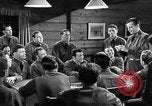
An officer highlights the basic and important points that can be used during different formations (WW2)
The advantages of the different Platoon formations during World War II. The Sergeant seated on a desk. A Rifle Squad officer stands in the center sums up with the highlights that were done in the lesson. He focuses on few big points during the formations they are provide good control, allow and use cover, get forward faster. Deploy skirmishes only when you are forced too. Always adopt a formation that will provide you with support squad. Maintain contact on the units to the right and left. To take up Echelon formation if the platoon leader has an open flank. The Sergeants listen to him.
CRITICALPAST.COM: About Us | Contact Us | FAQs - How to Order | License Agreement | My Account | My Lightboxes | Shopping Cart | Advanced Search | Featured Collections | Website Terms & Conditions | Privacy Policy ©2026 CriticalPast LLC.
License Agreement |
Terms & Conditions |
Privacy Policy
©2026 CriticalPast LLC.