


 Francais
 Deutsch
 Italiano
Refine Your Search
United States 1982 stock footage and images
- Showing 20539 to 20544 of 26493 results more
more Hide
Hide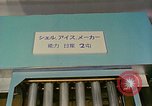
Shell Ice Maker machine demonstrated and and model of Pepsi Cola bottling plant exhibited in trade fair, Osaka, Japan.
Trade fair in Osaka, Japan. Sign written in Japanese (katakana characters) saying “シェルアイスメーカー” (“Shell Ice Maker” in English). Shell Ice Maker machine is demonstrated. Water flows over chilling columns on which it freezes and then cracks and falls into collection box. Crushed ice falls into the ice maker collection box. Sign at exhibit states its capacity is 2 tons per day of ice. A Japanese man working for Japan Pepsi Cola Company (present day Pepsi Japan franchise now under Suntory) shows a scale model of a Pepsi Cola bottling plant. Japanese man explains the Pepsi Cola bottling plant model. Bottles of Pepsi products are seen behind the man. Logo of Pepsi Cola is displayed on the Pepsi Cola booth in the trade fair
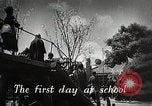
Infusing Nationalistic feelings in Japanese students.
Japanese children pray and bow their heads to the national flag.The totalitarian government infuses state shintoism in young children and it often blends religion with nationalism.This is done in order to destroy free thought and individuality among young Japanese.Minimum of six years of schooling is compulsory in Japan and all schools are under municipal control.Children draw and paint a picture of a bird and are taught to admire a cherry blossom tree.Fifth grade students read from their text books in a reading period.These government approved textbooks are poor in quality.
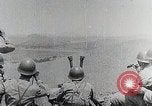
Role of metals in Japanese war against China during 2nd Sino-Japanese Conflict
Scenes of Second Sino-Japanese War, circa 1938. Japanese soldiers observing battlefield from a ridge. Japanese artillerymen firing field pieces. Flight of two Mitsubishi Ki-15-1 light bombers in formation, later called "Babs" by the Allies and known as a C5M in Japanese Navy usage. Aerial view of Japanese bombs falling on Chinese cities. Chinese citizens, including an injured woman, seeking shelter from bombing. Aerial view of Chinese ship being strafed by Japanese aircraft. The ship explodes. Downed Japanese warplanes burning. Scenes of destruction from bombing of oil facilities. Iron ore being moved in Japanese rail cars. Steel plants around Yawata, Japan. Numerous containers of molten steel inside a steel plant. Hot Steel ingots being moved. Animated map shows locations of iron ore deposits in Japan. Scrap steel being imported that, narrator states, helped boost Japanese wartime production to 12 million ingot tons in the Sino-Japanese war. More views of open rail cars moving alloying elements to a steel mill. Open mining using explosives. Mining operations for copper and bauxite (aluminum ore). Japanese miners shoveling ore by hand into open rail cars. Open rail cars moving in both directions on parallel tracks. (Note: Although some narration refers to 1941 Japanese production, the images are from earlier period.)
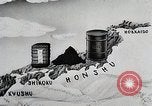
Japanese natural resources related to Second Sino-Japanese war and World War II
Animated map illustrating shortage of indigenous raw materials in Japan. As stockpiles vanish during Second Sino-Japanese war, Japan's domestic sources supply only 10% of the nation's needs for war. Animated sequence shows lack of steel, aluminum, copper, and power generation for the conduct of war. But one of the nation's greatest resources is the population of skilled Japanese workers, who are shown at various high tech jobs, as well as on the farms and in the fishing industry. Japanese workers are seen who work for the Zaibatsu (four ruling families of Japan). Banks of Japanese women typists and women in a factory. Young women painting faces on a "Kewpie doll." A Japanese family at dinner time. Women engaged in fabric spinning. Animated graphic illustrates Japan's war-related resources for World War 2, by showing a Japanese soldier standing astride map of Japan with lines extending to sources of needed raw materials from Japanese possessions in Korea, Manchuria,Formosa, China,Indochina,Malaya, and its network of Pacific Islands. Final scene displays copy of Los Angeles Times newspaper with headline reading: "Jap Supply Lines Blasted." It also features a story that appears to refer to the U.S. 6th Army invasion of Leyte in the Philippines, in October, 1944 (when General MacArthur waded ashore and stated,"I have returned"). (Note: Although produced during World War 2, this film shows prewar scenes of Japan. The animated illustrations and maps and, of course, the newspaper shown at the end, date from World War II.)
Views of China and Japan in the period leading up to the 2nd Sino-Japanese war
Film opens with outline map of Japan shown in contrast to 20 times larger China and figures representing China's 6 times greater population. Map of China is shown in pieces representing its numerous internal fiefdoms. In contrast, Japanese soldiers are shown marching in review before their singular leader, Emperor Hirohito and other national military leaders. Film shows contrasting 20th century characteristics of China and Japan. Sun Yat-sen, who figured prominently in post-Imperial China, and is considered the founding father of the Republic of China, is shown speaking to crowds. Narrator states that in 1911, this man fathered a peoples' revolution which brought to an end, China's ancient Imperial government. View of Chinese people marching and carrying flags and banners. Books are shown comparing China's Sun Yat-sen to America's George Washingon. Sun Yat-sen's political statement, shown in Chinese, contains words similar those in Abraham Lincoln's Gettysburg address. View of schools and colleges built in the new Republic of China. Chinese students shown in libraries. A couple dining in a Chinese hotel restaurant, overlooking other buildings. A tall clock tower looms at the same height outside their window. Steel being erected for a tall building. Architects at work. Scientist looking through a microscope. Technicians at work in a chemistry laboratory. Medical staff and patients in a modern hospital. Children in school under compulsory education program. Chinese people exercising their freedoms of expression and religion. The funeral of Sun Yat-sen, in 1925, attended by his successor, Chiang Kai-shek, and other Chinese leaders in military uniforms. Chinese people attending an outdoor ceremony. Examples of areas needing modernisation. Chinese workers using manually operated machinery to process fabrics. Commercial vessel plying a river using wind and sail only. Views of steam locomotives and trains being introduced to link parts of China. Trucks moving goods over roads (still unpaved). Miners working in open air mines, digging coal and iron. Molten tin being poured from a crucible. Machines performing complex tasks in a fabric mill and women tending spinning and knitting machines. School children engaged in collective outdoor games and exercise drills. Scene shifts to Japan, where Emperor Hirohito, on a white horse, leads military leaders in reviewing Japanese forces. A formation of Japanese Model 97 medium tanks passing in review, with tank commanders saluting from their turrets. Glimpse of Japanese steel mill. Headline in World-Telegram newspaper of 14 february, 1934, reads: "Tokyo House Passes Huge Arms Budget." A Los Angeles newspaper of 23 November, 1934, expands on the same story. New Orleans Times-Picayune, Sunday, 5, May, 1936, reports that Japan is strained by its huge arms costs.
U.S. Lieutenant General Daniel Sultan explains Japanese aggression in China and need for troops in India and Burma during WW2
World War II film about the China, Burma, India (CBI) Theater of Operations. A soldier is seen filling out a form seeking information about him and inviting him to write in questions about anything he hadn't learned through normal information channels. Scene shifts to Information and Education Department of the Burma-India Command, where it is being processed by a soldier. Lieutenant General Dan I. Sultan, commander of Burma-India Theater, is seen next, seated at a desk, with wall map of the region behind him. He is appearing in an information film intended to inform troops under his command. He notes that more than half the troops who filled out the information form, asked why American troops were stationed in India and Burma. He refers to the recent recall of General Stillwell and the splitting of CBI into two theaters (China and India/Burma). He states that the purpose is a path toward Japan. An animated map shows China (that narrator notes has been fighting Japan since 1937). Animation shows Japan walling off China from the outside world, by seizing her ports, and then concentrating its grip on the Eastern part of the country. Without access by sea, the allies had only one option to assist China in the fight against Japan. That was to open the Burma Road. Film shifts to scenes of Japanese bombing of Shanghai and Chinese civilians abandoning the city in 1937 during Second Sino-Japanese War. Wounded and injured Chinese fighting fires while tending casualties in an open area. Glimpse of Chinese soldiers near one of their few large artillery pieces. A gun crew manning one of her few antiaircraft guns. Chinese jam road in trek to the unoccupied provinces of the country. Chinese carrying casualties on stretchers, making do without ambulances. Chinese coping in the face of all kinds of shortages. In contrast, well supplied Japanese troops are shown in formation. Japanese troops, military vehicles and equipment are seen. Japanese firing machine guns and heavy artillery against Chinese positions. Japanese armor and long lines of troops engaged against the Chinese, who continue to resist in spite of shortages and hardship. Chinese soldiers without shoes, marching in a column.
CRITICALPAST.COM: About Us | Contact Us | FAQs - How to Order | License Agreement | My Account | My Lightboxes | Shopping Cart | Advanced Search | Featured Collections | Website Terms & Conditions | Privacy Policy ©2026 CriticalPast LLC.
License Agreement |
Terms & Conditions |
Privacy Policy
©2026 CriticalPast LLC.