


 Francais
 Deutsch
 Italiano
Refine Your Search
United States 1982 stock footage and images
- Showing 20581 to 20586 of 26493 results more
more Hide
Hide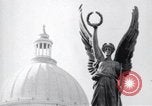
Racial segregation and unrest of 1957 in Arkansas; Reporter interviews the Governor of Arkansas, Orval Faubus.
Reporter interviews the Governor of Arkansas, Orval Faubus about racial segregation of 1957 during his term. The Governor says that he is always ready to accept changes, but he conveys support for segregation by equating it to an "old building" or a "fine painting" and saying that it is "not good to tear down such a building or destroy such a painting simply because it is old." He continues saying, "These things are not good because they are old; many of them have grown old because they are good. And the experiences of many people have proved them to be good." Montage shows buildings, courthouse and justice statues, and public protests, with police arrests of African American marchers and demonstrators during the civil rights movement. Police beat some protestors. Jim Crow era signs segregating whites only versus colored waiting room facilities. Signs read "Colored Waiting Room" and "White Waiting Room." Local Arkansas officials and police beating back protestors with clubs and batons, and police seizing African American protestors and making arrests. U.S. troops in jeeps and trucks arriving and deploying in Arkansas. Included are scenes with signs of Jim Crow segregation practices, with separate entrances for white versus colored patrons at an Intra-state bus depot.
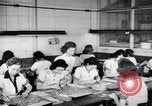
Blind, deaf, disabled and old American workers assisting in the war production effort in Dayton, Ohio, during World War II
Disabled and elderly war production workers contributing to the labor force during World War 2, in Dayton Ohio. Opening scene shows a woman supervisor observing deaf mute women in a lens factory, cleaning segments of bifocal lenses. Closeup of supervisor and one worker communicating by American sign language. A blind man in a shop, using a snap gauge to check finished parts for conformity. A man on crutches taking his place on a war production line. Older men in the shipping department of a factory, packaging and sealing boxes labeled, "Delicate instruments. Handle with care." and placing them on a dolly. Women can be seen at work in another part of the plant. Members of the Dayton Junior Association of Commerce, lined up applying for part-time employment of 4 hours a day, to help the war effort. Students leaving a High School building. (Narrator states schedules were re-arranged for students who would take part-time jobs.)
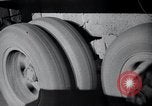
Red Ball Express trucks carry supplies, ammunition, and equipment in France during World War II.
On the "Red Ball Express." Tires of a running Red Ball truck. Wrecked truck being cleared of the path by a tank. Convoy of Red Ball trucks. Towing truck pulls a disabled Red Ball truck. Mechanic make repairs to truck at a service station. Drivers drink coffee. The convoy moves on. Gasoline canisters being loaded on trucks. Operator inside a radio truck controls truck movements. Artillery shells being manufactured inside a plant. Medical supplies, ammunition, and equipment carried by trucks. Newspaper headlines states that the "Red Ball Express" is discontinued as French railway service improves. Montage shows Red Ball Express trucks lined up at parking lots.
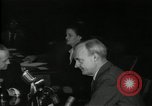
Senator Joseph McCarthy Subcommittee investigating espionage, questions O. John Rogge, counsel for David Greenglass
O. John Rogge, legal counsel for David Greenglass appears before Senator McCarthy's Subcommittee, investigating Army Signal Corps Subversion and Espionage, and states that his client, Mr. Greenglass will cooperate fully with the Subcommittee.
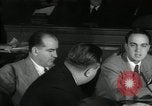
U.S. Senator Joseph McCarthy and Chief Counsel to the Senate Subcommittee question a witness about Joseph Livitsky
U.S. Senator Joseph McCarthy, Chairman of Subcommittee investigating Army Signal Corps Subversion and Espionage, and Subcommittee Chief Counsel, Roy Cohn, question a witness about the access of Army Signal Corps contractors to classified information. They conclude contractors had access up to and including information classified as "Secret." Mr. Cohn and Senator McCarthy decide to call Joseph Livitsky to testify. Senator McCarthy states that Livitsky was involved with the Rosenberg spy ring and Mr. Cohn concurs.

Several prominent American women make speeches at the eve of National Women's Conference
Bella Abzug makes a speech at National Women's Conference in Houston, Texas. Bella Abzug surrounded by photographers and reporters. Barbara Jordan delivers her speech during the National Women's Conference. Indiana State senator Joan Governs speaks. Montage shows interviews and speeches by several other prominent American women figures both for and against the Equal Rights Amendment, including Gloria Steinem, conservative and anti-feminist Phyllis Schlafly, Mary Anne Krupsak, Eleanor Smeal, Liz Carpenter, and Rosalynn Carter.
CRITICALPAST.COM: About Us | Contact Us | FAQs - How to Order | License Agreement | My Account | My Lightboxes | Shopping Cart | Advanced Search | Featured Collections | Website Terms & Conditions | Privacy Policy ©2026 CriticalPast LLC.
License Agreement |
Terms & Conditions |
Privacy Policy
©2026 CriticalPast LLC.