


 Francais
 Deutsch
 Italiano
Refine Your Search
United States 1982 stock footage and images
- Showing 20743 to 20748 of 26493 results more
more Hide
Hide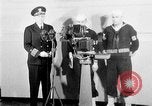
The Norden bomb sight is revealed to the U.S. public for the first time during World War II
The making of a public information film about the Norden bomb sight, during World War 2. Opening scene shows a Norden bomb sight on a pedestal, at the Museum of Science and Industry, in Radio City, Manhattan, New York City. It is flanked by U.S. Navy Captain, Irving Entwhistle and Shore Patrolman, Boatswain's Mate 2nd Class. Orville T. Payne. Another shore patrolman stands behind the bomb sight. The trio waits to begin. Then Captain Entwhistle begins to speak about the significance of the bomb sight to the war effort. The filming is interrupted and takes up again, focusing solely on Captain Entwhistle, as he continues to talk about the bomb sight, but is quickly interrupted, again, by the film director (heard, but not seen). The captain begins, repeating his scripted talk again. Scene shifts to Captain Entwhistle, now standing with hands on the bomb sight. He describes its operation as he maneuvers the sight. He notes the bomb sight's ability to take over control of the bomber's course to the precise drop point. Entwhistle, then looks up and comments: "Is that enough?" He then continues with his talk, but is interrupted, again. Next, Entwhistle picks up again, repeating part of his talk, while the camera pans over the bomb sight. Captain Entwhistle, states that, the instrument "is an automatic pilot, as well as a sight." He rotates the sight various ways for the camera, and asks: "'Want some more?" Scene changes, now showing Harold Barth, President of the Norden company, standing with Captain Entwhistle, who rotates the sight around on its pedestal, while chatting with him. (Microphones do not pick up the conversation.) Mr. Barth leans forward and peers through the sight. Next, in a closeup, the Captain manipulates the sight, while talking to Barth (sound not recorded). Mr. Barth and Captain Entwhistle, take turns looking through the sight. Closeup of the Captain looking through the sight, and manipulating its controls.

Men work at the construction site of the Macagua dam in Venezuela.
The Macagua Dam, (also known as the Antonio José de Sucre) during construction onthe Caroní River in Ciudad Guayana, Bolívar State, Venezuela. A waterfall in the region. The hydroelectric dam under construction in Venezuela. River flowing through jungle region. Infrastructure at the dam site. Large earth moving trucks carrying loads of dirt away during excavation. A man stands at the construction site. Men at work building the dam. A man welds a part of a machine.
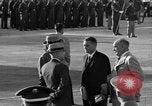
Indian Prime Minister Nehru being received by U.S. President Truman and other dignitaries in Washington D.C.
India's Prime Minister Pandit Jawahar Lal Nehru being welcomed by U.S. President Harry S. Truman in Washington DC. U.S. Secretary of Defense Johnson confers with President Harry S. Truman, Secretary of States Dean Acheson and other men. PM Nehru gets off from an air plane. Photographers take photographs of Nehru and other dignitaries. President Truman on speaker stand with mikes as he welcomes Prime Minister Nehru and invites him to make his speech. Nehru makes a speech and talks about east and west coming together. He opes that together they will work for betterment of humanity. Truman and Nehru shakes hands, pose and go off the platform.
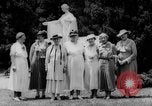
Members of Woman's Christian Temperance Union (WCTU) speak in favor of prohibition in Washington D.C.
Woman's Christian Temperance Union (WCTU) members speak and protest the ending of prohibition, in Washington D.C. Women members pose. One of the member states that she won't drink and that she will do everything to stop others from drinking alcohol. Another member prays and says that she wishes prohibition would come back. All of them say Amen three times.

U.S. Nuclear test "Cherokee" in Operation Redwing, off Namu Island, Bikini Atoll, Marshall Islands.
First air drop test of a thermonuclear weapon. The Hydrogen bomb nuclear weapon was dropped from a USAF B-52 bomber (not seen) that flew from Fred Island, Eniwetak (sometimes spelled Enewetak or Eniewetok), on May 21, 1956. View appears to be from an aircraft flying above altocumulus clouds, below higher stratiform layers. The film begins with a complete whiteout from the initial fireball. As that subsides, local stratiform clouds take on a rosy hue and the center fireball is seen rising above them. As the fireball rises, it takes on a somewhat hemispherical shape, flat on the bottom, from which a straight stem-like column extends toward the ground. The light of the explosion slowly fades and complete darkness ensues. Official accounts state that the intended ground zero was directly over Namu Island, but the flight crew mistook an observation facility on a different island for their targeting beacon with the result that the weapon delivery was grossly in error. The bomb detonated some 4 miles off target over the ocean northeast of Namu. As a result essentially all of the weapons effects data was lost. ( Note: According to ancillary reports, the delivery error resulted in blast overpressures and thermal effects on the 6 structural response targets between Iroij and Namu Islands, greatly exceeding specifications for any use in scientific military modeling of high yield aerial detonations. Plans for graded damages analysis failed when all the structures collapsed. Effects cameras also failed from the intense fireball heat.)
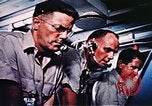
Detonation of liquid thermonuclear device MIKE, the first hydrogen bomb, at Enewetak Atoll, Marshall Islands.
Full-scale thermonuclear test of ultracold liquid deuterium, codenamed Ivy MIKE at Enewetak Atoll in the Pacific Proving Ground in the Marshall Islands (sometimes spelled Eniwetok or Eniewetok). (Left to right) Chief engineering and firing commander, Stan Burris -- later the leader of the Strategic Ballistic Missile development, including Polaris and later editions; retired as CEO of Rockwell Aerospace -- military firing and security commander, Colonel Richard Lunger, and ultracold refrigeration engineering commander for thermonuclear liquid fuel state monitoring, Robert Gibney. The intense nuclear radiation ignited the atmosphere around the device, creating a fireball 4.2 miles across. A remote firing control was created, using a televison tower beam signal to safely trigger the detonation from the USS Estes, approximately 35 miles south/southeast of the detonation. White hot device remnant specks are visible throughout the surface of the fireball. Shockwave from Operation Ivy Mike explosion is seen spreading across the water, then a white mushroom cloud spreading above. View of crew on ship deck observing blast. Device yield: 10.4 megatons.
CRITICALPAST.COM: About Us | Contact Us | FAQs - How to Order | License Agreement | My Account | My Lightboxes | Shopping Cart | Advanced Search | Featured Collections | Website Terms & Conditions | Privacy Policy ©2026 CriticalPast LLC.
License Agreement |
Terms & Conditions |
Privacy Policy
©2026 CriticalPast LLC.