


 Francais
 Deutsch
 Italiano

Refine Your Search
United States 1982 stock footage and images
- Showing 2107 to 2112 of 34981 results more
 Hide
Color Sound

United States Air Force officer talks on phone while looking at a file at Strategic Air Command Control Center
Aerospace Force Communication Electronics. United States Air Force officers at consoles in Strategic Air Command Control Center in United States. An officer works on consoles and speaks into phone. He makes a phone call and looks into a file as he speaks over the phone.

View of two red phones at Strategic Air Command Control Center in United States.
Aerospace Force Communication Electronics. Two red phones at console in Strategic Air Command Control Center in United States. United States Air Force officer writes in a note pad and opens a file as camera zooms out.

Charles Lindbergh places wreath at Tomb of Unknown Soldier, Arlington Cemetery, Virginia, United States.
Famous aviator Charles A. Lindbergh walks, with officials and military officers, across a plaza from, Arlington House, toward the Tomb of the Unknown Soldier (1 Wilson Ave, Fort Myer, VA 22211, United States) in Arlington National Cemetery, Arlington, Virginia. An honor guard of U.S. Army soldiers stands at attention as an officer hand a memorial wreath to Lindbergh, who lays it on the tomb, pausing a few seconds out of respect. View from behind the honor guard, as he steps away from the tomb. Lindbergh walks back toward Arlington House and mingles with various officials and others in attendance. He then enters an open car where his mother (Evangeline Lodge Land Lindbergh) is seated. He converses with a uniformed woman park ranger, standing next to the car. The car with the Lindberghs drives away very slowly as officials walk alongside. View from the rear, of the Lindbergh car, and others following as they leave the site.

Eleanor Roosevelt addresses a public meeting in United States, and tells a joke to the audience.
Eleanor Roosevelt arrives and addresses a public meeting in United States, wearing a red cross hat. During the speech she relates a joke involving her husband, President Roosevelt and the Japanese. It deals with a U.S. Marine ordered to leave Guadalcanal, but disappointed that he has not shot a Japanese soldier. The commanding officer gives him advice which Eleanor Roosevelt relates as a joke to the audience. (World War II period).

Smoke screen tested in United States.
A U.S. military truck with smoke screen mechanism doing tests in the United States during World War 2. Men on a tower find out the direction of the wind with a balloon. A wind wane also indicates the wind direction. A man turns on a button to lay the smoke screen. Smoke rises and engulfs the area in a blanket of smoke capable of covering military installations and operations with protective camouflage so it can not be seen by enemy aircraft.
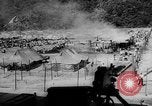
Prison riots in 1952 include North Korean POWs in Koji and U.S. prison riots in Michigan and New Jersey.
Major prison riots of the year 1952. North Korean POW soldiers of the Korean War stage a mass rebellion at POW camps in Koji islands and Pongam Island, off South Korea. U.S. and U.N. guards quell riots at the camps, resulting in death of North Korean prisoners and injuries. Medics are seen treating injured North Korean prisoners. U.N. guards escort prisoners in lines after the riots. Scene shifts to the the United States where damaged prison property in Michigan and New Jersey is seen after prison riots. Broken window glasses and furniture strewn about in a multi-story room of the New Jersey State Reformatory. Scene changes to Southern Michigan State Prison, also called Jackson State Prison, following riots there. Four prisoners including ring leader Earl Ward (second from left) are seen inside the building behind bars, during the standoff where they seized a cell block and held guards as hostages. A prison guard on watch with rifle in hand, looking from an elevated post downward onto a Jackson State Prison courtyard.
CRITICALPAST.COM: About Us | Contact Us | FAQs - How to Order | License Agreement | My Account | My Lightboxes | Shopping Cart | Advanced Search | Featured Collections | Website Terms & Conditions | Privacy Policy ©2026 CriticalPast LLC.
License Agreement |
Terms & Conditions |
Privacy Policy
©2026 CriticalPast LLC.