


 Francais
 Deutsch
 Italiano
Refine Your Search
United States 1982 stock footage and images
- Showing 21691 to 21696 of 26493 results more
more Hide
Hide
Plat coverage of the USS Forrestal fire off the Gulf of Tonkin (Vietnam War)
USS Forrestal fire off the Gulf of Tonkin during the Vietnam War. Time moving on a clock. An RA-5C aircraft is on fire. A man is seen in lower foreground of the footage. Crewmen spraying water on the plane in flames in the foreground. A large fire is seen in the background, as more planes around the vicinity catch fire. Smoke begins to get very heavy in the area filled with parked aircraft. A small explosion from a plane in the background. Debris shot up in the air. Personnel putting water over many aircraft in flames. Many Damage Control (DC) personnel among aircraft in the background. Vast area of the deck on fire, heavy smoke in the background. Fire spreading all over the USS Forrestal. An RA-5C being moved in the foreground to the right. DC personnel move toward main fire in the background. Burned out aircraft in the original area of the beginning of the fire. Men fighting fire in the background. Some units attempting to contain fire. Another RA-5C is moved away from the fire, after heavy sprays of water are put on the aircraft. Deck is filled with DC personnel using fire hose to put out fire. A forklift moves up to the starboard wing of an RA-5C. Forklift lifting the aircraft, with the nose of aircraft seen on the deck. Aircraft is seen with burns and heavy damage. Firefighters spraying with fire hoses. A heavy cloud of smoke obscures much of the background in the fire.
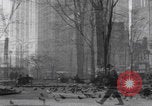
Grand Circus Park, factory building in Moorish design.
Intersection of Woodward and Adams Ave in downtown Detroit. A flock of pigeons, men and women walking in Grand Circus Park. The Fyfe Apartments at 10 W Adams Ave, Detroit, MI 48226 and Central United Methodist Church at 23 E Adams Ave, Detroit, MI 48226 are seen in the background. A Moorish style building beside a river. Chimney of the Moorish-style house emits heavy smoke. Heavy traffic on street in a Detroit city park.

German troops launch V-2 rockets heading to England (WW2)
Germany launch V-2 rockets against England, United Kingdom during World War II. View of the skies. A V-2 rocket in flight after its launch. Rocket contrails form from V-2 rockets in flight. A V-2 rocket in flight as seen from the ground. German soldier uses a pair of binoculars while another uses a gun sight to watch the launch of V-2 rocket. V-2 rocket contrail forms an arc shaped path. Another rocket launches upwards. German soldiers look up and watch. The V-2 rocket disappears from plain sight.
Junkers Ju-52 plane towing a glider during takeoff at the Peenemünde-West airfield (WW2)
Slate reads “Geheime Kommandosache” (“secret commando operation” in English). Flight test of Rheinmetall-Borsig Rocket Assist take off (JATO) units at the Peenemünde Army Research Center in Peenemünde-West during World War II. A Junkers Ju-52 taxiing in an open field during an afternoon test. The Junkers Ju-52 transport plane is towing a large glider.

Construction of the Sodium Reactor Experiment nuclear power plant in Southern California
The Santa Susana Mountains in Southern California. Bulldozers clear trees in the Santa Susana Mountains. Explosives blasting cleared land to build the foundation of the planned Sodium Reactor Experiment nuclear power plant at the Santa Susana Field Laboratory. Construction workers build the core cavity liner of the Sodium Reactor Experiment nuclear power plant. The core cavity liner of the sodium reactor before concrete is poured to make the foundation. A man welds steel pipes in the outer surface of the core cavity. A large circular hole for the inlet and outlet piping. Workers set up basic structures after the core cavity liner and foundation are built. Some workers are digging near concrete columns. A worker pushes a wheelbarrow. Concrete poured into wheelbarrow. The wheelbarrow pours concrete into a backhoe. Workers pour wet concrete into the foundation. Animation depicts four concentric rings installed at the bottom of the cavity liner. A ladder inside a tank. Workers install blocks of thermal insulation materials. A crane carries the outer tank made from low-alloy steel. Workers carefully lower the outer tank into the core cavity. Stacked thermal shield rings at the construction site. The “Pacific” crane lowers a thermal shield ring into place. The crane brings the stainless-steel core tank. The crane lowers the core tank into the core cavity. Stainless steel bellows is put into place to seal the core tank and outer tank. Animation shows how bellows maintain the sodium vapors within the core area. Workers in white protective uniforms install the moderator and reflector units under conditions of extreme cleanliness. A worker uses a high-capacity vacuum cleaner to clean parts. The workers proceed to install the 75-ton top shield. Scientists monitor the pumps that monitor the rate of coolant flow in the sodium loops. A scientist inspects the fuel elements installed in the core. Scientists working at a control room of the Sodium Reactor Experiment nuclear power plant. They monitor the reactor stability. Timer connected to the control rod. Various meters measuring various powers such as electrical, thermal, and main primary sodium flow, steam flow rate. A Honeywell meter measuring the reactor inlet temperature. A sodium inlet temperature meter. A scientist measures shielding effectiveness during power runs. The scientist inspects shield blocks above the radioactive coolant galleries and over the reactor core.
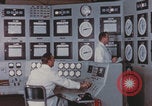
Scientists study and change fuel elements in core reactor of the Sodium Reactor Experiment nuclear power plant
Scientists working in control room of Sodium Reactor Experiment nuclear power plant at the Santa Susana Field Laboratory in Southern California. Fuel elements made from special uranium alloys, thorium uranium, and high temperature ceramic fuels. A scientist in white protective suit rides and operates bridge train. Fuel elements are removed from the core by the shielded fuel handling cast. The operator positions the cast in the general area over the used fuel element to be withdrawn. An indexing mechanism guides the cast to a preset position. Pneumatic mechanism forces an LED radiation shield down onto the surface of the loading face. Animation depicts a pickup device within the cast is lowered to engage the shielding plug of the used fuel element, with the shielding plug hanger rod and radioactive fuel element as one complete unit. Revolving fuel support plate at the top of the cast rotates to position new fuel element over empty fuel channel. The new fuel element is lowered into the core and shielding mechanisms are raised. The used fuel element is taken to underground cleaning cells where it is washed in a water bath. The fuel element is transferred into a storage cell after cleaning to permit reprocessing. Scientists use the hot cells for disassembly and study of experimental fuel elements. A scientist uses robotic arms to handle irradiated material in another room.
CRITICALPAST.COM: About Us | Contact Us | FAQs - How to Order | License Agreement | My Account | My Lightboxes | Shopping Cart | Advanced Search | Featured Collections | Website Terms & Conditions | Privacy Policy ©2026 CriticalPast LLC.
License Agreement |
Terms & Conditions |
Privacy Policy
©2026 CriticalPast LLC.