


 Francais
 Deutsch
 Italiano
Refine Your Search
United States 1982 stock footage and images
- Showing 23143 to 23148 of 26493 results more
more Hide
Hide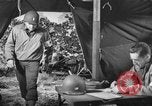
A U.S. Army psychiatric officer tries to detect signs of combat exhaustion and advises ways to prevent them
Reenactment of handling and treatment for U.S. Army World War 2 soldiers suffering combat exhaustion. A soldier gives answers to a psychiatric officer. The psychiatric officer tries to detect signs of combat exhaustion (modern equivalent Post Traumatic Stress Disorder or PTSD) like lack of physical coordination, slowing mental processes, excessive reaction off noise and inability to rest. Soldiers adjust position of artillery. The soldiers are directed to take proper meals and get sound sleep to prevent combat exhaustion and fight stress.
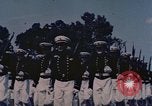
U.S. Merchant Marine Officers and engineers are trained to serve as crew aboard the nuclear-powered ship, NS Savannah
Cadets of the U.S. Merchant Marine Academy, Kings Point, Long Island, New York, are seen on parade. Crew of the nuclear-powered NS Savannah, will include some graduates from Kings Point. Scene in classroom where highly experienced merchant marine officers and engineers are being trained for positions in the Savannah crew. They are being indoctrinated and trained to run a ship requiring them to operate a nuclear reactor and associated systems. Included are seen students from foreign nations who were invited to attend the classes. Students are seen in various classes, and settings, including a mockup of the Savannah's control room, containing a reactor simulator.
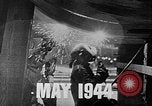
USS Wakefield is rebuilt, soldiers attend religious services and are issued rations aboard the ship in the Atlantic Ocean.
Activities of U.S. ship yard workers and soldiers aboard USS Wakefield in the Atlantic Ocean during World War II. Scenes in May 1944 as ship yard workers repair the fire damaged ship. Workers weld parts of the ship. A stern view of the ship. The ship at sea carrying thousands of troops. Bags hanging in the quarters of the troops. Soldiers rest in their quarters. Men look through binoculars and see an aircraft. Mounted guns aboard the ship. The troops standing near railings wave at the aircraft. The soldiers aboard the ship attend religious services. Ration is issued to the soldiers. The ship is underway at sea. A Coast Guard officer makes an announcement for all army personnel. The army personnel seated and resting on the deck listen to the announcement.
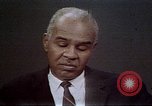
Roy Wilkins condemns looting following the death of Martin Luther King Jr.
Civil Rights leader Roy Wilkins condemns the looting and stealing taking place during the riots following Martin Luther King, Jr. He notes that this behavior "desecrates" the memory of Dr. King.
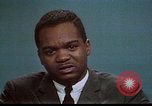
Walter E. Fauntroy says that people should behave non violently after the assassination of Martin Luther King.
Walter Edward Fauntroy speaks about rioting following the assassination of Martin Luther King Jr. and notes that all should "handle our grief in the spirit of non-violence." He adds that those who are responding violently are expressing dishonor towards King.

Plot to destroy national landmarks using dynamite is uncovered by New York policeman Raymond Wood.
Plot to blow up U.S. landmarks is uncovered in New York on February 16, 1965. Views of targets to blow up American landmarks in various cities. Multiple views of the Statue of Liberty in New York, front and back from the water and from the air. Next scene is low aerial view of the George Washington Monument equestrian statue at Benjamin Franklin Parkway and Eakins Oval. Car traffic seen and view of tall building skyline of Philadelphia. Exterior view of Independence Hall in Philadelphia, Pennsylvania, followed by view of the Liberty Bell in Philadelphia, View of reflecting pool and the Washington Monument on the National Mall in Washington DC. View of largely empty parking lot near the Woodland apartments in New York City. Bomb squad men wearing protective gear are seen moving package of dynamite. Bomb squad truck moving through city streets. The plot was organized by Robert Steele Collier, Walter Augustus Bowe, and Khaleel Sultran Sayyed of Black Liberation Front or BLF, and also a Canadian women, Michelle Duclos, of a Quebec separatist party. Undercover police officer Raymond Wood is seen getting an award for uncovering the plot.
CRITICALPAST.COM: About Us | Contact Us | FAQs - How to Order | License Agreement | My Account | My Lightboxes | Shopping Cart | Advanced Search | Featured Collections | Website Terms & Conditions | Privacy Policy ©2026 CriticalPast LLC.
License Agreement |
Terms & Conditions |
Privacy Policy
©2026 CriticalPast LLC.