


 Francais
 Deutsch
 Italiano

Refine Your Search
United States 1982 stock footage and images
- Showing 2491 to 2496 of 34981 results more
 Hide
Color Sound
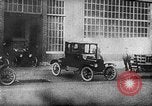
Scenes related to the Ford Motor company and the Ford Model T automobile in the United States.
Ford Model T cars being driven out the exit door of the Highland Park factory, Michigan,circa 1916. Numerous Model T cars driving on both sides of a divided highway. The Ford Highland Park Plant, circa 1920. Panoramic exterior views of the Ford River Rouge plant and factory buildings, circa 1930. A Ford Freighter ship, docked at the River Rouge plant. A view of the home of Henry and Clara Ford, at 66 Edison Road (now 140) Dearborn, Michigan, in 1914. Sketch of children coming home from school, singing song from McGuffey reader school book. View of schoolroom with McGuffey readers on desk. Narrator relates story of Henry Ford trying to buy a McGuffey reader and being unable to obtain one. Narrator states that Ford realizes from this incident "the changes that are reordering his culture. The modes of life which Henry so loved are passing, disappearing into history." Street scene outside Ford Plant, during shift change, and street filled with workers. A car driving on empty road in Sudbury, Massachusetts. The historic Wayside Inn (immortalized in Henry Wadsworth Longfellow's "Tales of the Wayside Inn") which Henry Ford purchased in 1923, to preserve for posterity. View of the original Pennsylvania Railroad Station in New York City, circa 1912. View of crowded sidewalks and street on 5th Avenue, and other street scenes in New York City, circa 1920. Model T Ford cars driving in U.S. National Parks. A visitor feeding a bear from his Ford car, as a U.S. National Park Ranger stands nearby. People in Ford Model T, stopped by side of road to pick wild flowers. Two men remove a seat back from their Model T car to make a camper. Both men lying down in the car. Man carrying picnic basket from Ford Model T, parked beside a beach, where he joins the rest of his party on the sand. Children run along the beach, and stop to play with seaweed.
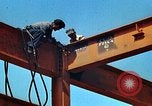
American people working, enjoying recreational activities, and voting in the United States after World War 2
A film about contribution of the U.S. Navy personnel for better life of Americans in the United States after World War II. Scenes of former soldiers, sailors, and military personnel returning to civilian life after the end of World War 2. Men drill on metal structure erecting a new building. Men load sacks in a cart. A man works on a typewriter. People worship in churches. A couple sits on a swing. A man plays chess. People read newspaper sitting outdoors. A man fishing in a river. Men play golf. People on a sailing yacht. Paintings displayed on a wall. A statute in a garden. A man sits on his front porch, plays guitar and sings. A jazz band of African American musicians plays music including piano, drums, clarinet, bass, trumpet (playing part of song "Pop goes the Weasel."). Piano player is smoking a cigarette while playing. Audience watching an orchestra play on stage. A man speaks and presents his view to a gathering. Exteriors of a church. People walk out of the building. Children play on swings in a school playground. Children inside a house run down stairs to the Christmas tree on Christmas morning. A woman drops her completed ballot in a ballot box on voting day, as a man waits to receive his ballot. He enters a voting booth and a uniformed police officer closes the curtain behind him. View shows him marking a check box on the ballot document.

Photograph of Orville Wright honored by Judson Harmon and delegates leave after flag raising ceremony in the United States
Honors bestowed on Wright brothers and commemorating ceremonies of invention of aircraft in the United States. Still photo of Governor Judson Harmon standing at base of large grandstand. Grandstand completely filled with spectators. Spectators are lined up in the stand in a formation resembling the flag. Various dignitaries sit in booths in stand with the Wright brothers. Wright Field, Dayton: The flag raising ceremony shows aviator Orville Wright pulling the rope which raises flag upon mast. Various military and civil leaders present. The flag being raised. Firing cannon salute at the ceremony. Orville Wright,General Quincy Gillmore and U.S. Army Colonel Edward Andrew Deeds stand on platform. Washington DC: members of the party enroute to conference at Washington DC , members get into Colonel Deeds aircraft. 'The King Bird' taxis. Washington: Delegates stand in front of a building. Orville Wright in whose honor the conference is held. Orville Wright flanked by various delegates. (World War II period).
A P-38 aircraft in flight and an animation depicts bail out techniques from the aircraft in the United States.
Normal and emergency operating characteristics of United States Army Air Force Lockheed P-38 Lightning aircraft in the United States. Three P-38 aircraft fly in formation. A P-38 Lightning aircraft in flight. Animation depict bail out techniques from the aircraft. The aircraft flies low over a shoreline. The P-38 aircraft accelerates while in flight. The propellers of the aircraft rotate. Cockpit panel of the aircraft.

Milo Garrett Burcham applies brakes and gauges on the panel of a P-38 Lightning aircraft show readings in the United States.
A film about the United States Army Air Force Lockheed P-38 Lightning aircraft in the United States. A P-38 Lightning aircraft lifts in air. American aviator Milo Garrett Burcham applies brakes. Revolutions per minute ( RPM ) gauges show reduced speed of the aircraft. The aircraft in flight. The aircraft tilts while taking a sharp turn. A temperature gauge on a panel of the aircraft.

Milo Garrett Burcham operates valves and switches while the landing of a P-38 Lightning aircraft in the United States.
A film about the United States Army Air Force Lockheed P-38 Lightning aircraft in the United States. Landing light of an aircraft. American aviator Milo Garrett Burcham applies brakes to reduce the speed before landing. Manifold Pressure Gauge on the panel of the aircraft. The landing gear of the aircraft is lowered. The pilot applies the brakes. The landing gear of the aircraft is pulled up. The pilot operates auxiliary hand pump. A bypass valve is closed. The landing gear is lowered. The pump is operated. A selective valve is closed. Flaps are put in position. The aircraft lands on two main gears. The nose wheel touches down while the landing.
CRITICALPAST.COM: About Us | Contact Us | FAQs - How to Order | License Agreement | My Account | My Lightboxes | Shopping Cart | Advanced Search | Featured Collections | Website Terms & Conditions | Privacy Policy ©2026 CriticalPast LLC.
License Agreement |
Terms & Conditions |
Privacy Policy
©2026 CriticalPast LLC.