


 Francais
 Deutsch
 Italiano

Refine Your Search
United States 1982 stock footage and images
- Showing 2989 to 2994 of 34981 results more
 Hide
Color Sound

Senator J William Fulbright tells about the Educational Exchange Program in a Television Journal show in United States.
Fulbright Program in United States. A Television Journal titled 'Longines Chronoscope'. Television host introduces coeditors of the program. Board on wall reads 'Longines-Wittnauer Show'. First is Mr Larry LeSueur. Second is Chief Editorial Writer of New York Herald Tribune. They talk to Senator J William Fulbright about the Fulbright Educational Exchange Program ("Fulbright Program"). Larry LeSueur asks the Senator about the amount recommended in budget for the program. Senator answers the amount 7.5 million dollar is not enough for the program. In response to the effects of the program. Fulbright says that these programs are of great advantage to increase understanding between two countries. It is better to live in a country and know its propaganda to increase understanding about that country. Interviewer asks is it not better to use broadcasting service instead of exchange program to enhance understanding? Fulbright says broadcasting has its own resistance to propaganda. Senator tells that there are about 4000 students from both side exchanged under this program.

Senator J William Fulbright discusses Educational Exchange Program in United States.
Fulbright Program in United States. A Television Journal tilted 'Longines Chronoscope'. Co-editors of the program ask William J Fulbright about the minimum requirements for a student to be exchanged under Fulbright Program. Senator answers that student must have a degree and a good academic record. They talk about the other requirements for the program. Senator explains that a student must have a nice personality and suitability for the program. Student should be one who can contribute to the human society and these kind of persons often are good athletes. These students must have participated in activities.

Television host describes the Longines Watch Company and a model 'ATMOS' in United States.
A television advertisement for Longines Watch Company in United States. Doll couple at table. Television host talks about souvenirs presented on weddings. He shows a pair of watch. Host tells that Longines Company has received many awards. He tells that it is world's most honored watch. He shows emblem of the company. Host explains about a watch of Longines Company - 'ATMOS', the perpetual motion clock. Host describes its functioning and about its maker.

John C Stennis talks on the Role of Congress in Foreign Policies during a debate in United States.
Debate on the 'Role of Congress in Foreign Policies' between John C Stennis and William J Fulbright in United States organized by American Enterprise Institute. Moderator Peter Lasigor says that Congress is reasserting its role after Korean and Vietnam War. Distinguished citizens sit to participate and ask questions. The debaters: Senator John C Stennis, Chairman, Armed Service Committee and William J Fulbright Chairman Foreign Relations Committee. John Stennis starts the debate. Stennis talks about the role and responsibilities of Congress in domestic and foreign affairs. He speaks about his experiences in legislation as Senator. Stennis gives examples of Theodore Roosevelt, the Congo Rebellion in 1963 and National Commitment Resolution of 1969. He then talks about world affairs and foreign policies regarding World War II. Stennis mentions various treaties and resolutions related to post world war.

John C Stennis talked about reassessment of Congress and work of Foreign Relations Committee in United States.
Debate on the 'Role of Congress in Foreign Policies' between John C Stennis and William J Fulbright in United States organized by the American Enterprise Institute. Senator John C Stennis, Chairman, Armed Service Committee talks on the topic 'Role of Congress in Foreign Policies'. He says that treaties signed previously must be reassessed on new political and economic grounds. He talked about Russian weapons and power. Stennis discussed about the bases of reappraisal of treaties. He said that review and analysis must be done world wide and it must be done with in the congress. He then talked about steps taken by Foreign Relations Committee. He states that it must review weapon system, funding and recommendations for a treaty. Reassessments of treaties must be done in respect to other countries who have signed the treaties. He discusses the basic approach necessary for foreign policies. Stennis talked about Russian Strategic Threat and the work Congress must do in the future.
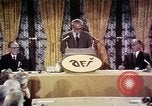
William J Fulbright, Chairman,Foreign Relations Committee, talks about power of Congress in United States.
Debate on the 'Role of Congress in Foreign Policies' between John C Stennis and William J Fulbright in United States organized by the American Enterprise Institute. Senator William James Fulbright, Chairman, Foreign Relations Committee discusses Section- 8, Article-1 about the powers of the Congress. He states the power of Congress regarding war and making rules. He states that since the Kingdom of George III the power remains with the supreme, as stated in article -2 the President has the powers to command all three defensives branches of country. He discusses the role of the President. Fulbright talks about war and treaty power, that the Senate has always supported the Congress, but the Congress has constitutional authority to exercise powers.
CRITICALPAST.COM: About Us | Contact Us | FAQs - How to Order | License Agreement | My Account | My Lightboxes | Shopping Cart | Advanced Search | Featured Collections | Website Terms & Conditions | Privacy Policy ©2026 CriticalPast LLC.
License Agreement |
Terms & Conditions |
Privacy Policy
©2026 CriticalPast LLC.