


 Francais
 Deutsch
 Italiano

Refine Your Search
United States 1982 stock footage and images
- Showing 3043 to 3048 of 34981 results more
 Hide
Color Sound
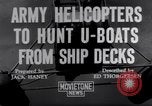
Sikorsky YR-4 helicopter takes off for submarine search at sea in United States.
Sikorsky YR-4 helicopter takes off for submarine search at sea in United States. It lands on the deck of a moving tanker and takes off. Soldiers stand on the ship deck. Helicopter in flight. (World War II period).
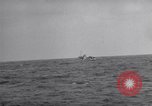
U.S. Coast Guard Cutter, Campbell, makes temporary repairs, at sea, after collision with German submarine U-606 in World War II
Canadian corvette HMCS Dauphin (K 157) seen from the U.S. Coast Guard Cutter George W Campbell, as the Campbell makes temporary repairs at sea, following collision with German submarine U-606, during World War 2. Crew of the Campbell lowering heavy canvas over the side to staunch flow of water into her engine room from the collision. Crew members look over her side as others place the canvas into position. Coastguardsmen swarm over the canvas as they nail it fast to the deck. Crew members run lines up over the ship's side to secure the repair tight against the hull. Crew tilt a fabricated cofferdam and lower it overboard, where it is then seen floating next to the ship. Two crewmen in rubber gear stand on the raft and use poles to stuff material into the gashed hull. Ship's crew runs to starboard to tilt the port hull up for repair crew.Then they run to the port side. Officers make final check on a diver in rubber suit, who then descends side of the ship on a rope ladder. Another diver, sans suit, descends the ladder. Divers back on deck after completing work. Officer on the Campbell hailing a merchantman on a megaphone as she comes abeam, underway. The HMCS Dauphin providing protection for the Campbell. Crew of Campbell securing the cofferdam in place. All hands pulling on lines with block and tackle to tighten the repairs in place.

Damaged United States planes return from a mission at Pacific (WW2)
Shows activities aboard an aircraft carrier in the Pacific ocean as damaged planes return from a mission in World War II. United States soldiers looking towards the sky. They watch towards the sky through binoculars. Airplanes flying in the sky. A man waving signal boards towards the airplanes. A plane lands with one wheel. Another skids off the landing deck and hangs on the side of the ship. The third plane slides off the deck into the ocean, killing the pilot. Soldiers taking the pilot on stretcher. Cost of the plane and the pilot's training. Shows that a human life cannot be measured in dollars. Indicates that the mission of the civilians at home is to purchase war bonds.
U.S. Navy Flight Safety training about Dive Bombing Crashes
The United States Navy training film on flight safety, 'Dive Bombing Crashes'. Illustrates a dive bombing crash during training to point out the necessity of keeping aware of your altitude and using instruments on high speed dives. (World War II period).
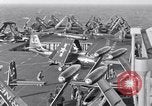
Navy film about proper handling of jet airplanes on U.S. aircraft carriers
Blue shirts moving Marine F2H Banshee aircraft with folded wings, on flight deck of a U.S. aircraft carrier. They roll one by pushing on the leading edge, without rocking the aircraft. Diagram shows tendency of jets to rock fore and aft. They use a tug to move a jet forward only. Blue shirts rolling one back to allow forward towing. An F2H being taxied with wings folded. Blue shirts position one pointing aft overboard to minimize blast from engine during start. Wheels being chocked.
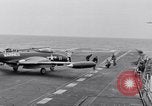
Deck crews aboard a U.S. Aircraft Carrier handle aircraft and prepare them for catapulting.
U.S. Marine Corps McDonnell F2H Banshee jet airplane being guided by a Yellow shirt. Scene shifts to animated diagrams interspersed with actual pictures. They show narrower tires used on jets giving lower braking friction and less lateral stability. One is shown in sketch, being blown over by jet blast. Sketch illustrates jet intake suction and reward blast. Deck crewman removing loose tools from pockets and fastening chin strap and goggles on his helmet, to avoid loose items being sucked up or blown about on deck and protect himself from jet blast. A Marine Corps Captain, pilot, climbs aboard his F2H airplane and deck crewman moves out of line of fire from plane's weapons. Next, a Navy F2H of Attack Squadron 12 (VA-12), Carrier Wing One (Tail code "T") is seen being readied to depart. Deck crew has already pulled the duct covers and pilot is in the cockpit. A 3-wheeled starting "jeep" containing an auxiliary power unit provides power for engine start and then pulls away. Fire fighter standing by in protective gear is seen. Deck crew pull chocks and aircraft taxis guided by yellow shirt who gives signals to spread wings and lower flaps. Yellow shirts guide jets to catapults for takeoff. Yellow shirt Plane Director uses various hand signals to guide pilot. Deck crew scramble underneath the aircraft an set it on the catapult.
CRITICALPAST.COM: About Us | Contact Us | FAQs - How to Order | License Agreement | My Account | My Lightboxes | Shopping Cart | Advanced Search | Featured Collections | Website Terms & Conditions | Privacy Policy ©2026 CriticalPast LLC.
License Agreement |
Terms & Conditions |
Privacy Policy
©2026 CriticalPast LLC.