


 Francais
 Deutsch
 Italiano

Refine Your Search
United States 1982 stock footage and images
- Showing 3541 to 3546 of 34981 results more
 Hide
Color Sound
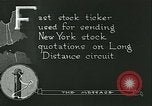
Men operate a ticker and a woman operates a piano keyboard type ticker in the United States.
A film on technological advancements in the United States. Use of fast stock ticker tape machine for sending New York quotations on a long distance circuit. A man operates a ticker machine. A fast stock wire sends stock quotations. Men look and work at a ticker tape. A woman operate a piano keyboard type ticker.
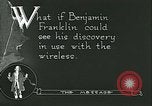
A telephone, radiophone, phonograph, and Aldis lamp demonstrated in the United States.
A film on technological advancements, innovations, and inventions in the United States during the industrial age and industrial revolution. An actor portraying Benjamin Franklin talks to other men. A man explains to him how a wireless is operated. Benjamin Franklin actor at a telephone switchboard. An operator hands him earphones. Franklin listens. A radiophone in operation. A recording being played on a phonograph. Closeup view of the needle on the phonograph while the record is playing. Franklin listens to radio. Two men, standing near a biplane aircraft, operate a battery-powered Aldis lamp. (Slate incorrectly refers to Heliograph, which uses the sun as light source.) One man uses a sight to aim the lamp at the intended recipient of the message. The other man, holding the battery, sends coded message by operating a key on the battery box. Biplane in flight overhead signals back. Franklin seated at a desk writes in candlelight.
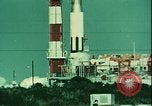
Men and women work on electronic computers for bank book keeping in the United States.
A film titled ' The second revolution in banking' on bookkeeping services and computer improved banking services in the United States. A Titan rocket is launched from a launching pad. Heavy columns of smoke rise as the rocket is launched. Narrator indicates the launching of the rocket implies electronic and technological advancements. The Titan rocket ascends in the sky. The first revolution in banking is book keeping machines during World War I. A man seated at a desk works. Several men and women seated at desks in an office. They work on book keeping machines. The machines are clumsy and use lots of papers. A man empties a sack of bundles of paper on a table. The second revolution is electronic computers. These computers can read, sort, print, process check numbers, record and store customer account information which can be retrieved in record time. The Merchandise National Bank of Chicago installs electronic computers. Men work on the computers in a computer room. Several symbols printed in magnetic ink on a check. The symbols enable the computer system to read information faster and accurately. A man works on a typewriter. He types customer information. Other men work on a machine. The machine reads the information. A reader sorter in operation. A woman at work. The information is read, sorted and interpreted.
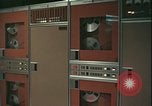
Computer room with tape units of computer systems in operation for book keeping in the United States.
A film on bookkeeping services and computer improved banking services in the United States. Computer system reads and records vital details and information. It records bank checking accounts. A tape unit in operation. The tape unit saves space in addition to operating with a high speed. A woman works on a machine. Several accounts and a detailed information can be stored on a tape. A printing machine in operation.

Parts and systems of electronic computers for bookkeeping, in an early 1960s computer room in the United States.
A film on bookkeeping services and use of early model computer technology to improve efficiency of banking services in the United States. A man seated at a desk while at work. Early model computer central processor in operation. A bank check being placed in the loading mechanism of a "reader-sorter" machine. The machine reads symbols printed in magnetic ink. The bank identification number of the check is checked. After checking the identification number, documents are read. Information contained in the magnetic symbols is checked. The documents are sorted. The information is placed on a magnetic tape. Close-up views and wider views of of computer magnetic tape and magnetic tape drive machines. Next, the information is processed and sent to a high speed printer for immediate examination. Man wearing glasses examines pages from the printer as it runs a continuous feed paper roll. Sorting of the documents. The documents are arranged in numerical order by the machine. A woman works loading magnetic tape reels on the tape drive machine. The master file containing complete data of each account is worked upon. Views of lights on the early model computer. The computer reads an identification number. Several information and transactions of the customers are added to previous transactions. Another master file is created using the information. It records the information of the customer account. Other information like that of overdrafts and closed accounts is also recorded. The customer statement is prepared. Customer information and opening balance is recorded from a tape. Information about the current balance is also recorded. A woman works on a reader sorter machine in operation. It sorts the checks. Close-up view of printer running continuous feed paper and printing transaction information. Tape unit containing complete information of all accounts is printed. View of an analog clock and a hour glass with sand in it. Narrator states that the computer will take 3 or 4 hours to complete the accounting for up to 30,000 daily deposit transactions, which would formerly take 60 man hours for the same operation. Views of the computer central processor unit (CPU) and views of the computer operator's console. A man seated at the console desk works. Three men wearing business suits, who are employees or officers of the Merchandise National Bank of Chicago, are seeing viewing blueprints and discussing.
New recruits, including African Americans, commence training in the U.S. Army during World War II
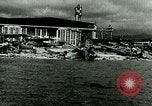
Views of damage in the aftermath of the Japanese attack on Pearl Harbor, December 7, 1941. Scene shifts to African American pastor in pulpit of a church speaking about U.S. armed forces. A woman in the congregation whose son is serving in the Infantry, points to a flag filled with blue stars for service members from the church. She reads letter from her son telling her he has been selected for Officer Candidates School. View of new recruits in a railroad depot. African American recruit pauses to say goodbye to his mother, but is moved along by a uniformed Army officer. Closeup of locomotive wheels turning. Glimpse of barracks in an Army base. Recruits leaving railroad train and entering a snow-covered building. Army sergeants organizing the new recruits inside the building. An army spokesman welcomes them to the training camp. Recruits being interviewed about their past training and experiences. Closeup of a Sergeant inquiring about the kind of machine tools a recruit had worked with. Recruits assembled in a base auditorium where they hear from a Chaplain and an officer who demonstrates how to salute. (World War II; WW II; World War 2; World War Two)
CRITICALPAST.COM: About Us | Contact Us | FAQs - How to Order | License Agreement | My Account | My Lightboxes | Shopping Cart | Advanced Search | Featured Collections | Website Terms & Conditions | Privacy Policy ©2026 CriticalPast LLC.
License Agreement |
Terms & Conditions |
Privacy Policy
©2026 CriticalPast LLC.