


 Francais
 Deutsch
 Italiano

Refine Your Search
United States 1982 stock footage and images
- Showing 3835 to 3840 of 34981 results more
 Hide
Color Sound
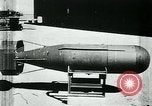
Assembling an Azon Bomb, attaching it to a B-17 Bomber of United States Air Force and its firing at the target.
An unassembled Azon Bomb at a United States base. Airmen removing protective plugs from nose section of warhead. Attaching various components control surface, instruments to the bomb, and then the bomb to the underside of a B-17 bomber. It takes off. Dropping bomb to the target. (World War II period).
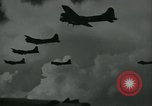
U.S. Army Air Forces demonstrate a glide torpedo for use against water-borne targets in World War II
A demonstration of the Aeronca GT-1 glide torpedo. Six Boeing B-17 Flying Fortress bombers, of the U.S. Army Air Forces, fly in formation. Next, splashes from their guided bombs are shown in water below. A slate appears with illustration and title, "Preset Glide Torpedo Model GT-1." A GT-1 is shown rotating while hung from a chain in a manufacturing area. Another Aeronca GB-1 is on the floor in the background. Four airmen push a GT-1 on a wheeled dolly. They roll it and position it underneath the wing of a B-17. Closeup of them jacking up the dolley to position the GT-1. View of the torpedo secured under the aircraft. Gun camera footage shows a GT-1 on a long glide towards the water, after release from above. View from water surface of the GT-1 approaching the water. At the last moment, its paravane (wing) separates and the torpedo contacts the water. The paravane falls aside into the water. The camera pans over to a makeshift target. The process is repeated with a second GT-1 but it is not seen close to the water. A third demonstration is successful and the wake of the torpedo is tracked from an overflying aircraft.
Target Seeker Guided Missile GB-6 fired for a target from B-25 bomber of the U.S. Army Air Corps
Target Seeker Guided Missile GB-6 of the U.S. Army Air Corps kept at a laboratory at a USAAC base. Two Airmen attach components to the GB-6. Testing the missile by holding a flame in front of it. B-25 bomber with an attached GB-6 takes off. GB-6 fired takes an aerial route from among the clouds and strikes its target among trees. (World War II period).
Light Seeker Guided Bomb GB-5 of the U.S. Army Air Corps causes explosion at its target in night.
Light Seeker Guided bomb GB-5 of the U.S. Army Air Corps fired on a target at night. The bomb moves in dark seeking lighted target. It strikes the target and a massive explosion takes place. (World War II period).
Radar Seeker Guided Bomb GB-7 of the U.S. Army Air Corps with nose cover removed showing a radar antenna.
Radar Seeker Guided bomb GB-7 kept at a base of the U.S. Army Air Corps. An airman removes the nose cover of the bomb. A radar antenna inside the nose with an aerial can be seen. (World War II period).
High angle bomb controllable in range and azimuth generally called Razon, kept on a rack at a U.S. Army Air Corps base.
High angle bomb controllable in range and azimuth, generally called 'Razon'. Models VB-2 and VB-3. A high angle bomb placed on a rack kept at a United States Air Force base. (World War II period).
CRITICALPAST.COM: About Us | Contact Us | FAQs - How to Order | License Agreement | My Account | My Lightboxes | Shopping Cart | Advanced Search | Featured Collections | Website Terms & Conditions | Privacy Policy ©2026 CriticalPast LLC.
License Agreement |
Terms & Conditions |
Privacy Policy
©2026 CriticalPast LLC.