


 Francais
 Deutsch
 Italiano
Refine Your Search
United States 1982 stock footage and images
- Showing 4039 to 4044 of 26493 results more
more Hide
Hide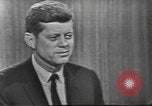
Senator Kennedy gives his closing statement during the fourth presidential election debate held in New York, United States.
The fourth presidential election debate held between Democratic nominee Senator John F. Kennedy and Republican nominee U.S. Vice President Richard Nixon in New York, United States on 21st October 1960. ABC news correspondent Quincy Howe asks Senator Kennedy to give his closing statement. Senator Kennedy says if he loses the election he would continue in the Senate to try and build a stronger country. He says that the year is of importance for the United States. He speaks about the present situation of the U.S. in regard to education, science, and diplomatic relations. He says that the Republican party has stood still really for twenty-five years and opposed all of the programs of President Roosevelt and others. He further says that the U.S. should get a party which believes in going ahead so that the country can reestablish its position in the world with strong defense, economic development, justice for people and should particularly to try to reestablish the atmosphere which existed in Latin America at the time of Franklin Roosevelt.
Former Ambassador to the United States for Germany, Johann Heinrich von Bernstorff, leaves New York for Germany aboard the Frederik VIII Danmark.
Rear view of railroad train from Washington carrying former Ambassador to the United States for Germany, Johann Heinrich von Bernstorff. Count von Bernstorff waving from the train. Unidentified man talking to an officer, possibly Captain Thomsen of the Frederik VIII . View of the Frederik VIII as it pulls away from pier. Ship Frederik VIII in harbor. Unidentified man in bowler hat. Count von Bernstorff was allowed to depart for Germany amidst diplomatic tensions as the United States USA was preparing to enter WWI.
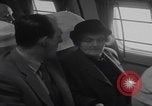
1956 Hungarian Revolution refugees arrive at Camp Kilmer, New Jersey, United States
An elderly woman and a man, both Hungarian refugees, looking out a plane window. A woman puts on lipstick. Excited Hungarian refugees smile after their plane lands. Douglas C–118 Liftmaster taxiing at McGuire Air Force Base (JB MDL, 3021 McGuire Blvd, Trenton, NJ 08641, USA) Hungarian refugees disembark from the Douglas C–118 Liftmaster plane. A man holding a “United States Escapee Program” bag climbs down an airstair with a small child. Refugees board a Starr Transit Co. (70) Bus. A Hungarian family disembark a plane together. Refugees boarding a charter bus with sign "Hightstown-New Brunswick" Buses arrive at the United States Army Camp Kilmer Reception Center. Sign reads “US Army Reception Center Isten Hozta Camp Kilmer”. “Isten Hozta” on sign means “God brought (you here)” in Hungarian. A United States Army officer assists refugees out of the bus. A Hungarian man tips his hat to thank the officer. Poster reads “Catholic Relief Services N.C.W.C. Katolikus Segitő Szolgalat N.C.W.C. Katolikus Magyarok Bevándorlási Szevezete”. Hungarian refugee family talk to an official at the reception center in Camp Kilmer. Woman relief worker signing documents for refugees.
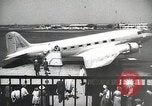
A United Airlines passenger plane equipped with modern, luxurious facilities takes flight in the United States.
Passengers board DC-2 airliner parked at airport. View inside cabin. Baggage being loaded in door under cockpit. Engine starts. Fire extinguisher near wheels in foreground. Aircraft taxis out. "U.S.Mail" painted on tail. "United Airlines" logo on fuselage. View of takeoff from underneath aircraft. Stewardess (flight attendant) passes out newspapers to passengers. DC-2 in flight near clouds. A child watches the plane in flight. Old man watches airplane overhead. First class luxury in flight: A steward in uniform serves passengers as they dine on fine food inside the plane. A steward arranges sleeping berths for the passengers. They climb into the berths. A globe shows the development of aviation.
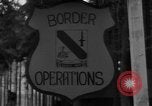
United States troops in Germany. Army training in Alaska. Army Reserve and National Guard Units increase readiness
A sign reads 'Border Operations'. Other signs on area roads read: "Ronshausen; Kreis Rotenburg; Zonen- Grenzbezirk." U.S. Army soldiers seen guarding key installations and supply lines in Germany. American troops keeping ready with training, crawling under live machine gun fire. U.S.Army Arctic Training Center in Big Delta, Alaska. Army troops training in snow on skis. U.S. Army Reserve and National Guard units being trained to increase their readiness. Army troops in routine activities, eating, etc. stop everything, and respond to battle stations when an alarm sounds.
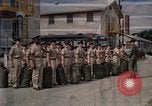
American soldiers undergo Advanced Individual Training at unit level in United States
American soldiers undergo Advanced Individual Training (AIT) for maintaining physical fitness at the unit level. Group of U.S. Army recruits having completed basic training stands in line and boards a bus with their duffel bags to head to initial assignments. At initial assignments, physical training continues, as drill trainers give technical instructions to the soldiers. They undergo physical exercises, rifle drill, marching, rugged grass drill, obstacle course. U.S. Army soldiers practice bayonet tactics. Soldiers also learn hand to hand combat tactics and play soccer to maintain their fitness.
CRITICALPAST.COM: About Us | Contact Us | FAQs - How to Order | License Agreement | My Account | My Lightboxes | Shopping Cart | Advanced Search | Featured Collections | Website Terms & Conditions | Privacy Policy ©2026 CriticalPast LLC.
License Agreement |
Terms & Conditions |
Privacy Policy
©2026 CriticalPast LLC.