


 Francais
 Deutsch
 Italiano

Refine Your Search
United States 1982 stock footage and images
- Showing 4201 to 4206 of 34981 results more
 Hide
Color Sound

Men move rail tracks beside an overpass during the Woodward Avenue Project in the United States.
Men at work during the Woodward Avenue project in the United States. Cars move on a road. A train moves on the tracks in the background. Men at work on the railroad tracks. They move tracks beside an overpass. Cranes being used for picking dirt. Men drill holes in a concrete wall. The cracked concrete. A crane picks up concrete in the background.

James Macaboy speaks about the objectives of the Speed Recovery campaign in the United States.
The members of the Speed Recovery Campaign being introduced in the United States. The members of the Speed Recovery Campaign stand in a group. A man introduces each member of the group. President of Detroit Board of Commerce James Macaboy speaks about the objectives of the campaign.

Animation shows the links of the cables of barrage balloons to detect and destroy enemy airplanes in the United States (WW2)
A World War II training film depicts the use of barrage balloon to damage enemy airplanes flying at low altitude during a war in the United States. Animation shows the barrage balloons attached with wired cables in the protected area. A barrage balloon in sky. Enemy airplane in flight against the wind hits the balloon. The cable breaks and airplane can get damage. An airplane in flight in the wind direction. The airplane hits the cable and no damage is caused. The wire falls at the base. The barrage balloon flies away. Animation shows links attached to the cable in a barrage balloon. The enemy aircraft approaches the balloon. The aircraft cuts the link. The cable wire with attached parachute comes on the wing. The parachute opens and the wire cuts the wing of the airplane. The balloons deflates comes down.

Animation shows the influence of weather on the barrage balloon in the United States (WW2)
A World War II training film depicts the use of barrage balloon to damage enemy airplanes flying at low altitude during a war in the United States. Animation shows the influence of weather on the barrage balloon. A balloon floats in air due to high wind. The cable breaks. The balloon flies and drags cable on the ground. Sparkling on electric wires as cable hits the wires. The cable accidentally breaks. The dive in the balloon explodes cuts the cable. The parachute opens. The balloon deflates floats downwards. Animation shows links attached in the wire cable and their function.

A soldier demonstrates proper installation of barrage balloon in the United States.
A training film depicts proper installation of barrage balloon in the United States. Two barrage balloons in sky. A lower link of a parachute attached on a cable. The upper link of the parachute attracted to the junction assembly. A building in the background. Troops carry a box. A soldier demonstrates the installation of barrage balloon. The soldier disconnects cable terminal assembly from a bell crank by removing the pin. He unscrews the channel pin. The soldier holds the link in his hand. He attaches the male end to the cable terminal assembly. Screws the cable pin in to correct position. He locks the terminal pin. He attaches the female end to the bell crank and tighten all the screws. (World War II period).
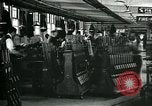
World War I United States arms factory
A U.S. arms manufacturing in World War 1. Hundreds of war production workers seen at shift change, waiting for their respective trolley cars passing on tracks between arms manufacturing plant's buildings. Women at work on metal working machines in an arms factory. Racks of Browning Automatic Rifles (Rifle, Caliber .30, Automatic, Browning, M1918) are being moved about. Assemblers are seen hand fitting parts for the Browning M1917 water cooled machine gun. One man makes final assembly adjustments to one of the machine guns set up on tripod in the factory. He enjoys firing the Browning M1917 machine gun. (Note:The M1917 and M1918 BAR were manufactured by numerous American arms makers. Colt, Remington, Marlin, Royal typewriter, Winchester. Most of the M1917 machine guns were manufactured by New England Westinghouse.)
CRITICALPAST.COM: About Us | Contact Us | FAQs - How to Order | License Agreement | My Account | My Lightboxes | Shopping Cart | Advanced Search | Featured Collections | Website Terms & Conditions | Privacy Policy ©2026 CriticalPast LLC.
License Agreement |
Terms & Conditions |
Privacy Policy
©2026 CriticalPast LLC.