


 Francais
 Deutsch
 Italiano
Refine Your Search
United States 1982 stock footage and images
- Showing 4651 to 4656 of 26493 results more
more Hide
Hide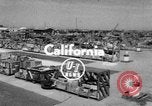
Army surplus goods including light and jeep on public auction in California, United States.
Army surplus goods being auctioned in California, United States. Army surplus goods worth 12 million dollars piled up at Sharpe General depot for an auction. Goods include a battered jeep as men work on it. Lights and lanterns for sale. Bidding takes place. Men seated in chairs as they bid for the goods.
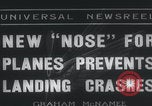
United States Army Air Corps pilot tests propeller protection device.
United States Air Corps Lieutenant Roscoe Charles Wilson is seen wearing civilian clothing and parachute. Lt. R.C. Wilson, a pilot, climbs into the cockpit of a modified Boeing P-26 fuselage. The fuselage is mounted in a jig designed to protect the propeller during landing accidents. The entire fuselage is tipped over slowly as a means of demonstrating the protection device. Lieutenant Wilson in cockpit pushing against sponge rubber in top of canopy.
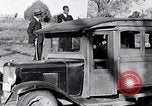
School bus carries African American children in South Carolina, United States.
Disparity between White and African American schools in South Carolina, United States. House in the background. Men stand near school bus. School bus carries African American children. Children walk in the campus of Maryland State Normal School. Damaged bus stands. African Americans board the bus. White children stand in farmland. School bus picks up White children. African Americans walk on the road.
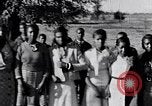
African American women on farmland and a disabled man in a wheel chair in South Carolina, United States.
African American life and education in rural South Carolina, United States in the 1930s. Group of young African American women, possibly students, stand under a tree posing for the camera, and then they turn and head into a building. Two African American children clean the exteriors of a house with brooms. Disabled African American man sits on a wheel chair. Man greets the disabled man. View of a grave yard or cemetery. Child climbs into school bus. African American boy stands by the side of a car. View of building (possibly school building) and farm land in southern U.S state of South Carolina.
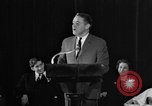
Sargent Shriver delivers a speech in New York, United States about the role of Peace Corps.
Robert Sargent Shriver, Director of Peace Corps in New York, United States. Shriver enumerates poverty, hunger and lack of political freedom as the main constraints in development of an individual in various parts of the world. It is these objectives that Peace Corps works for. He clarifies that Peace Corps is not against communism. Rather it works to release people from the clutches of imperialism. He states that Peace Corps volunteers help people in various countries to strive for betterment as per their own way of life and culture without directing them to Western culture. He also explains the essence of community development in Peace Corps.

Sargent Shriver ends a speech in New York, United States about the efforts of Peace Corps.
Robert Sargent Shriver, Director of Peace Corps in New York, United States. Shriver at the end of a speech about the activities of Peace Corps volunteers, answers questions of the audience. He clarifies that the Peace Corps is free from the government control and the State Department has never dictated terms to the Corps. He also tells that Peace Corps is open to people who do not have a college degree in a specific field. A man delivers a vote of thanks to Shriver and audiences applaud in appreciation.
CRITICALPAST.COM: About Us | Contact Us | FAQs - How to Order | License Agreement | My Account | My Lightboxes | Shopping Cart | Advanced Search | Featured Collections | Website Terms & Conditions | Privacy Policy ©2026 CriticalPast LLC.
License Agreement |
Terms & Conditions |
Privacy Policy
©2026 CriticalPast LLC.