


 Francais
 Deutsch
 Italiano

Refine Your Search
United States 1982 stock footage and images
- Showing 4873 to 4878 of 34981 results more
 Hide
Color Sound

USS Intrepid (CVS-11) passes over the Chesapeake Bay Tunnel complex in the United States.
U.S. Navy aircraft carrier USS Intrepid (CVS-11) departs for Vietnam from NOB, Norva pier 12 of Naval Station in Norfolk, Virginia. USS Intrepid underway at a sea. Aircraft parked on the center portion of the flight deck of the aircraft carrier. NOB piers and shoreline of Norfolk in far background. A view of the starboard quarter. The ship passes over the Chesapeake Bay Tunnel complex.

Countless servicemen overseas in WWII have children at home in the U.S. Children of three servicemen are seen, representing all
During World War 2, woman tells of selecting three, out of countless names of servicemen overseas, who have children at home. Their children were filmed. First seen is Diane Sandra Fine, one year old, daughter of Sergeant Bernard Fine, a U.S. Army mail clerk somewhere in India. Baby Diane Fine is in high chair and mother feeds her with spoon. Then she is seen in her crib, playing with a toy, and later ready to sleep. The next child seen is the son of Corporal Carl Christianson, of the 464th Quartermaster Company, serving somewhere in the Pacific. His boy sits in a high chair scribbling a drawing to be sent, along with a letter his mother is writing, to his father. Mrs. Christianson holds her son and he hugs her. The third pictures show the family of Yeoman Second Class, Earl M. Robinson. Shown are sons Terry and Danny, together with their mother, Geraldine Robinson, of Roanoke, Virginia. Three year old Danny rides on a hobby horse, while his mother dresses eighteen month old Terry. Exterior view of the Robinson home. More than 20 members of the extended Robinson family come out of the house.

Tennessee Valley Authority develops the Tennessee River system in United States.
Harnessing rivers in United States. Tennessee River flows with full force. Floods cause damages in farms and towns. The flow of water causes soil erosion. Tennessee Valley Authority develops the Tennessee River system for flood control and to generate surplus electricity to avert waste of water power. Congress passes Tennessee Valley Authority legislation. Construction crew works on the construction of dam. Workers balancing on steel beams, high in the air. Riverters throwing and catching hot rivets. Steam shovels and pneumatic hammers in operation. Concrete being poured and a welder with helmet and torch,at work. Animated map shows the river and tributaries. Several other dams in view. The dams help in electricity power generation and irrigation.

An educational film on a cartoon character Private Snafu shows him realizing the importance of his work in the United States (WW2)
World War II cartoon character Private Snafu sorts shoes in the QM (quartermaster) in the United States. A sign reads 'Q.M. Depot, Shoe Division'. He arranges the shoes. He envies his brothers for their easy jobs. Technical Fairy, First Class arrives and shows him the job work of his brothers. One brother faces many trials as a farmer. He has a poultry farm. A hen wants food. Private Snafu's brother has to take care of the eggs. Another brother serves as a quarry for war dog training. A sign reads 'Training Center'. Dogs run behind him. Private Snafu then realizes the importance of his work.
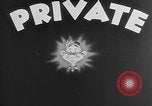
An educational animated film shows Private Snafu being placed as the in charge of a camp in the United States (WW2)
An animated film shows cartoon character Private Snafu in the United States. Private Snafu works and complains about his work. He is admitted in a hospital. Technical Fairy, First Class arrives and places Private Snafu as in charge of a camp. Private Snafu permits the discipline to break down. The troops enjoy themselves. The troops sit with girls in a Jeep. Private Snafu sits in a camp and is attended by several women. Technical Fairy, First Class informs Private Snafu about the attack of enemy on the camp. Private Snafu calls for his troops. The enemy attacks unopposed. Private Snafu hides himself in the ground. The enemy aircraft attacks him. A Nazi German sign on the enemy aircraft. (World War II period).

A fleet oiler re-fuels destroyer, USS Cooper (DD-695), underway at a sea in the United States.
Fueling of destroyer, USS Cooper (DD-695) underway at sea in the United States. Sailors aboard a destroyer ship. Officers maneuver the destroyer. An engineer involved in the preparations. An animated diagram shows information applicable when a destroyer takes on board fuel oil from a tanker alongside and both ships are underway. The small tanks are filled first. The officers work efficiently and wear life jackets. Men at forward fueling station. An animated diagram shows the course taken by the destroyer and the tanker. The animated diagram shows the collision of both ships. The heaving line and towing line are taken from the tanker to the destroyer ship. The free end of the messenger is returned to the destroyer. Sailors hold the fuel hose and take it to the tanks. A safe distance is maintained between the two ships. The straps are cut after refueling and the destroyer ship increases it's speed. (Note: The USS Cooper was torpedoed by the Japanese Destroyer, Take, during an engagement with Japanese naval forces in the Gulf of Leyte, on December 3, 1944. Reportedly, She exploded, split in two, and sank. Of her crew, only 168 could be rescued. The remaining 191 lost their lives.)
CRITICALPAST.COM: About Us | Contact Us | FAQs - How to Order | License Agreement | My Account | My Lightboxes | Shopping Cart | Advanced Search | Featured Collections | Website Terms & Conditions | Privacy Policy ©2026 CriticalPast LLC.
License Agreement |
Terms & Conditions |
Privacy Policy
©2026 CriticalPast LLC.