


 Francais
 Deutsch
 Italiano

Refine Your Search
United States 1982 stock footage and images
- Showing 5023 to 5028 of 34981 results more
 Hide
Color Sound
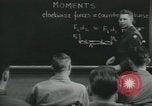
A review of modern U.S. Army field weapons (circa 1955) showing some in tests and exercises
A U.S. Army Sergeant at a blackboard explains the concept of moments in mathematical terms to a classroom of soldiers. Next, soldiers are seen in a shop equipped with electronic equipment. An oficer watches as a soldier removes a motherboard from a bank of early computers. As the officer refers to a wiring diagram, the soldier checks the board. Scene changes to outdoors where several infantrymen are seen running alongside an M4A3E8 76 mm armed Sherman tank, as it climbs up from a ravine and moves forward. Next, two views of a Flame Thrower Tank M67 are seen as it fires a jet of flaming fluid. Field artillery pieces and tank guns and machine guns fire and destroy various targets on a field. A soldier presses plunger to remotely launch a tactical rocket. More views of tactical rockets being fired. A mushroom cloud created by the explosion of a tactical nuclear weapon. Camera pans over a variety of Army artillery, tanks, self-propelled guns, missiles and other field weapons.
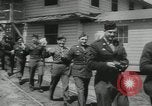
Demobilized Army soldiers at an academy and National Guard soldiers march on a field in the U.S., post WW2
Demobilization at the end of World War Two. Servicemen being mustered out at a separation center and returning home to resume normal civilian lives following discharge. Servicemen going home on a train. Some servicemen decide to remain in the armed services. They interact with fellow soldiers. Peacetime soldiers playing baseball, during leisure time, while others watch them and drink cokes. U.S. National Guard men march on a field. Some soldiers join Army Reserve units where they keep up their ratings and skills. A reserve gun crew loads shells and fires artillery. Officer looks through binoculars.
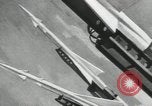
U.S. Army National Guard serves the country during peace and war.
Film opens showing a poster of a National Guardsman with Nike missiles in the background. Sketches of National Guard (the Militia) maintaining order during civic disturbances in history. Sketches of Guardsmen in various uniforms over the ages. An early National Guard encampment. Mounted National Guard cavalry moving in formation during World War 1; Guard soldiers climbing a hill under fire on a Pacific island in World War 2; Guard troops marching in review during the Korean War; Guardsmen directing traffic during an emergency; Views of a disaster site. A National guardsman giving water to disaster victims. A contingent of National Guard demonstrating the manual of arms using their rifles. National Guard members training under supervision of the U.S. Army. They move across a field, cross a pontoon bridge. National Guard training in M4A3E8 Sherman medium Tanks. Guardsmen in Hawaii and in Alaska. National Guard maintaining a Nike Hercules missile.
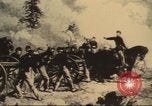
Union soldiers print the first issue of Stars and Stripes newspaper during the Civil War in the United States.
The history of the Stars and Stripes newspaper. Union soldiers print the first issue of Star and Stripes newspaper in a captured press in the U.S. on 9th November,1861 during the Civil War. World War I scenes show soldiers disembarking from a ship and advancing on a battlefield. Commanding Chief of the American Expeditionary Force John J. Pershing writes for the newspaper. Soldiers greet the Chief and wish him luck. After the end of World War I newspaper publication is ceased. During World War II the newspaper publication starts in London, England in 1942. Publication of the Pacific Stars and Stripes newspaper after the end of hostilities in Europe. Headlines in various editions of the Stars and Stripes.
Republican nominee Richard Nixon speaks about his family and past life prior to U.S. Presidential Elections of 1968.
Self-portrait of Republican nominee Richard Nixon aired during his 1968 presidential run against Hubert Humphrey and George Wallace in the United States. A photograph of Richard Nixon with his wife Pat Nixon. Richard Nixon's childhood photographs and family portraits. Richard Nixon tells his own story. Nixon says that his mother's side of the family were Quakers and father's side of the family were Methodists. He speaks about his grandmother. Photographs of his grandmother. Exteriors of the house of Nixon's grandmother.
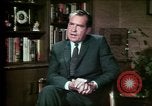
Republican nominee Richard Nixon recounts his past and speaks about his father prior to U.S. Presidential Election of 1968.
Self-portrait of Republican nominee Richard Nixon aired during his 1968 presidential run against Hubert Humphrey and George Wallace in the United States. Richard Nixon recounts his past and speaks about his father Francis A. Nixon. Nixon says that his father was a very determined person who wanted him to accomplish what he could not accomplish in his life. He speaks about achievements of his uncle who is the younger brother of his father. An old photograph showing the Nixon Family in Ohio. He says that his father started working on a farm at the age of nine. Nixon states that he was born in a house his father had built. A picture of Richard Nixon's father standing in front of the house where Richard Nixon was born.
CRITICALPAST.COM: About Us | Contact Us | FAQs - How to Order | License Agreement | My Account | My Lightboxes | Shopping Cart | Advanced Search | Featured Collections | Website Terms & Conditions | Privacy Policy ©2026 CriticalPast LLC.
License Agreement |
Terms & Conditions |
Privacy Policy
©2026 CriticalPast LLC.