


 Francais
 Deutsch
 Italiano
Refine Your Search
V2 stock footage and images
- Showing 6295 to 6300 of 9941 results more
more Hide
Hide
Battle of Los Negros in Admiralty Islands during World War II
On orders from General MacArthur, the 2nd Squadron (dismounted), 5th U.S. Cavalry Regiment, 1st Cavalry Division of the United States Army on a Reconnaissance in Force mission at Los Negros,Admiralty Islands. Prior to their landing, two Spitfire aircraft of No. 73 Wing, Royal Australian Air Force (RAAF) are seen attacking Japanese positions in the jungles near the beach. U.S. Navy warships bombard the area and U.S. B-25 bombers from the 345th Bomb Group , 5th Air Force, drop bombs along the beach. After landing, the Reconnaissance Squadron, reinforced with other U.S. 1st Cavalry Division troops, advances into dense jungles. Troops spray the area with machine gun fire. A Squad seen firing a mortar. U.S. troops firing a field gun with "Bataan" written in chalk, on the barrel. B-25 bombers fly very low over edge of Momote airfield and drop bombs. 1st Cavalry troops battle their way against hidden Japanese forces and capture the Momote airfield. General MacArthur comes ashore and congratulates the troops. A wounded soldier carried on a stretcher. U.S. medics tend to wounded soldiers. Wounded are given plasma. Dead Japanese soldiers on ground.
Research work helps in the identification of genetic disorders causing mental disability in United States.
'Light for Debra' depicts research work on mental disability in the United States. Several mentally disabled children in a row. A mentally disabled girl, Debra, in the forefront. A woman writes on a clipboard. A mentally disabled boy and Debra arrange cutlery on a table. A man times her. Debra sits on a chair in front of a computer. The computer screen shows digits 1 and 2. A woman at a table with a mentally disabled girl on one side and Debra on the opposite side. The woman shows some cards and lays them in front of the girl. Some cards in front of Debra. The woman notes on a paper. A researcher at a laboratory. The needle of a machine marks on a paper. A counselor counsels a couple.
Italian and German forces engage British in North African campaign during World war II
Film opens showing Italian soldiers in North Africa using a sound detection device to locate incoming aircraft during World War 2. They detect a British bomber and ready their anti aircraft gun (90mm Cannone da 90/53). Shells being loaded in the tun and closeup of the principal gunner. British aircraft maneuvering in sky overhead. Two anti aircraft guns firing. Closeup of one viewed from breech as it fires. Batteries of the anti aircraft guns firing. Closeup of Italian gunner reacting as a British plane is hit and falls trailing smoke. It crashes and explodes in the desert some distance away. Closeup of burning aircraft wreckage. Some German Messerschmitt bf 109 fighters taking off from a desert field. Airborne view of Messerschmitt Me bf 110 in flight (view from wingman's aircraft). Closeup of back seat machine gun barrel. View from aircraft strafing ground target on desert below. View from rear seat of the Me 110, where occupant is sending Morse code radio message. View of German field radio station (sign reads: "Funkbetriebs Stelle!") German army radio operators with headphones working at the station and using a blanket for cover from strong wind. Wind blowing and sand drifting. German soldiers seeking protection from sand storm. Wind undoes tiedown of a tent which soldiers hasten to refasten. Two soldiers raise canvas that covered them during storm and stand upright.
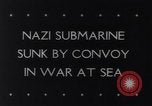
Allied Forces drop depth charges on a German submarine and force her to surface in the North Atlantic during the World War II.
Allied convoy underway through heavy seas in the North Atlantic during World War 2. American flag in stiff breeze on U.S. Navy ship. Later, with seas calmer, the convoy speeds up. A seaman outlook spots a German submarine and depth charges are launched and explode in the water. Soon, the damaged German submarine surfaces and her crew abandons her as she sinks.
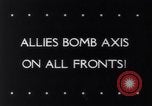
Film about Allied bombing campaigns against the Axis powers and Japan all over the world during World War II.
Opening scene shows British Avro Manchester bombers lined up on a field in England during World War 2. British air crew board a bomber that taxis out for takeoff. View from inside the aircraft as it lifts off on takeoff and then towards its tail on climb out. Gunner seen manning machine guns as his turret rotates during flight. Formation of Manchester bombers en route to Axis military targets in German occupied France. View from bombardiers position of ground below. The bombardier seen and bombs dropping, as viewed from another bomber in the formation. View from a bomber of railroad yard and an airport with bombs exploding on the ground. Manchester bombers on return flight home over the English Channel. They pass below formation of U.S. B-17 flying Fortresses heading toward France. Close aerial view, from below, of the formation of B-17s overhead. Scene shifts to North Africa, where American Captain Eddie Rickenbacker, famous aviator of World War I, talks pilots of Major General Jimmie Doolittle's Bomber Command. Closeup of General Doolittle smiling outside a tent. A B-17 takes off. An Army cameraman seen inside at a window of the B-17. He is to record an attack on the Sicilian port of Marsala. View from a bomber of bombs exploding along the Port's coast, and of bombs passing the camera as they fall to earth. View from below of a B-17 with battle damage to its left elevator. View from a returning B-17 as it lands at its base in North Africa. Airmen walk around a B-17 that crash landed. One airman walks under part of a bomber tail destroyed by Axis gunfire. Scene shifts to the South Pacific and Allied air attacks against Japanese targets. A formation of B-24 Liberator bombers headed toward the Japanese held island of Nauru. Views of bombs striking the island. Scene shifts again, this time to Attu in the Aleutian Islands. A U.S. Navy PBY Catalina flying boat seen in flight. A task force of U.S. Navy warships in Aleutian waters. American amphibious landing on Attu. Arms and supplies piled up on a beachhead. American forces firing artillery. Infantry search for Japanese soldiers in hiding. Bodies of dead Japanese soldiers. American wounded carried on litters. A formation of B-24 bombers headed toward the Aleutian island of Kiska. Closeups of crew members in a B-24. View of glaciers and volcanic mountains below. A bombardier releasing bombs on a Japanese submarine base and airdrome. view of bombs falling. Formation of B-24s releasing their bombs. A gunner in a B-24 firing at attacking Japanese planes and then firing in a low level strafing attack. A U.S. fighter plane lands back at its base on a water-covered runway, raising waves of water that cover cover it.
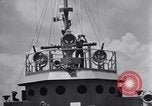
Allied Invasion of North Africa during World War II
Allied warships move towards North Africa during World War 2. A U.S. Navy sailor on a destroyer monitors sonar indicating presence of a submarine. A sailor looks through a pair of binoculars and another U.S. Navy sailor nearby has a pair of headphones. Loudspeaker signals call to general quarters. Sailors rush up the stairs. Numerous depth charges are launched and explode in the water. Next, a wide oil slick on the surface indicates the submarine has been struck by the depth charges. An officer looks through a pair of binoculars. A man speaks into a radio. Soldiers amuse themselves on a troop ship. One plays the piano and others playing play cards, read novel while eating an apple. Flags of Major General Patton and Rear Admiral H. Kent Hewitt aboard the USS Augusta (CA-31) off the coast of North Africa. Semaphore flags and signal lights communicate between ships. Soldier with 'map of West Africa' in his back pocket. Two soldiers read a language guide. An animated map detailing Plan Acrobat to invade North Africa. Map includes Casablanca, Algiers, Tripoli, and Libya. Soldiers exercise, peel potatoes and relax on a troop ship. Clothes hung on a line. British soldiers write letters home. A soldier pastes news on a bulletin board. The bulletin announces that the 'German Afrika Corps' are in full retreat. Night time aerial views of bombing of cities in Italy. Narrator states the bombing included Naples, Genoa, and Turin. Explosions and smoke on the ground below from the bombing. Aerial view of daylight bombing at lower altitude of a Renault tank factory. Submarine on surface at twilight. Eighth Army plane. General Eisenhower, General Mark Clark and French General Giraud. Night scene. Soldiers on the deck. German WWII headquarters at night with guards in Rome and at the The Reich Chancellery in Berlin. Hitler at Berghof . German switchboard, terminal, and radio communications. Messages passed between Allied ships via signal light and ship-to-ship cargo transfer. ( Note The Operation Acrobat discussed in this film is misleading. That plan was scrapped, and the Allied North African campaign was conducted as part of Operation Torch.)
CRITICALPAST.COM: About Us | Contact Us | FAQs - How to Order | License Agreement | My Account | My Lightboxes | Shopping Cart | Advanced Search | Featured Collections | Website Terms & Conditions | Privacy Policy ©2026 CriticalPast LLC.
License Agreement |
Terms & Conditions |
Privacy Policy
©2026 CriticalPast LLC.