


 Francais
 Deutsch
 Italiano

Refine Your Search
V2 stock footage and images
- Showing 6547 to 6552 of 9941 results more
 Hide
The U.S. Air Force tests rocket-assisted takeoff on a C-47 transport aircraft
A United States Air Force C-47 aircraft (tail number 43-48765) is seen parked on a grass airfield, with its rear door open and entry ladder down. Camera zooms in on so-called jet-assisted takeoff (JATO) cylinders fastened underneath the aircraft. Closeup of the aircraft landing gear and tires. Closer view of the JATO cylinders, that appear to be twin 12AS-250 Junior JATO cylinders made by Aerojet Corporation.. Two Air Force officers approach and board the aircraft, which is being guarded by an armed Staff Sergeant. Camera pans across to the aircraft as the crew starts number 2 engine, as a fire guard with extinguisher stands by. A collection of military and other persons stands by vehicles in the background. The fire guard walks to number 1 engine which the crew starts. With both engines running smoothly, the pilot waves to the fire guard from his open cockpit window. Next, the aircraft is seen taxiing on the otherwise empty airfield. It turns near a large tree and commences a takeoff roll. The Jato bottles fire and the aircraft is launched into the air after a very short ground run, with smoke spurting from the JATO rocket cylinders. Another view of the Jato takeoff is seen as well.

Airmen and officials at the International Memorial for the twenty fifth anniversary of first powered flight in Dayton, Ohio.
Airmen and officials at the International Memorial for the twenty fifth anniversary of first powered flight in Dayton, Ohio. Group of dignitaries and airmen walk past the line of parked Curtis P-1 Hawk and Douglas M-2 aircraft. Two men sit in the original model of original Wright Flyer. Assistant Secretary McCracken places wreath on memorial of Wilbur Wright. Orville Wright and other people attending the ceremony pose for a photograph at Wright Field.

Adolf Hitler and Hermann Goering plan their Europe conquest and German bombers raid London, during World War II.
Adolf Hitler and Hermann Goering with a map discuss their mission of Europe conquest, at Hitler's house in Berchtesgarten, Germany. German planes take off in numbers and bomb England during World War 2 Battle of Britain. British plane spotters in office. Danger alarm rings and anti aircraft guns in alert position. Civilians sleep on subways of London. German pilots in planes bomb British cities. Destruction in London by blitz bombing during Battle of Britain. Firemen fight fires in buildings. Fire fighters direct water hoses on blazing fires. High mast lights and anti aircraft guns on alert for German Luftwaffe bombers. Civilians, women and children crowded together sleeping in underground Leicester Square tube station serving as air raid shelter during blitzkrieg.
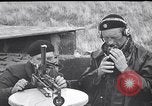
British Royal Air Force warplanes engage German Luftwaffe bombers in dogfights over England, during World War II.
German Luftwaffe aircraft on bombing runs over England during Battle of Britain blitzkrieg in World War 2. British plane spotters in office. Royal Air Force plotting room with officers planning to combat German bombers during blitz. Aerial view of German Heinkel He-111 bombers in flight. Royal Air Force Spitfire warplanes in formation. The Spitfires engage in dogfights with German planes over England. R.A.F. Hurricane aircraft pursues a German bomber. Pilot hand seen pressing button to fire guns. Gun camera footage from British RAF aircraft shows the German Luftwaffe bomber aircraft as it is hit and crashes into the English Channel. Multiple aerial battle and dogfight scenes between British and German aircraft are seen. Guns on RAF planes fire. Anti aircraft gunners and plane spotters on a post in England. A civilian spotter writes swastika symbols on chalk on a wall, representing German aircraft downed. Scenes inside a control room where spotters are relaying German enemy aircraft sightings to controllers deploying British defenses. Smoking ruins of buildings in London during the Blitz in the Battle of Britain. Prime Minister Winston Churchill seen touring the streets with citizens and being cheered by citizens. Narration on clip is in Japanese.

Various European nations occupied by German Nazis and their conquest for Russia during World War II.
Battles fought by Russians fighting military raids from other nations. Animated map shows Nazi forces' conquest in various nations of Europe. Newspaper printing press operating with rollers spinning quickly. Adolf Hitler and other Nazi Generals in discussion with a map. Hungarian, Romanian and Bulgarian troops parade prior to Nazi occupation. Admiral Miklos von Horthy of Hungary, General Ion Antonescu, King Michael of Romania and King Boris of Bulgaria. Nazi military marches through Hungarian cities. Benito Mussolini walks in Italy. Yugoslavian cities bombed by Nazi planes during invasion of Yugoslavia. German Stuka aircraft dive bomb their targets. Map shows Hitler's conquest on various European nations. Greek soldiers march. Soviet Russian munition factories and war production plants in operation producing cannons, tanks, armament, shells and ammunition. Russian troops march. Warships on alert in sea. Soviet men in civilian clothing gathering together to drill and march as they enter military service as new recruits during military mobilization. Soviet soldiers in training during World War 2.
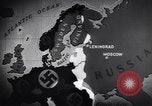
German Operation Barbarossa on the Eastern front in World War II
Animated map shows extent of German controlled areas in Europe following their conquest of the Balkans in World War 2. Norway is under their control and German forces threaten Leningrad and Moscow. A soviet defense line is shown on the map. The German attack is shown to come from 5 directions on June 22, 1941, with the launch of German Operation Barbarossa. A sky filled with German Heinkel He 111 bombers is shown. German Panzer III tanks with 75 mm guns. Army trucks carry German troops into battle. German soldiers on motor cycles and infantry advance under fire. Animated map shows principal German targets as Leningrad, Moscow, and Kiev. It then shows beginning a drive from the North to encircle Leningrad. Arrows show where German Marshal Fedor von Bock's forces drove 480 miles into Soviet territory. Slates identify cities being overrun by German invaders, including: Pskov, Novgorod, Brest-litovsk, Minsk,Mogilev, and Vitebsk. On July 17, 1941, a German tank is seen entering Smolensk, past the Dnieper River threatening Moscow, itself. To the south, German forces, under Marshal Gerd von Rundstedt, cut deep into the Ukraine. Newspapers world-wide consider the Soviet forces close to defeat. Slate shows communique from the German High Command stating: "The issue in the East is already settled. Smolensk is the last halt on the road to Moscow." German infantry marching. Scene shifts to heavy artillery being fired by Soviet forces in a snowy scene clearly later in the year. Animated map shows German forces very close to Moscow on October 15, 1941, forcing the Soviet Government and all foreign missions to move to Kuibyshev, 700 miles to the east. Adolf Hitler, in a speech on October 3, 1941, states that the enemy is broken and will never rise again. Animated map shows 500 thousand square miles of Soviet territory occupied by German forces. Views of fires burning in Russia. Damaged and abandoned Soviet industrial plants. A German guard atop a hill looks down on thousands of Soviet people in the occupied areas of Russia. Damaged and abandoned Soviet T-26 tanks. Glimpse of damaged Soviet aircraft and field artillery. Headline in New York World Telegram newspaper reads: "Berlin Admits Russ War May Last Winter." Another headline reads: "Red Army Holds Push On Moscow." Weary German soldiers traveling in horse-drawn wagons, pulling field artillery. Soviet and German war planners are seen at work. Slate quotes Adolf Hitler saying: "A single blow must destroy the enemy, without regard for losses... A gigantic all-destroying blow." German armor moving along a road. Animated map shows this technique in the German invasions of Poland, France, the Balkans, and Yugoslavia. In contrast, the Soviet planners are seen, as map illustrates how they intend to take advantage of the vast area of their land by holding lines of defense an falling back as necessary to keep engaging the invaders across interior of the Soviet Union. Soviet infantry are seen marching along a road. German troops riding atop their tanks. Soviet troops forcing German invaders into close combat in her cities. Soviet soldiers running in a city and firing heavy machine guns. Bomb damage and rubble inhibit German armor mobility in cities. Cities where this kind of Soviet resistance prevailed were: Rostov, Kharkov, Kiev, Kursk, Smolensk. German troops leaving a city with heavy black smoke rising in the background. More views of cities where Soviet troops are engaged German forces in House-to-house battles, including: Odessa, where the Old Opera Theater building is shown sandbagged and relatively undamaged. The Odessa NI tank, created from an STZ-3 agricultural tractor.
CRITICALPAST.COM: About Us | Contact Us | FAQs - How to Order | License Agreement | My Account | My Lightboxes | Shopping Cart | Advanced Search | Featured Collections | Website Terms & Conditions | Privacy Policy ©2026 CriticalPast LLC.
License Agreement |
Terms & Conditions |
Privacy Policy
©2026 CriticalPast LLC.