


 Francais
 Deutsch
 Italiano

Refine Your Search
V2 stock footage and images
- Showing 6619 to 6624 of 9941 results more
 Hide

Allied forces commence operations crossing the Ruhr River in Germany during World War II
On February 23, 1945, Allies commence operations to cross the Ruhr River in Germany, during World War 2. U.S. artillery soldiers fire 155mm guns from West bank of Ruhr River, against German lines on the East bank. Troops of Allied 1st and 9th Armies await signal to follow advance platoons that crossed the Ruhr earlier. Compelling close-up views of serious expressions on faces of U.S. Army soldiers as they prepare to move forward. M4 Sherman tanks fire guns at the river edge. Through misty conditions, troops of 104th Infantry Division, 415th Regiment, carry assault craft and begin crossing the river and attacking the industrial area of North Duren. U.S. soldiers are seen running across fields near large factory buildings and firing from them. Troops walk along street in Duren, after its capture. U.S. troops seen entrenched. A medic adjusts his personal flotation belt. Two U.S. Army soldiers smoking cigarettes while standing in a ditch with flotation devices around their waists as they wait the moment for the river crossing. They leave their positions and move along a road to cross the river at Linnich. All soldiers are wearing personal flotation belts as they paddle small assault boats across the swift moving river under enemy fire. One assault boat is overturned. Drenched soldiers make it to land and continue their advance. Army engineers construct a floating footbridge, under enemy fire. A soldier runs across the bridge as an American light airplane flies low overhead, surveying the operation. U.S. troops move through destroyed towns and villages. Large column of captured German prisoners of war is marched toward the rear, with arms held above their heads, passing by giant piles of debris and wreckage from bombing of the town.
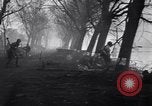
U.S. 29th Infantry Division crosses Ruhr River and captures Jülich, Germany during World War II
Troops of the U.S. 29th Infantry Division cross a floating footbridge erected by U.S. Army engineers across the Ruhr river at Linnich, Germany, during World War 2. Their mission is to capture the fortress town of Jülich. They hurry across the bridge under enemy fire. Major General Charles Gerhardt, Commander of the 29th Infantry, crosses the footbridge along with his troops. Troops enter the city, which has been destroyed by prior Allied bombing, and flush out remaining German snipers from basements of ruined buildings. Soldier seen firing into a basement. Remains of footbridge across the Ruhr river, destroyed by Germans during the night. Combat engineers work building a new heavy pontoon bridge across the river. A German soldier (narrator states: in an American uniform) carrying a white flag, walks towards U.S. soldiers on the opposite bank of the river, and is shot by one of them. U.S. troops cross the new heavier bridge across the river. A U.S. tank that had crossed the river, is seen. A banner is seen, fastened above a stone arch, reading: "This is Julich Germany. Sorry it is so messed up. But we were in a hurry! 29th (Blue & Grey) Div." The Division insignia appears on the banner.
The Battle of Iwo Jima in World War II
Scenes filmed by Navy and Marine combat photographers, of the Battle for Iwo Jima, in February and March, 1944, during World War 2. View from a boat offshore, of Mount Suribachi, on the Island of Iwo Jima. Warships of the U.S. 5th Fleet attack with naval gunfire, as landing craft manuever near shore. U.S. Marines aboard Landing Vehicles Tracked (LVTs) head for the beach, with the heavy cruiser, USS Baltimore (CA-68) in the background. U.S. Carrier-based Grumman TBF Avenger aircraft drops bombs on Mount Suribachi. Landing craft arriving at a fairly level area of beach. U.S. marines moving cautiously on the beachhead. The USS Baltimore and a Fletcher class destroyer offshore in background. Marines hunkered down with smoke rising near them, and then moving forward again, through the black sands. Closeup of a marine with flame thrower. Several U.S. Chance Vought F4U Corsair aircraft fly overhead, dropping bombs on the mountain. Marines continue to move forward, under constant fire from Japanese small arms. A heavy landing craft Infantry, LCI(H) moves toward shore in background. A DUKW ("Duck") coming ashore. Marines using a crane to offload a 105mm howitzer from a landing craft. As they raise the gun, the landing craft moves away and marines Hook the howitzer to a DUKW to help move it. Next, marines are seen setting up two 105s on the beachhead and firing them. Marines with more artillery pieces stacked on the beachhead. A gunboat, LCI (G), firing from close to the shore behind them. Marines digging in sand that the narrator calls the floor of an active volcano. Smoking sulphur gases are seen rising behind them. The USS Baltimore firing her guns from close to shore. Machine gun tracer rounds crossing the beachhead, as Naval gunfire resumes from offshore. Marines crawling and then occasionally sprinting forward across the sand dunes. (One carries a stretcher.) Four marines carrying one wounded back to the beachhead, on a stretcher. Two marines carry another between them. Marines scrambling over brush and rough ground. View from hillside of marines climbing up from below, as shell bursts only a few yards away. Scene shifts to later in the battle for Iwo Jima. A catapillar tractor is parked near bodies of Japanese soldiers strewn across the landscape. (Narrator notes that more than 14 thousand such dead had been counted by March 6, 1944.) Finally, the iconic moving images of U.S. marines raising the American flag over Mount Suribachi.
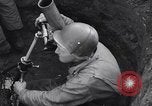
United States 81 mm mortar crews fire shells at enemy targets in Germany during World War II
American soldiers in fortified position firing 81mm mortar in support of U.S. infantry in Germany during final months of World War 2, in Europe. Early in February,1945, U.S. soldiers of Company M, 3rd Battalion, 313th Regiment, 79th Division, are seen supplementing their ammunition with captured German 80mm mortar shells. Closeup of the U.S. 81mm mortar shell next to a German 80mm shell. M Company soldiers firing the German shells from their 81mm mortars at German targets across the Mulde River. They are operating amongst homes in a residential area. Explosions in distance from the mortar shells.
American 10th Air Force aircraft being repaired at Hindustan Aircraft Limited facilities in Bangalore, India during World War II
A film titled 'Modern plant services and Allied aircrafts' shows workers streaming out of facilities of Hindustan Aircraft Limited, in Bangladore, India, during a shift change, during World War 2. View inside one of the factory buildings, where U.S. Army Air Forces C-47 transport aircraft of the 10th Air Force are seen lined up for maintenance. Heating fires burning in containers outside one plant entrance. Inside, workers move heavy machinery. A worker in a laboratory. Outside, several U.S. Lockheed B-25 Mitchell bombers are seen in various states of repair, with Hindustan Aircraft workers working on and around them. A C-47 aircraft is seen nose into a hangar. Its empennage is mostly removed. However its tail number (41-7759) is visible on the still intact vertical stabilizer. Workers are seen on scaffolding set up around a Consolidated PBY Catalina amphibian aircraft. The final scene shows several B-24 Liberator bombers in various stages of repair, parked on an outdoor ramp.
First Allied convoy reaches Kunming, China, over the Ledo Road, during World War II
U.S. military trucks, part of a convoy of 113 vehicles, led by Brigadier General Lewis Andrew Pick, are seen traversing the Ledo Road (aka the Stilwell Road) approaching their final destination of Kunming, China, on February 4, 1945, during World War 2. (They departed Ledo, India, on January 12, 1945, traveling a distance of 1,079 miles.) (Narrator gives distance as 1,044 miles.) View from an overflying airplane shows the long column of trucks on the road below. View from the ground, of the convoy reaching the city gates, where it halts as General Pick and his staff proceed through the gates to a speaker's platform set up in a covered pavilion displaying American and Chinese flags, and pictures of U.S. President Franklin D. Roosevelt and Chinese Generalissimo Chiang Kai-shek. General Pick and staff are introduced by Chinese General J.L. Wong who, speaking in English, celebrates this first convoy over the Ledo Road, and points to a banner containing four Chinese characters that spell out "The Road to Victory." General Pick takes the podium, shakes hands with General Wong, and accepts the banner from him. Camera shows the area completely filled with Chinese troops, witnessing the ceremony, including many sitting atop a nearby roof. General Pick speaks briefly, accepting the banner on behalf of the convoy members. He then leaves accompanied by the Governor of Yunnan Province, China. Officers cut a ceremonial ribbon across the road at the West Gate of the city, and the convoy is led into the city by two Chinese soldiers on motorcycles. Chinese spectators line the way and celebrate with firecrackers and cheers, as General Pick passes, standing in a jeep, displaying the Amercan flag and with the Chinese "Road to Victory" banner in its back seat. views of the convoy trucks proceeding through the city. Closeup of one, with a painting of the road, and snow capped mountains, and "First Convoy over the Ledo Road" and "Pick's Pike Life Line from India to China" painted on its canvas cover. A sign over one of the shops along the road reads in Chinese and English, "Welcome First Stilwell Highway Convoy." Views of troops waving from the trucks and Chinese citizen spectators crowding the sides of the road to watch.
CRITICALPAST.COM: About Us | Contact Us | FAQs - How to Order | License Agreement | My Account | My Lightboxes | Shopping Cart | Advanced Search | Featured Collections | Website Terms & Conditions | Privacy Policy ©2026 CriticalPast LLC.
License Agreement |
Terms & Conditions |
Privacy Policy
©2026 CriticalPast LLC.