


 Francais
 Deutsch
 Italiano
Refine Your Search
V2 stock footage and images
- Showing 6715 to 6720 of 9941 results more
more Hide
Hide
General J Lawton Collins and General Barton at Red Beach.
General Barton of the 1st Engineers 2nd Brigadier, and General J. Lawton Collins 7th Corps with other General talking on beach. General Collins leaves in a vehicle. The other officers leave in another vehicle. Sign board of 'Red Beach Hq.' can be seen.
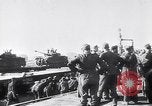
German tanks and supplies moved forward to attack Russians in Russia.
German Panther tanks of 5.Pz.Div, Pz.IV's and supplies are moved forward in Russia on railway flatcars. Troop trains move on the front. Soldiers in discussion and one smokes a cigarette. Trenches are dug and command post with radio operation is set up. German soldier climbs up tower. Mortars, artillery, and machine guns are fired at Soviet troop positions. Grenades are hurled and German Tiger tanks counterattack under protection of artillery fire. Tigers seen are from s.Pz.Abt.503 and SS.Pz.Rgt 2 (Das Reich) in 1943 and s.Pz.Abt.502 with ace Otto Carius in 1944. (World War II period).
German Panzer Units advance in fight with Allied Forces during World War II.
Views of battle between German Panzer Units and Allied Forces south of Caen, France, during World War 2. SS troop soldier looks through binocular from trenches. Explosions raise huge clouds of smoke. Close up view of SS tank ace Michael Wittmann and loader on a German Tiger tank of s.SS.Pz.Abt.101. (Wittmann wears Knights Cross and Swords military decoration.) German SS grenadiers in position. German tanks firing. Multiple views of wrecked British tanks, including one on its side. An abandoned British soldier helmet and gas mask on the ground. German artillery is fired. German soldier prone firing MG 34 machine gun equipped with TM 34 75-round double-drum magazine. German soldiers fighting in streets of town. Heavily bombed buildings of a French town south of Caen. German soldiers moving building to building. German soldiers firing flamethrower.
German infantry use antiaircraft weapon to attack Allied ground armor.
German infantry battle against Allied forces in Normandy region in World War 2. German soldiers fire machine guns. German troops take high ground above a wide valley with forest in distance. Nazi German infantry forces supported by tanks and artillery battle for wooded area. German soldiers run over open ground toward Allied targets. In an unusual move, German soldiers employ a 20 mm Flakvierling 38 antiaircraft gun against Allied armor emerging from the woods. Explosions and smoke during battle. German tanks advance.

Athletic Games at Madison Square Garden in New York.
New York Athletic Club Games at Madison Square Garden. Women running on track and Yetta Heiner of Germany wins the women's 60 yard sprint. Men compete in pole vaulting. French competitor falls short as his pole breaks in half. Rolando Cruz of Villanova tops 16 feet in Pole Vault. Crowd watching and cheering. Gerry Ashworth wins the men's 60 yard dash. Jim Beatty sets a new Indoor record for the mile in 3:58:6. View of Tom O' Hara who also finished under four minutes. In the high Jump, Valeriy Brumel of the Soviet Union sets a new Indoor mark at 7 feet 2 inches.
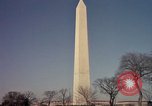
American flags flying at half-mast at base of Washington Monument and Iwo Jima Statue.
American flags flying at half-mast at base of Washington Monument (2 15th St NW, Washington, DC 20024, USA). United States flags flying at half-mast from the US Marine Corps War Memorial and various government buildings.
CRITICALPAST.COM: About Us | Contact Us | FAQs - How to Order | License Agreement | My Account | My Lightboxes | Shopping Cart | Advanced Search | Featured Collections | Website Terms & Conditions | Privacy Policy ©2026 CriticalPast LLC.
License Agreement |
Terms & Conditions |
Privacy Policy
©2026 CriticalPast LLC.