


 Francais
 Deutsch
 Italiano
Refine Your Search
V2 stock footage and images
- Showing 7231 to 7236 of 9941 results more
more Hide
Hide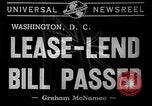
U.S. Senate passes H.R. 1776, Lend Lease Bill. Senate Majority Leader Alben W. Barkley telephones the news to the President.
View of Senate chamber in Washington DC, United States. Senate Majority Leader, Alben W. Barkley, hurries to private phone booth to telephone the news to President Roosevelt. A Senator emerges from the chamber waving newly signed documents passing H.R. 1776 to aid the United States war industry in World War II. Majority Leader, Barkley converses with other Senators. Senator Walter F. George, of Georgia speaking in praise of Lend-Lease, says "We are now ready to forge ahead and to cast the full strength of American industrial power into the struggle against aggression." Non-interventionist Senator Burton K. Wheeler, of Montana, who objects to the Roosevelt administration's lend lease bill, and to direct American involvement in World War 2 in Europe, speaks about continuing the fight to "keep American boys out of the holocaust of Europe's wars."
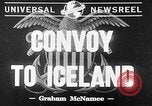
A convoy of United States troops and supplies to Iceland prior to U.S. entry into World War II.
United States Naval convoy underway at a sea en route to Iceland, prior to U.S. entry into World War 2. Heavy seas flooding deck of troop transport ship. Soldiers on the deck of a ship. U.S. destroyer escorts are seen, including a 4-stacker. A U.S. flag flutters from ship's bridge. Supplies are unloaded and placed in military vehicles. Cartons of caned food and other provisions being piled up on the docks. American soldiers climb rope ladder from small boats to the dock. Sailors toss some of the supplies from small boats to others on the dock. Commander of Allied forces in Iceland, British Major General Henry Osborne Curtis, escorts U.S. Major General, Charles H. Bonsteel, in review of a unit of British soldiers. Buildings along the sides of a street in the Icelandic Capital City, Reykjavík. Civilians walk on the streets. U.S. sailors walking on sidewalks of the city. A British Hawker Hurricane aircraft landing on airstrip. A machine gun emplacement at side of the runway. Military quarters surrounded by mud. A soldier walks from row of Quonset Huts. An air alert sounds. British troops respond in armored cars equipped with mounted antiaircraft guns. Soldiers taking up positions in trenches and manning a large antiaircraft gun. A soldier aircraft spotter wearing headset and talking on radio. Beside him are charts of aircraft identification silhouettes. A formation of aircraft overhead. Waterfront scene with boats in water. A camouflaged machine gun emplacement. A sentry on duty.
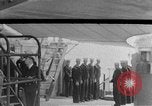
British Prime Minister Winston Churchill and top ranking British officials board USS Augusta to meet U.S. President Roosevelt
U.S. President Franklin Roosevelt and British Prime Minister Winston Churchill meet for the Atlantic Conference in World War 2 aboard USS Augusta in Placentia Bay, Argentia, Newfoundland. U.S. General George C. Marshall, Vice Admiral Ernest J. King, and Admiral Harold R. Stark, descend steps to main deck of U.S. Heavy Cruiser, USS Augusta, where they greet top ranking members of the British military establishment as they arrive for the Atlantic Conference. U.S. General Marshall is seen greeting British Field Marshall Sir John Dill. President Roosevelt is assisted by his son, Franklin, Jr. who helps him obtain a handhold on a fixture of the ship. (This is a rare shot of President Roosevelt where he is seen walking a few steps with his cane, assisted, as his disability was typically not captured on film to be shown to the public.) President Roosevelt greets British Admiral Sir Dudley Pound, Admiral of the Fleet, First Sea Lord and Chief of the Naval Staff. He also greets British Field Marshal Sir John Dill, Chief of the Imperial General Staff. British Prime Minister Winston Churchill arrives, salutes the President, and walks past. Franklin Roosevelt, Jr. steps forward and guides Churchill back to stand with President Roosevelt, for the camera.
Atlantic Conference. A gangway is set between HMS Prince of Wales and USS Augusta. Roosevelt and Churchill converse.
In preparation for the World War 2 Atlantic Conference, crews of the British Battleship, HMS Prince of Wales and the U.S. Heavy Cruiser, USS Augusta, prepare a gangway connecting the two ships. British Prime Minister Winston S. Churchill is seen pacing the deck of the Prince of Wales, as the crews are at work. A cat is seen on deck. Several individuals pass over the gangplank. Later, President Roosevelt and Prime Minister Churchill are seen seated on deck of the USS Augusta, as members of their respective parties mingle and converse. Sailors from the USS Augusta mingle with British sailors aboard HMS Prince of Wales.
Delegates from 51 nations meet for Convention on International Civil Aviation in Chicago.
Scenes from the first International Civil Aviation Conference (ICAO) in the city of Chicago, Illinois. At the invitation of the United States, delegates from 51 nations arrive to begin drafting and concluding the Convention on International Civil Aviation (Chicago Convention), including discussion on freedom of aircraft traffic in the world's aviation routes. Opening scene shows the Stevens Hotel at 720 S. Michigan Avenue, Chicago, United States, with automobile traffic driving past it on the street. Delegates from 51 nations are seen entering the hotel Grand ballroom, being monitored by U.S. Army Military police, as they enter. View from inside the ballroom as delegates enter. Some are seen standing around a globe of the world, discussing the transfer of military air routes back to civilian operations, in the future after the end of World War 2. View from a balcony of the delegates gathered below. Closeups of delegates from: Belgium; a military aviator in uniform, representing Haiti; delegates from Iraq, India, Australia, and Norway. Assistant Secretary of State, Adolf A. Berle Jr., Head of the U.S. delegation, delivers a brief welcoming speech, on behalf of President Roosevelt, from a podium behind which flags of participating nations are displayed. He speaks of the importance of freedom of air space, noting that closed air space can lead to war. He says that the air which God gave to everyone, should not become the means of domination over anyone.
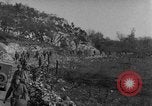
Scenes of the Battle of Monte Cassino, Italy, in World War II
American infantry walking along a rocky mountain road, carrying their individual bedrolls. A local woman holding a small child, watches as they pass. Scenes of devastation near a body of water. Snow-covered mountains are visible in the background. Camera pans across the waterfront, showing debris everywhere. Destroyed structures. Some are simple dwellings. Others are remains of reinforced concrete structures. Two U.S. soldiers explore the top of a half submerged Sherman tank, at water’s edge. Their jeep is parked nearby. Another Sherman tank sits above water level, on a sand bar. Thousands of rounds of spent artillery shells are stacked, casually, in a field and partway up a hill. American soldiers gather informally,at side of a hill as one (likely an Army Chaplain) reads from a bible, as he leans over a fallen soldier, partially covered with a tarpaulin. A soldier looks at the Abbey of Monte Cassino through binoculars. Views of the town from overlooking mountain. Smoke rising from the castle and town as artillery shells strike. (World War II; WW II; World War 2; World War Two)
CRITICALPAST.COM: About Us | Contact Us | FAQs - How to Order | License Agreement | My Account | My Lightboxes | Shopping Cart | Advanced Search | Featured Collections | Website Terms & Conditions | Privacy Policy ©2026 CriticalPast LLC.
License Agreement |
Terms & Conditions |
Privacy Policy
©2026 CriticalPast LLC.