


 Francais
 Deutsch
 Italiano
Refine Your Search
V2 stock footage and images
- Showing 7333 to 7338 of 9941 results more
more Hide
Hide
Views from within Gemini spacecraft practicing docking maneuvers in space.
Views of Earth from NASA Gemini 7 spacecraft, as it moves in formation with the spent 2nd stage of its Titan II launch rocket. Glimpse of astronaut in capsule, as it moves over an ocean on earth. Gemini 6 approaching within 1 foot of Gemini 7, accomplishing the first rendezvous of manned vehicles in space. Narrator states that Astronaut Frank F. Borman, II, On Gemini 7, prepares to photograph Gemini 6. In change of sequence, the unmanned Agena space vehicle, is seen as Gemini 8 docks with it in a practice maneuver. But a failed thruster on Gemini 8 causes too much yaw and roll, so Command Pilot Neil Armstrong undocks. Gemini 8 rolling at an excess rate of 1 revolution per second, which Astronaut Armstrong had to struggle to overcome before completing the mission.
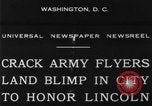
U.S. Army aviators land an airship at the Lincoln Memorial to place a wreath honoring Lincoln's Birthday
A U.S. Army blimp is seen approaching the Lincoln Memorial (2 Lincoln Memorial Cir NW, Washington, DC 20002, United States), at low altitude. The Washington Monument is in the background. The view shifts to inside the open gondola of the blimp, with the reflecting pool below, and the Lincoln Memorial and Potomac River in the background, dead ahead. Pilots at the controls wear helmets, goggles, and parachutes. The airship descends slowly over the reflecting pool, and then rises slightly above the Lincoln Memorial. The scene shifts to view from the ground, as the blimp descends to land on nearby partly snow-covered field. U.S. Army and airship number C-41 are stenciled on the blimp. Sequence shifts to the airship cockpit again, viewing over the pilots' heads, as the blimp nears the ground. Several automobiles are parked at the curb, and a few dozen spectators stand watching the airship from below. The pilot, in right seat, stands up and signals to Army men on the ground, while the pilot in the left seat controls the airship's flight path. As they land, Army ground crewmen take hold of lines from the blimp, and the pilots climb out carrying a large floral wreath. Closeup of the pilots unloading the wreath, with the Lincoln Memorial in the background. Airship model identification TC-6 or TC-8 seen stenciled on the side of the gondola. The airship's engine and propeller are clearly visible in the open gondola. The aviators step to the ground and carry the wreath across the grass, and around to the front steps of the Memorial Building. The reflecting pool and Washington Monument are seen in the background. Pilot of the airship, U.S. Army Captain, William J. Flood, and his copilot (unknown) pose with the wreath, on the top step of the Lincoln Memorial.
Men with life jackets on deck and Brooklyn class Cruiser,Destroyer underway in the North Atlantic Ocean
A convoy of Allied ships underway in the North Atlantic Ocean during World War 2. Transport and U.S. Navy Destroyer underway. Men with life jackets on deck. Transport and destroyer zig zagging. Brooklyn class Cruiser underway. Troops lean on rail of transport underway. Transport and destroyer silhouetted against sun. Cruiser underway.
U.S. Navy guards on deck of Destroyer underway and SOC Seagull lands in the North Atlantic Ocean
A convoy of Ships underway in the North Atlantic Ocean during World War 2. U.S. Navy guards with life jackets pace on deck. A sailor leans on rail. A sailor looks through telescope. A United States biplane SOC Seagull in flight. The SOC Seagull aircraft lands on water and taxis towards Brooklyn class cruiser. A Destroyer under way in the foreground. Sailors and civilians on deck wearing life jackets.
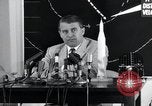
German rocket physicist Wernher Von Braun lectures at press conference about space launch vehicles
German rocket physicist Wernher Von Braun gives recorded and broadcast lecture about Space Launch vehicles. He sits at a table containing models, including one of the Juno II space launch vehicle. Speaking in German, he addresses an audience, discussing capabilities of the Juno 2 vehicle and requirements for achieving escape velocity and other facets of space flight. He refers to the Explorer I satellite in his remarks. After Dr. Braun completes his comments, he stands and leaves, revealing a chart illustrating the ideas of his talk. Also seen is a blackboard listing velocities that have already been achieved by rockets and noting the escape velocity needed to achieve earth orbit. These blackboard notes are all written in English. German scientist, Albert Zeiler, is seen momentarily at a seat in front of the blackboard.
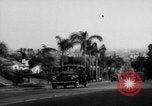
The buildings of Metro Goldwyn Mayer Studio, Paramount Pictures and air raid shelter in Hollywood, California.
Motion picture studios in Hollywood, California during World War 2 period. Cars driven on road in Hollywood with palm trees in median beside street. Street sign on corner reads "Los Feliz Boulevard" (between Glendale Avenue and Western Avenue.) A sign at the entrance of a building reads 'Metro Goldwyn Mayer Studio' (MGM). People walk through the Paramount Pictures entrance gate. People walk on street in front of MGM studio. MGM studio employees bulletin board detailing the MGM company investments in War Bonds and donations to the Red Cross. Banners along the board encourage employee participation, such as "To speed victory. To bring our men home. Our government asks that you buy War Bonds." A sign atop Paramount Pictures building reads 'Buy Bonds at Acct Office'. An air raid shelter building.
CRITICALPAST.COM: About Us | Contact Us | FAQs - How to Order | License Agreement | My Account | My Lightboxes | Shopping Cart | Advanced Search | Featured Collections | Website Terms & Conditions | Privacy Policy ©2026 CriticalPast LLC.
License Agreement |
Terms & Conditions |
Privacy Policy
©2026 CriticalPast LLC.