


 Francais
 Deutsch
 Italiano
Refine Your Search
V2 stock footage and images
- Showing 7411 to 7416 of 9941 results more
more Hide
Hide
World War II Damage to Reich Air Ministry building, Berlin, Germany
Early post-World War 2 views of damage to the German Air Ministry building (Detlev-Rohwedder Haus), Located on Wilhelmstrasse at the intersection with Leipziger Strasse, in Berlin, Germany. Opening scene shows large statue of eagle surmounting an enwreathed swastika. Scene shifts to Wilhelmstrasse, near gate to courtyard at center of the building. Gate is flanked by two eagle statues on pillars. There are pedestrians on the street and some cyclists, but no motor vehicles. Rubble lines the street, and one gaping hole is shown in the side of the building. All the windows have been blown out, and one wing is missing from an eagle statue. Closer view of the courtyard and eagle-flanked gate. Another heavily damaged area of the building showing section of exterior walls collaped revealing structural damage inside. Building entrance with "Heil Hitler" in an embossed relief stone decoration over the door.
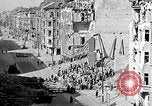
Berliners work together to clean up streets and sidewalks of their city at the end of World War II in Europe
In Berlin, at the end of World War 2, in Europe, a large group of ordinary people gather at a hill of debris where a building once stood. Men and Women use shovels to dig dirt from sidewalk and place it in buckets, that others pass up the hill, in a bucket brigade. Closeup of people filling the buckets at the base of the pile of debris. The bucket brigade consists mostly of women. They transfer the filled buckets up the hill and empty ones down via a separate group of volunteers. The buckets are emptied at the top of the heap. Some women transfer large fragments of concrete to one another. The entire project seems intended to clear more space in the sidewalks and streets. View from a high point reveals skeletons of tall buildings and other groups doing similar work to clear rubble from the city walks and roads.
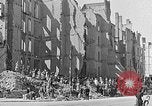
Citizens of Berlin (mostly women) form bucket brigades to clean up streets and sidewalks of their city at the end of World War II in Europe
At the end of World War 2, in Europe, citizens of Berlin (mostly women) cooperate in a bucket brigade to clear rubble from their walks and streets. Lacking any machinery, they use shovels to fill buckets and pass them up the hill of debris at the base of bombed out buildings. A train passes below damaged roadway where camera is located. Camera pans to the cleanup site, where dozens of people are occupied. Closup of a man using a mason's hammer to break concrete slabs so they can be moved by hand. Women inside the walls of a demolished building, where they empty the buckets and throw the concrete slabs.

U.S. Marines launch amphibious assault against Japanese forces at Betio, Tarawa Atoll, in the Pacific during World War II
Scene is dawn viewed from deck of a troop transport ship off the coast of Tarawa, Gilbert Islands, on D-day (November 20, 1943) for the amphibious assault by U.S. marines against the Japanese- held atoll, in World War 2. Marines loaded into a Higgins boat at the side of the transport ship. Several such landing craft maneuvering off the ship's bow. Benson-class destroyer bombarding the coast. Closer view of the destroyer with landing craft nearby. Glimpse of Japanese Aichi D3A (Val) dive bomber above. Two bombs exploding in water near the camera ship. U.S. Navy F4F aircraft flying low bombing and strafing. Glimpse of Navy warships bombarding after Navy planes depart. Then many landing craft are seen, some from the USS Sheridan (APA-51). Mixture of quick views showing naval gunfire, Marines in landing craft (including closeup of two marines looking out from inside one). U.S. Naval aircraft bombing inland, close to the shoreline. A derelict Japanese ship, displaying battle damage is seen in the surf. (Narrator notes that Japanese machine guns were set up and fired at landing craft from this hulk.) Closeup of radio operator on deck of invasion vessel. Views of amphibious landing vehicles tracked (LVT) moving toward shore. All American Higgins boats and LVTs subject to heavy Japanese machine gun and mortar fire, as well as bombing by Japanese Aichi D3A dive bombers. Burning landing craft in the surf. Landing craft arriving at the beach under heavy fire. One is marked, "KA 20-11" indicating it is from the USS Virgo (AKA-20). Long shot of Marines strung out on section of beach. Closeup of marines wading ashore from wrecked LVT. Several marines move along a concrete pier. Many marines are hunkered down behind it. Various views of marines pinned down on the beach. Some sheltered behind an LVT.
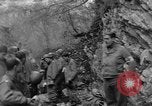
U.S. Army forces assault the German Winter Line of Defense during the Italian campaign of World War II
American troops of the 45th Infantry Division, are seen in mountains after breaking through the first segment of the German Winter Line, near San Pietro Infine, Italy, in World War 2. It is Christmas Day, 1943 and they occupy Mount Lungo. They receive Christmas dinner in their individual mass kits and sit down on the ground to eat it. On December 28th, they employ pack mules and also use stretchers to retrieve remains of fallen 3rd Division defenders down the steep mountain trails of Mount Lungo. They place the carefully wrapped remains at the base of a bullet pock-marked stone structure. Scene shifts to Mount Sammucro where American troops take advantage of a brief lull in fighting. On 1 January, 1944, Second Corp reinforcements have arrived and Americans commence a new assault on the German Winter Line defenses, with an artillery barrage on German positions guarding San Vittore del Lazio. View of smoke rising from that town. Shelling of Mountaintop flanking Highway 6held by Germans. Groups of American troops firing mortars from valley below. Shells exploding on German positions. Closeup of American gun crew loading and firing a 155mm long tom field gun. Soldiers holding their ears when gun fires. Bombs dropped from American warplane aircraft explode near roads in the valley. Glimpse from U.S. warplane flying overhead, of smoke rising from German positions in the Winter Line. Soldiers of the 168th Infantry Regiment firing a recoiless rifle from wooded area. Shells striking at base of mountain. Troops of the U.S. 137 Infantry Regiment advancing on San Vittore. view in the Italian town on 7 January, 1944, when street fighting has ended. American soldiers are seen mingling with the civilian inhabitants. German military equipment destroyed and burning during the American Winter Line offensive. Captured German soldiers being taken into custody, searched, and processed as prisoners of war.

Women stitch an airship bag and inspect the completed bag using a spot light in the United States.
Women make dirigibles in the United States in World War 2. A woman and a man make a part of a bag of a non rigid airship. Women paint on the bag. Two women and a man stitch the bag of the airship. They paint on the bag. The women walk on the completed bag. Two women inspect the bag using a spot light. The gondola of the airship on a trolley. The gondola is attached to the bag. The finished air ship is taken about of a hangar. The air ship in flight and 'US Navy;' written on the airship. A pilot in the gondola.
CRITICALPAST.COM: About Us | Contact Us | FAQs - How to Order | License Agreement | My Account | My Lightboxes | Shopping Cart | Advanced Search | Featured Collections | Website Terms & Conditions | Privacy Policy ©2026 CriticalPast LLC.
License Agreement |
Terms & Conditions |
Privacy Policy
©2026 CriticalPast LLC.