


 Francais
 Deutsch
 Italiano
Refine Your Search
V2 stock footage and images
- Showing 7453 to 7458 of 9941 results more
more Hide
Hide
Israeli delegates go to the United Nations and seek for a separate Jewish state -- formation of Israel.
Formation of Israel in May 1948 and events leading up to it. October 1947: Jewish refugees from Europe aboard two ships arriving in Palestine, only to be turned away by British authorities and sent to internment in Cyprus. They get off from the ship Cyprus. A Jewish woman with her child at the dock. A sign reads 'United Nations Palestine Commission'. Delegates seated in a hall debating about the partition of Palestine between the Jews and the Arabs. Destroyed houses and buildings in Haifa after fighting between Israeli and Arab forces. Jewish troops holding guns walk on the ruins of building. The dead Jewish people on street. The troops stand in a group. Captured Arab prisoners in the Negev desert area, being directed by Israeli Defense Forces soldiers (IDF). The prisoners with their hands up enter a vehicle. Cars and people on a street with a traffic circle in Tel Aviv. Prime Minister of Israel, David Ben Gurion, enters a building on May 14, 1948, to be installed as leader of the new government. The Jewish soldiers stand holding guns. A flag of Israel flutters in the air on a flag pole. United Nations soldiers stand holding a white flag and join Israeli troops in recovering bodies of Israeli soldiers killed in ongoing skirmishes with Arab forces. The troops stand on a border. President of Israel Chaim Weizmann, a Jewish patriot, walks with officials. Soldiers stand on the side. The Israel delegates go to the United Nations and seek for Israel to be admitted to the United Nations. Delegates seated in hall. Middle Eastern Arab country representatives of the UN walk out of the hall in protest after Israeli receives the vote admitting it to the UN. The empty seats of the Arab countries. The new state of Israel is born. Flags are raised at the UN including the flag of Israel. People cheer and celebrate. From a July 2, 1964 newsreel of "Yesterday's Big Story".

New York Yankees win against Milwaukee Braves by 3-1 in the opening game of the 1957 World Series at Yankee Stadium
1957 World Series game 1 baseball between New York Yankees and Milwaukee Braves at Yankee Stadium in New York. People crowd outside the stadium. The spectators enter the stadium to watch the game. The fans seated in the stands. Yankees manager Casey Stengel and Braves manager Fred Haney pose. The spectators in the stand. Legion Junior League star Freddy Prox throws in the game ball to start the game. The baseball game underway. Warren Spahn of Braves pitching in the 5th inning as Jerry Coleman gets his second hit with a single. With two outs, Hank Bauer hits a double to center field past Hank Aaron, and Coleman scores the first run of the game. in the 6th Inning Yankees' Nelson Howard hits a single. Yogi Berra is walked by Spahn. Andy Carey then gets a single and Howard scores, making the score 2-0 Yankees leading. Next shows more fans cheering, then Jerry Coleman facing Braves pitcher Ernie Johnson. Johnson bunts and Yogi Berra scores from third. In the 7th inning, Wes Covington hits a double off of pitcher Whitey Ford. Covington later scores, but the Braves fall to the Yankees by a score of 3 to 1.
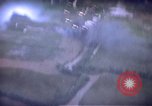
F-100 Super Sabre jet fighter aircraft does strafing attacks on enemy structures and along river in farming area in Vietnam.
U.S. air strikes in Vietnam during the Vietnam War. USAF (United States Air Force) F-100 Super Sabre jet fighter aircraft does strafing attacks on enemy structures along a river in farming area, 15 miles northeast of Binh Thuy, on 2nd September. The smoke rises due to the attack. The smoke rises in the sky.
The U.S. fleet of warships at anchor off Ulithi Atoll in World War II
U.S. Naval fleet of warships anchored off Ulithi Atoll, Palau, Western Caroline Islands, during World War 2. Aircraft carriers are seen and many other types of warships. Closeup of a Pensacola, Salt Lake City ("Swayback Maru") class heavy cruiser, in camouflage paint, with Kingfisher scout plane on her stern. An escort aircraft carrier. A sling filled with supplies being unloaded on an aircraft carrier. A U.S. flag on the cargo ship in the background. Food supplies being unloaded from cargo nets. Sailors pick up the supplies and store them aboard the aircraft carrier. Cartons piled up inside the aircraft carrier. A sailor pulls a trolley loaded with food supplies. The interior of the carrier with stored food supplies.
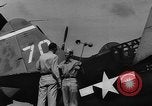
U.S. Navy aircraft making use of new airstrip at Ulithi Atoll in World War II
Three crew members stand on deck of a U.S. aircraft carrier, anchored off Ulithi Atoll during World War 2. One holds an anemometer, with its buckets spinning. A TBF avenger aircraft on deck ready to be catapulted. It launches and is seen flying away above a variety of naval vessels at anchor. View from an aircraft flying fast and low, past Ulithi Atoll. A TBF avenger landing on the Ulithi airstrip. (Note: At TC 00:28 through 00:36, the Destroyer Tender, USS Prairie AD15, is seen with several destroyers tied to it. She rescued survivors from the sinking of the Oiler, USS Mississinewa, AO-59, by a Japanese Kaiten suicide submarine, on November 20, 1944.)
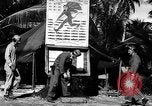
U.S. air operations at newly built airstrip on Ulithi Atoll in World War II
During World War 2, three pilots of Marine Torpedo Bombing Squadron 232 (VMTB-232) stand in front of Billboard displaying their squadron symbol of a red devil with spear and cape. It also displays silhouettes of Japanese ships they had struck. View of the newly constructed airstrip at Ulithi, as an F6F aircraft takes off. It is followed, in turn, by a C-47 (R4D),a PBY, and another F6F. Aerial view of Ulithi and the new broad runway running across the atoll.
CRITICALPAST.COM: About Us | Contact Us | FAQs - How to Order | License Agreement | My Account | My Lightboxes | Shopping Cart | Advanced Search | Featured Collections | Website Terms & Conditions | Privacy Policy ©2026 CriticalPast LLC.
License Agreement |
Terms & Conditions |
Privacy Policy
©2026 CriticalPast LLC.