


 Francais
 Deutsch
 Italiano
Refine Your Search
V2 stock footage and images
- Showing 7681 to 7686 of 9941 results more
more Hide
Hide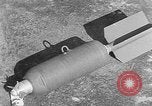
Optimum mix of fragmentation and incendiary bombs is determined during tests at Eglin Field, Florida, during World War II
Conclusions of tests conducted by U.S. Army Air Forces, at Eglin Field, Florida, seeking best way to attack Japanese homeland during World War 2. Actor Lee J. Cobb, portraying an Air Force Captain, smoking a pipe in his "office." Views of M-41 fragmentation bomb and a bundle of M-69 incendiary bombs. The Captain holds a model of a B-17 bomber and uses it to discuss bombing techniques. B-17 in flight. Views of effects of fragmentation bomb, showing numerous small holes produced by it. Aerial view of the test area houses. Mixture of M-69 incendiary bombs and M-41 frag bombs being dropped by the plane on the test area. Various views of resulting damage and effects. Test report is shown, concluding that demolition bombs are not effective against congested wooden structures; that M-41 frag bombs deter early firefighting efforts; and that a mix of 80 percent M-69 incendiaries and 20 percent M-41 frag bombs is optimum. Views of Japanese cities burning, from such bombing, during the war.
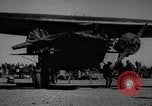
In 1927, Lieutenant Hegenberger and Lieutenant Maitland make record-breaking flight over water from California to Oahu Hawaii.
U.S Army ground crews prepare Fokker C-2 Trimotor aircraft called "Bird of Paradise." Crowd at Oakland Airport as plane takes off. Aerial views of Oakland Airport and surrounding area, as seen from aircraft over San Francisco Bay. Aircraft in flight. Aircraft lands in Hawaii less than 26 hours later. Lieutenant Alfred Hegenberger and Lieutenant Lester Maitland are greeted by large crowd in Honolulu, Oahu, Hawaii, as they were the first aircraft ever flown from the United States to Hawaii. Leis placed around neck of Hegenberger and Maitland.
American industry focuses on defense and war materiel production during World War II
Film opens showing smoke pouring from industrial smoke stacks in American manufacturing plants, during World War 2. Sparks fly from crucible of molten steel. Steel workers silhouetted against fog as they leave on a shift change. Men tapping an open hearth furnace in a steel mill. Hot steel being poured in Crucibles and then into steel containers on rails. Huge overhead cranes moving in a mill. A Bessemer converter furnace tilted and blowing with flames extended from its mouth. (A smoke ring leaves the converter.) Various views of activities in steel mills with flaming steel involved and processing such as extrusion and forging taking place. Closeups of hardworking steel workers handling white hot steel ingots. Sheets of aluminum being processed in rolling mills and then inspected. Scene shifts to an oil field with numerous derricks and then to a refinery, with 10 tall smoke stacks, where crude oil is made into gasoline. Views of Grand Coulee Dam, Bonneville, Boulder, and the Tennessee Valley, where hydroelectric power is produced. Churning waters being discharged through dam spillways. Huge number of men and women war factory workers seen in a shift change at a war production plant. Closeup of machines producing small arms and ammunition. A woman war production worker assembling an M1 Garand rifle. Others working on Browning 30 caliber M1919 machine guns and Browning Model 1917A1 water-cooled machine guns. Belts of machine gun ammunition being boxed in ammunition boxes for shipment. Thousands of bullet rounds pouring through funnel machinery. Shops where torpedoes, shells and bombs are manufactured and seen in piles and stacks. A worker checking out movement of a Anti-aircraft 40-mm Automatic Gun M1. Field artillery pieces covered outside a war plant. A 14 inch barrel, for a coastal gun or Navy ship gun, seen suspended from an overhead crane in a factory. Views of various such barrels including a view through one. Elements of mobile weapons being assembled. Jeeps being assembled and driven out of a factory at the rate of one per minute and temporarily stored in a yard. Special machinery grinding gears and other parts. Arc welders at work on weapons. M4A1 Sherman medium tanks being manufactured. View in factory of M3 Lee medium tanks being assembled. Rear view of one being fitted with its treads. Others are seen suspended from overhead crane.
America fully mobilized in World War II
Opening slate announces 11 million Americans to bear arms (in World War 2.). U.S. Army Chief of Staff, General George S. Marshall conversing with Chief of Naval Operations, Admiral Ernest King. Next, Admiral King is seen standing with Commanding General of the U.S. Army Air Forces, Lieutenant General Henry H. (Hap) Arnold, and Admiral William D. Leahy, Chief of Staff to the President of the United States. Scene shifts to a graduating class of cadets from the United States Military Academy, at West Point. They are seen receiving their diplomas. West Point cadets are also seen cheering at an athletic event and in several views of them marching in formations on different occasions. Views of cadets from the U.S. Naval Academy, at Annapolis, Maryland, on parade and at a graduation ceremony in Dahlgren Hall, where each receives a diploma and they toss their hats into the air at the end of the ceremony. Next, ordinary citizen soldiers (mostly draftees) are seen marching in formation They participate in calisthenics en masse. Heavyweight boxing champion, Gene Tunney, is seen leading an exercise session. Soldiers run over an obstacle. Next cadets are seen on parade in the U.S. Merchant Marine Academy, at Kings Point, New York. Some cadets are seen practicing escape from a burning vessel at sea. U.S. soldiers engage in field training that includes live weapons fire above their heads as they crawl under barbed wire on a training course. View of soldier firing a Browning M1917 water-cooled machine gun near the trainees. Another is firing a Browning M1919 air-cooled machine gun.
Celebrities help promote American Red Cross blood donor programs and War bond drives during World War II.
Film opens showing a huge crowd gathered in New York’s Madison Square Garden for a rally in support of the American Red Cross, during World War 2. Eleanor Roosevelt, the First Lady welcomes and introduces Princess Martha of Norway. The audience applauds. Scene then shifts for Red Cross activities on the home front. Two Red Cross women remove items from a station wagon in preparation for a local Blood drive. A panel truck parked next to them is marked: “American Red Cross Blood Donor Service.” More Red Cross volunteer women remove items from the panel truck to set up the blood donor activity. View of many persons in beds at a blood donor center. Nurses and Red Cross volunteers working at the center with donors. One of the donors is an active duty sailor in uniform. Complete change of scene to California, where Hollywood stars are seen involved in a war bond drive. Closeup of several, including Irene Dunn, Ronald Coleman, Hedy Lamarr, and Greer Garson. Glimpse of crowd at the bond drive.

U.S. Army Air Forces Air Transport Command activities during World War II.
U.S. Air Forces Air Traffic Controllers on duty at a control Tower in an airfield during World War 2.. Several multi-engine aircraft are parked on the ramp, outside, including two Douglas C-54 transport aircraft. One controller looks through binoculars. Next, airmen are seen loading cargo into an aircraft from a truck backed up to its side. Air Forces ground crewmen are silhouetted against a light sky as they watch aircraft take off while being ferried overseas. Parked behind them is a USAAF Consolidated B-24 bomber. A Boeing B-17 Flying Fortress bomber taking off. A Douglas A-26 Invader aircraft landing. A North American B-25 Mitchell bomber taking off. Next, numerous Douglas C-47 transport airplanes are seen taxiing on an airfield. View from directly in front of a C-47 aircraft as it takes off, and passes over the camera. View from ground of a low flying C-47, and then of several in loose formation flying overhead.
CRITICALPAST.COM: About Us | Contact Us | FAQs - How to Order | License Agreement | My Account | My Lightboxes | Shopping Cart | Advanced Search | Featured Collections | Website Terms & Conditions | Privacy Policy ©2026 CriticalPast LLC.
License Agreement |
Terms & Conditions |
Privacy Policy
©2026 CriticalPast LLC.