


 Francais
 Deutsch
 Italiano
Refine Your Search
V2 stock footage and images
- Showing 7711 to 7716 of 9941 results more
more Hide
Hide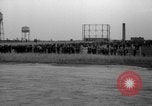
Airship LZ 129 Hindenburg lands at Lakehurst Naval Air Station in New Jersey.
Crowd assembled to see German zeppelin airship, LZ-129 Hindenburg, descending to land, upon arrival on its first flight to the United States, at Lakehurst Naval Air Station in New Jersey. Mooring tower and U.S. Navy dirigible LZ-126 the USS Los Angeles (ZR-3) are seen on the field. A DC-2 aircraft takes off in front of the Hindenburg as it approaches. Ground crew secures the Hindenburg to the Mooring tower. Officers of the Hindenburg look out from the control room.Officials gather underneath the airship. Passengers look out windows of the cabin. A tractor,built into the mooring tower, travels along a track to move the hindenburg, while ground crews hold lines to stabilize the air ship.

Helicopter SH-3A dips sonar (Sound navigation and Ranging) in the Mediterranean water.
Helicopter SH-3A in flight over the Mediterranean Sea. SH-3A hovers over sea, dipping sonar. SH-2A dips sonar. SH-3A lifts sonar and flies off.
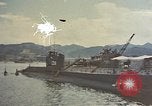
Activity aboard captured Japanese submarines at Japanese Naval Base, Yokosuka, Japan, at end of World War II.
Japanese Imperial Navy submarine I-369 docked at Yokosuka Japanese Naval Base, at end of World War 2. Another submarine nearby has white tents on its deck. American Navy sailor walking along deck of a docked Japanese submarine. Several Japanese I-400 class submarines tied side by side. Armed sailor walks along deck of another Japanese submarine that displays painted images of tigers on its conning tower along side ID numbers that include Japanese characters and "101". Two U.S. Navy sailors aboard the submarine. One examines its deck gun. Japanese soldiers unloading, what appear to be, military duffel bags, from a barge at the dock, as a Japanese officer and several U.S. sailors watch.
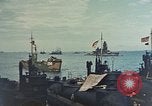
Japanese I-400 class submarines and Battleship Nagato in harbor of Yokosuka Naval Base, at end of World War II
Japanese I-400 class submarines and ships, including the Battleship Nagato, in harbor of Yokosuka Japanese Naval Base, during Japanese surrender operations at end of World War 2. Several of the submarines and an approaching small warship display American flags above Japanese flags. Japanese sailors and their baggage crowd a barge, nearby. Several Japanese navy sailors jump down to the barge from adjacent submarine which is floating much higher. The barge, flying an American flag, and manned by U.S. sailors, pulls away from the dock. View of Japanese ships from one flying American flag over the Japanese Naval Ensign. Japanese sailors and marines leaving submarines and boarding barges under guard by U.S. sailors.

Japanese plane explodes in midst heavy flak fire and tailspins into water beside U.S. Navy ship, during World War II
Actions on USS Randolph during Japanese air attack in World War 2. F6F Hellcat aircraft ready to be catapulted from flight deck of USS Randolph. F6F planes taxi and take off from USS Randolph. Japanese plane explodes midst heavy flak fire and tailspins into water. Parachute floats through air and lands in water off stern of light cruiser underway. A North Carolina class battleship is seen in the background.
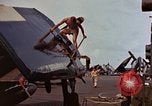
Men sun bathe and play catch on flight deck of USS Randolph, Pacific Ocean.
Activities aboard USS Randolph underway in Pacific Ocean. Men work on flight deck of USS Randolph. Officers and men sun bathe on deck. Men play catch. SB2C Helldiver with folded wings parked in the background. Man lying on stomach, plays with a dog along deck. Aviation ordnance men clean belt of 50 caliber ammunition.
CRITICALPAST.COM: About Us | Contact Us | FAQs - How to Order | License Agreement | My Account | My Lightboxes | Shopping Cart | Advanced Search | Featured Collections | Website Terms & Conditions | Privacy Policy ©2026 CriticalPast LLC.
License Agreement |
Terms & Conditions |
Privacy Policy
©2026 CriticalPast LLC.