


 Francais
 Deutsch
 Italiano
Refine Your Search
V2 stock footage and images
- Showing 7783 to 7788 of 9941 results more
more Hide
Hide
U.S. form the Berlin Airlift to supply the city over pre-arranged air corridors.
Summary of events after World War II. Statistics shows reduction in armed forces after WWII. Reduction in arms shows submarines, ships and other arms. Bombers are destroyed. Blasting planes on airfield. Junk piles and wreckage of equipment. Factories are converted to peacetime production. Workers operating various machinery in factories. Delegates seated in the UN assembly. Andrei Gromyko walks out of a debate on the Iranian question. The U.S. proclaims the Marshall Plan. Various delegates at Paris meet including Winston Churchill. Animated map of Europe demonstrates the expansion of communism and the iron curtain post WW2. Supplies for Europe are loaded on ships at docks as part of Marshall Plan. Reconstruction work progresses in Europe. Farmer rides new American tractor (Massey Harris tractor) away from ship docks and back to his farm. Communists demonstrate and blockade Berlin. Russians reinforce blockade. U.S. planes flying supplies to blockaded city in Berlin Airlift operation. U.S. military planes landing on airfield of Germany. Berlin Blockade is lifted by Russians.
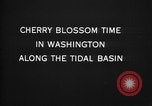
The Tidal Basin with cherry blossoms, Lincoln Memorial and Washington Monument in Washington DC.
Monuments and memorials of historic importance in Washington DC. The Tidal Basin with cherry blossoms. Women pose. The Lincoln Memorial (2 Lincoln Memorial Cir NW, Washington, DC 20002, United States). Steps lead to Lincoln Memorial building. The Washington Monument near the west end of the National Mall.
Series of test in which automatic detonator 'mole' is tested for effectiveness in disabling railroad trains.
A research film in which 'mole', an automatic detonator, is tested for effectiveness in disabling railroad trains when a train suddenly enters darkness as in a tunnel. Railroad train approaching camera position near track. Point of view shot from left side of railroad locomotive train as it approaches and enters a tunnel. A train passes through tunnel. Working and components of mole explained. Components include photoelectric cell, amplifier and a detonator. Working of mole explains where to place explosive, why and how to prepare it. Charge is placed on a railroad car. This car is attached at the end of train. A train moves. Train car damaged after detonating mole. Men at railroad car examine. Charge placed by men on train. Explosion and reaction of train is tested. Damage is examined. Next test shows 'linear shaped charge' with explosive and bracket to hold it, demonstrates how to secure charge to bracket, bracket to train car and where to place components of mole. Explosion on train. Damage in detail is examined. World War 2 period.
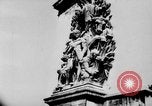
German troops decorated and troops pass in review along Avenue Foch, Paris, during World War II.
German troops awarded medals in Paris, during World War 2. Arc de Triomphe (Pl. Charles de Gaulle, 75008 Paris, France) in Place de L'Etoile, Paris. German soldiers salute Tomb of Unknown Soldier. Crowd lined up. German troops receiving medals. Troops giving salute after receiving medals. View of Avenue Champs-Élysées. Troops parade along Avenue. Arc de Triomphe in the background. Troops pass in review before reviewing German officer, Lieutenant General Kurt von Briesen. Briesen on horseback. Band plays. Horse drawn artillery pieces on Avenue Foch. Bugle corps on horses.
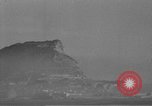
Naval mine laying by air in North African coast of Morocco.
An aerial view of North African coast of Morocco during World War 2. French fliers in aircraft above waters off Morocco. Aerial views of breakwater. An Italian submarine is spotted, on the surface, inside the three-mile limit of French Moroccan coast. A French destroyer races to intercept the errant submarine before it can retreat beyond the 3-mile limit. However the submarine manages to safely exit French Moroccan waters.
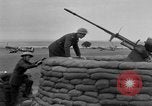
Antiaircraft gun position and crew at RAF spitfire base in England. Crew mans the gun and maneuvers it.
A Royal Air Force base in England during the Battle of Britain in World War 2. Spitfire aircraft parked in background. An antiaircraft gun crew moves into their sandbagged position and maneuvers their gun about.
CRITICALPAST.COM: About Us | Contact Us | FAQs - How to Order | License Agreement | My Account | My Lightboxes | Shopping Cart | Advanced Search | Featured Collections | Website Terms & Conditions | Privacy Policy ©2026 CriticalPast LLC.
License Agreement |
Terms & Conditions |
Privacy Policy
©2026 CriticalPast LLC.