


 Francais
 Deutsch
 Italiano
Refine Your Search
V2 stock footage and images
- Showing 7807 to 7812 of 9941 results more
more Hide
Hide
American Peace Mobilization delegates march outside the White House gates carrying placards in Washington DC.
American Peach Mobilization delegates march outside gates of the White House, Washington DC, early in World War 2. People carry signs and march on the street . Traffic passes on the street in foreground. Signs held by anti-war marchers on street read 'No Police Terrors Against Strikes', 'Strike Is Only Protection To Labor', 'All Out Aid To Britain Means Total War For America', 'Defend The Rights Of Labor', 'Fight Every Step To War', and 'There Is A Way Out War - Join APM'. People pass by the White House gate.
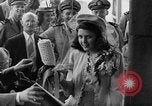
Launching of cruiser USS Santa Fe (CL-60) by sponsor Miss Caroline T. Chavez in Camden, New Jersey.
Launching of USS Santa Fe (CL-60) in Camden, New Jersey in World War 2. Sponsor of the Santa Fe, Miss Caroline T. Chavez speaks into a microphone. Officers and guests in background. Chocks under the side of the Santa Fe prior to the launch. Miss Caroline and two maids of honor at the launching ceremony. Miss Chavez breaks a bottle of champagne on the bow of Santa Fe as she starts to slide down the way. Shipyard workers wave at the launching of the ship.
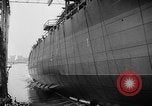
Cruiser USS Santa Fe (CL-60) slides down ways at her launch in Camden, New Jersey.
Launching of USS Santa Fe (CL-60) in Camden, New Jersey in World War 2. USS Santa Fe slides down the way. Shipyard workers at the launch of the ship. Tugs take over Santa Fe and tow her into a basin.
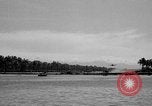
U.S. flight operations at Torokina fighter strip, Cape Torokina, Bougainville, in World War II
View from boat in the water as a U.S. F6F Hellcat aircraft takes off from Torokina fighter strip, Cape Torokina, Bougainville, during World War 2. The aircraft climbs out directly overhead. A small boat is seen at the beach and military vehicles move along the airfield roads. A P-39 aircraft taxis onto the runway and takes off in the opposite direction from the just-departed F6F. Military engineer equipment is seen working on the airstrip. A number of P-39s are parked beside the runway, close to surrounding trees. An F4U Corsair aircraft takes off towards the water (and camera), passing directly over a construction tractor working on the field. Another Corsair takes off over the heads of two armed sentries, and yet, another takes off immediately afterwards. View from the water, as an F4U flies low overhead toward the field for landing.
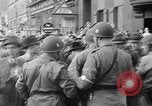
Members of the Danish Royal Family are feted by Danish citizens as they appear on balconies of Amalienborg Palace
The Danish Royal Family appear on balconies of the Amalienborg Palace in Copenhagen. Danish Police and soldiers, in Copenhagen, Denmark, attempt to control a large crowd of people milling about on a downtown street in the vicinity of the Royal Palace. Several uniformed band members with instruments are seen trying to move through the throng. Scene shifts to the courtyard of the Amalienborg Palace (Amalienborg Slotsplads 5, 1257 København K, Denmark) where a military honor guard and band stand in formation. A little boy stands alone nearby, waving a small flag. A tall man steps in front of the camera and takes the boy's hand to lead him away. Two soldiers in a color guard march in slow ceremonial steps, carrying the colors to the formation as the band plays and people watch and photographers take pictures. The honor guard shoulder their arms. Honor guards are seen at order arms position as camera focuses on the palace balcony, where King Christian X is seen by the railing of the left balcony, with a military aide in uniform behind him in the doorway. On the right-hand balcony, Crown Prince Frederik (IX) and Crown Princess Ingrid are seen with their three daughters, 6-year old Princess Margrethe Alexandrine Þórhildur Ingrid (later Queen Margrethe II); 2-year old Princess Benedikte Astrid Ingeborg Ingrid; and baby Princess Anne-Marie Dagmar Ingrid, in her father's arms. The king returns inside, and his balcony doors are closed. The Prince motions in that direction and converses with his wife, now holding their baby daughter. Change of scene shows a square in downtown Copenhagen jammed with pedestrians, some holding umbrellas. Camera pans over the crowd.
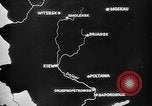
German infantry supported by tanks, artillery, rockets, and Stuka planes move up near Nevel, Russia
Animated map starts the film, showing the Eastern (Russian) front in vicinity of the Dnieper River, during beginning of winter, 1943-44, as German forces battle against Soviet forces in World War 2. German troops are seen in deep trenches and lying prone behind rubble. Light snow covers the ground. Closeups of German tiger tanks moving along a muddy path beside a river. German Panzergrenadiers taking a smoking break during a lull in combat. German soldiers trudging through mud as snow falls. They pass by some German artillery field pieces firing at Soviet positions. Heavy German guns firing. German troops hurrying toward entrenched positions. Closeup of two soldiers conversing as one points toward Soviet positions. A soldier takes up his defensive spot at the mouth of a dugout at the end of a trench. Closeup of two German soldiers smoking cigarettes. A German soldier reports to an officer at the front, who pins a medal on him and shakes his hand. Another view of a soldier smoking a cigarette. German soldiers walk past some knocked out tanks. Closeups as they pass the camera. One soldier looks skyward. A large formation of German Junkers Ju 87 (Stuka) dive bombers is seen overhead. View from a Stuka cockpit, as it dives emitting classic sound. Stuka aircraft diving and dropping bomb that are seen bursting on ground below. Good closeup of Stuka in a dive.
CRITICALPAST.COM: About Us | Contact Us | FAQs - How to Order | License Agreement | My Account | My Lightboxes | Shopping Cart | Advanced Search | Featured Collections | Website Terms & Conditions | Privacy Policy ©2026 CriticalPast LLC.
License Agreement |
Terms & Conditions |
Privacy Policy
©2026 CriticalPast LLC.