


 Francais
 Deutsch
 Italiano
Refine Your Search
V2 stock footage and images
- Showing 8071 to 8076 of 9863 results more
more Hide
Hide
U.S. task force underway for Peleliu (Palau) Invasion during World War II.
Opening slate reads LST 554, and date 8-13. Views of U.S. invasion task force vessels underway toward Peleliu Island (Palau), during World War 2. A 110 foot wooden Subchaser, number SC 633 is seen close, to starboard of camera boat (LST-554) and refueling lines are stretched between the LST and the Subchaser. Ensign Maynard K. Ross of Philadelphia, PA, directs the take-up of slack in the refueling lines while a Navy Commander on the LST bridge oversees the operation. (Note: SC 633 ended up running aground during the invasion.) Break in sequence and scene shifts to glimpse of slate reading August 20, 1944, and then view aft on LST 554. On the bridge, 21-year-old Ensign Charles Kahler, of Schenectady New York, uses a sextant to shoot sun lines. Another officer is seen taking relative bearings with a pelorus. Sailors are resting on deck. A series of splashes are created in the water by gunners testing their weapons. LST 557 is cruising to starboard. Puffs of black FLAK smoke appear overhead as antiaircraft weapons are tested.
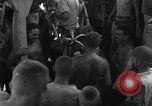
Ship's company take part in a line-crossing ceremony aboard LST 554 during World War II
U.S. Sailors and Marines participate in traditional nautical ceremonies marking the crossing of the Equator, aboard the Landing Ship Tank, LST 554, during World War 2. This involves "Shellbacks" (sailors who have already crossed the equator) intiating "pollywogs" (sailors who have never crossed the Equator) into the Kingdom of Neptune. "Pollywogs" are seen assembled below, and then brought up on deck where they are subject to various forms of horseplay and embarrassment (all in good fun). Some are seen in silly lookout poses. One is seen nearly atop the ship's mast. One, naked, pours water over the head of another. Another is made to dance with a mop. Then two are made to dance together, after which they must mop the deck. Finally, the Pollywogs have their heads shaved, and dunked in water, after which they run a gauntlet of shellbacks who hit them hard (with soft paddles). Initiates being sprayed with water on deck.
A documentary titled 'He Has Seen War' depicts life of U.S. soldiers under difficult conditions during World War II.
A documentary titled 'He Has Seen War' depicts life of U.S. armed forces soldiers under very difficult conditions during World War 2. Massive large columns of U.S. Army soldiers marching in formation. Wounded and dead soldiers during the World War II. A number of corpses kept under the open sky during the war. Soldiers march in dense wooded areas, in muddy roads and paths, and in dry deserts during various missions carrying their weapons. Tanks and armored vehicles march on roads of ruined villages. U.S. Army soldiers relax, smoke, and eat meal rations during the war. Soldiers stepping up to a pot with steaming drink or soup. African American soldiers wash their feet in a stream. Soldier sits on ground in a rainstorm, smoking a cigarette and reading a wet letter or map.
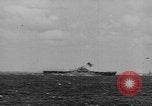
Under kamikaze attack, gunners aboard a U.S. Aircraft Carrier fire antiaircraft guns at Japanese during World War II.
A U.S. Aircraft Carrier under attack by Japanese Kamikaze aircraft during World War 2 in the Pacific Ocean. US Navy Ship's gun crews fire anti aircraft guns. Kamikaze planes falling from the sky in flames. Dramatic footage as Kamikaze aircraft is struck and on fire, and passes just beside the ship and crashes into the water very close to the ship.
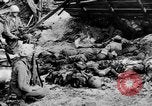
Scenes of the horror of World War II, in the Pacific and Europe. Dead, dying, and wounded casualties of war
From "He Has Seen War", scenes of badly disfigured dead bodies of Japanese and American soldiers killed on islands in the Pacific, during World War 2. Corpses of U.S. Marines on a beach. Soldiers dig out dead bodies from mud. Body of U.S. soldier, in mud, being fingerprinted for identification. American dead lying in a field, each with a white covering. Bodies kept under a white cover on a ship. A cemetery of dead soldiers. American dead, each draped in an American flag, being buried at sea. Exhausted and wounded soldiers walk out of a Landing Craft Vehicle. Group of tired U.S. Army soldiers look at camera with blank, exhausted, saddened faces. Sad and depressed war struck civilians. U.S. soldier lifts body of little girl from under rubble and debris. U.S. Army soldier seated beside a grieving civilian family. A dead boy lies between them. They sadly cover his body. Wounded U.S. soldier on stretcher cries out in pain. Soldiers walking in long lines to or from battle. Faces of war-hardened U.S. Soldiers and Marines. Narrator describes the nature of what these soldiers have seen and that they will be changed by their experiences.
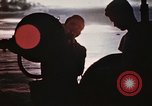
U.S. Navy Signalmaen send blinker signals as the task force advances during the invasion of Iwo Jima, Japan.
United States sailors during the invasion of Iwo Jima, Japan during World War 2. Two U.S. Navy Signalmen send red light blinker signals. The sun sets in the sea and yellowish sea water as seen from the ships of the task force. A Landing Ship Tank (LST) underway as seen from another naval vessel sailing in the sea.
CRITICALPAST.COM: About Us | Contact Us | FAQs - How to Order | License Agreement | My Account | My Lightboxes | Shopping Cart | Advanced Search | Featured Collections | Website Terms & Conditions | Privacy Policy ©2026 CriticalPast LLC.
License Agreement |
Terms & Conditions |
Privacy Policy
©2026 CriticalPast LLC.