


 Francais
 Deutsch
 Italiano
Refine Your Search
V2 stock footage and images
- Showing 8401 to 8406 of 9862 results more
more Hide
Hide
Soviet forces demonstrating their prowess and weapons in 1941 during World War II
After credits, opening slate refers to the battle front of the future, battles of the Motherland. Opening action shows a Tupolev SB-2 Katyushka bomber taking off on a grassy field. Momentary glimpse of the nose of a Mig-1 with engine running. Then a stubby Polikarpov I-153 biwing aircraft takes off. Two of them are seen in flight overhead, and then several more. Scene shifts to some captured German prisoners of war being escorted by Soviet armed guards. Troops and more prisoners walk down gang planks from a large flat river barge. A T-26 tank sits overlooking the barge as its occupants depart under guard. Scene shifts to an advanced model T-26 Soviet tank moving across a field. Another is also moving in the background. Other tanks move past the camera, through sand, and past trees. A Soviet BT-5 tank speeds past the camera. Soviet troops firing Quad-mounted PM M1910 Maxim machine guns as antiaircraft weapon. Other antiaircraft weapons firing at a German Bf 109 aircraft in flight overhead. Aerial view of a German Stuka Dive Bomber (Ju-87). Soviet gunners firing a camouflaged 85 mm M1939 (52-K) anti-aircraft gun. A German Bf 109 fighter aircraft turns and makes a gentle dive . Next, a burning aircraft is seen plummeting to earth. A large explosion. Two 85mm antiaircraft gins firing. More German aircraft are seen and another one is shot down. Several early ,model Soviet T-26 light infantry tanks run in formation over sharply rolling hills in what appears to be a testing or demonstration ground. several explosions occur near them as they move. Field artillery firing from concealed positions in woods. A tree is felled by shelling and an explosion nearby raises huge clods of earth. Soviet infantry charge through barbed wire. One soldier carries a mine detector. Soviet troops charge through woods. Several German prisoners of war are taken. Numerous German prisoners seated on the ground in an open field.

Last part of a U.S. Army Air Forces film to prepare aircrews for bombing raid on Ploesti oil facilities in Romania in World War II
Training and motivational film for U.S. Army Air Force crews preparing for the bombing of the Ploesti (or Ploiesti) oil fields in Romania, (Operation Tidal Wave) of August 1943. Final part of a training film to brief U.S. Army Air Forces aircrews in preparation for their bombing raid on the Ploesti oil refineries in Romania during World War 2. Formation of bombers is seen flying toward oil derricks in the oil fields. Aerial views of the oil fields and refineries. Oil storage facilities. Closeup of oil workers at a drilling rig. German officers walking in snow, ostensibly seeking places to obtain oil to fuel their wartime operations. German Field Marshal Erwin Rommel and other Nazi officers examine a chart in Africa. German prisoners taken in North Africa. Large numbers of German prisoners walking across the desert. A flight of several German Messerschmitt Bf 109 fighter planes in formation. Italian Dictator, Benito Mussolini, walking with an entourage in an Italian colonial region of Africa. He climbs aboard an open rail car on a small gauge railway. Accompanied by others, the rail car is pushed along the track by Colonials in white garb. German Field Marshal Fedor von Bock, who commanded German forces attacking the Soviet Union in Operation Typhoon, is seen visiting a German base. Next, Lieutenant Colonel James "Jimmy" Doolittle has his hands on the fins of a bomb while posing with his flyers when underway in the Pacific, aboard the USS Hornet (CV-8) for their daring raid B-25 bombing raid on Tokyo, Japan. View of a B-25 taking off from the Hornet. An American B-17 flying fortress, bomber taking off for a daylight raid in Europe. President Franklin D. Roosevelt, speaking on radio, saying "We believe the Nazis and fascists have asked for it. And they're going to get it." Oil storage tanks ablaze with heavy black smoke rising.

Construction of U.S. B-25 Mitchell bomber aircraft in the United States to carry out combat operations during World War II.
Film titled 'Combat Report' depicts the construction of U.S. B-25 Mitchell bomber aircraft to attack German submarine during World War II. Exteriors of U.S. War Department building in Washington D.C., United States. U.S. Assistant Secretary of War for air Robert Lovett and Under Secretary of War Robert Patterson seated at desk. U.S. officer looks at combat report at his desk. View of a oil tanker hit by torpedo as it sinks in the Gulf of Mexico. View of crewman at controls and a tower. Combat report being typed. U.S. sailors type report at typewriters. Man speaks into radio. Navy officer instructs an officer. U.S. B-25 Mitchell bomber aircraft in flight over sea. Pilot and copilot at controls in B-25. The position of attack being radioed to a U.S. B-25 Mitchell bomber aircraft in flight over sea. Interior views of cockpit of B-25 bomber, and of Instrument panel of B-25. Engine of planes. Men in war production aircraft factory at work building and assembling aircraft during World War 2. Blast furnace in factory. The airplane engines being assembled, tested and installed in B-25.

U.S. Troops of 504th Parachute Infantry, 82nd Airborne Division take Cheneaux town in Belgium during World War II.
U.S. airborne troops take Cheneaux town in Belgium during World War II. Abandoned German 105mm howitzer, trucks, Sdkfz.10/5 SP Flak and Sdkfz.251/9 Stummel halftracks. Dead German soldier lying on a muddy street. Troops of 504th Parachute Infantry, 82nd Airborne Division in a village as they speak with a chaplain. Soldier speaks into a walkie-talkie. Troops move on a road. U.S. 2nd Battalion soldiers on muddy road speak to Chaplain and hold short services just before moving up to relieve 1st Battalion soldiers.
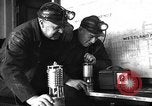
Coal miners prepare to return to work and listen to news over a radio about end of labor strike in December 1946.
Westland Mine coal mine workers, wearing helmets with lights, are gathered in a room as they listen to a radio news broadcast in a local office of the Pittsburgh Coal Company, in Washington County, Pennsylvania. On December 7, 1946, United Mine Workers President John L. Lewis called an end to the labor strike by 400,000 coal miners that he had called on November 20, 1946. Maps of Westland mines No. 1 and 2 are among many that line the walls of the office. The mine workers look at a notice of the Government takeover ordered by the Secretary of the Interior, and a notice to their union, The United Mine Workers of America. Coal miners check their personal equipment in preparation for entering mines, with the strike now ended.
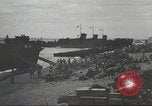
U.S. forces prepare for attack against Japanese forces on Munda, readying supplies, troops, and aircraft.
Planning and moving of U.S. equipment, supplies, aircraft, and soldiers in preparation for attack at Munda Point on New Georgia Islands, Solomon Islands during World War 2. U.S. Marines and infantry massed up on Guadalcanal beach prepare for the invasion of Munda Point. Gasoline barrels are rolled on the beach. Crated food in cargo nets hoisted aboard ships. Equipment is loaded onto ships. U.S. combat aircraft assemble for an aerial offensive. U.S. Army General Douglas MacArthur exits car and talks with another U.S. officer. General MacArthur, U.S. 13th Air Force Lieutenant General Hubert R. Harmon, U.S. Army Air Force General Nathan Twining and U.S. Fleet Admiral William Halsey plan the attack on Munda Point. United States Army Air Force P-40 Warhawk fighters taxi and take off from an airfield. U.S. aircraft including P-40 Warhawk, P-39 Airacobra, U.S. Navy F4F Wildcat, TBF Avenger, B-25 Mitchell and B-24 Liberator aircraft in flight heading to destroy enemy positions on Munda. Japanese aircraft seen taking off and in flight.
CRITICALPAST.COM: About Us | Contact Us | FAQs - How to Order | License Agreement | My Account | My Lightboxes | Shopping Cart | Advanced Search | Featured Collections | Website Terms & Conditions | Privacy Policy ©2026 CriticalPast LLC.
License Agreement |
Terms & Conditions |
Privacy Policy
©2026 CriticalPast LLC.