


 Francais
 Deutsch
 Italiano
Refine Your Search
V2 stock footage and images
- Showing 8467 to 8472 of 9862 results more
more Hide
Hide
Telephone men replace bombed telephone cables and splice cables in Germany.
Repair of telephone cables in a bomb ditch in Germany during World War 2. Telephone men splice cables. A bomb explodes. Scenes of operators and communication systems that have lost connections due to the blast. A man talks over a telephone and works on an instrument panel rerouting communications, and then researching to locate the outage. A truck arrives at the explosion site. Repair personnel locate the cut line and then install and solder a new line into place. After communications are restored, scenes of German women at typewriters and switchboards resuming communications.

German ski troopers climb the French Alps during World War II.
German ski troops advance in the French Alps during World War 2. Troopers climb a snowy mountain. Various views of troops using ropes to climb over the mountain.
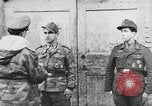
German troops are decorated by a German officer and troops advance in Italy during World War II.
German troops in Italy during World War 2. A German General decorates German soldiers with Iron Cross. German paratroopers battle enemy in a burning village. Artillery is fired at American forces. Tanks advance on a battlefield.

Students of Royal Hungarian High School march into Prisoner of War enclosure at Freyung, Germany near end of World War II.
Youth cadets from the Royal Hungarian High School march into a U.S. 11th Armored Division Prisoner of War enclosure at Freyung, Germany, during final days of World War 2, in Europe. Several takes of the young boy students, with packs and in soldier uniforms, marching through a gateway into the enclosure, as U.S. soldiers watch them. U.S. Army translator talks in German with the boy soldier leading the group.
Hungarian schoolboys are interviewed by American soldiers of U.S. 11th Armored Division at Freyung, Germany in World War II
American soldiers interviewing prisoners at the U.S. 11th Armored Division Prisoner of War enclosure in Freyung, Germany near the end of World War 2. An American Army Sergeant questions a young man with help of another Sergeant, interpreter, who speaks to him in German. The boy identifies himself as being Hungarian from the Royal Hungarian High School. The boy tells them he learned marching drill, but had no weapons training. He had been enrolled four years, and had never been engaged in combat with Americans. He states his age as 14 years. Scene shifts to another interview with a younger boy soldier. The interpreter asks if he speaks German. The boy says no, he is Hungarian. Nevertheless, with some difficulty, they determine that he too is from the Hungarian military school. When asked about his military training, the boy answers by demonstrating, standing at attention, saluting, and simple close order drill actions. They determine that he is in the third year of school. The film director calls for a cut at this point. They resume asking if he ever fought against Americans. He has difficulty understanding but eventually says no. The boy is 12 years old.
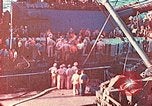
U.S. Task Force being resupplied, in Marshall Islands, during World War II.
Film taken from the heavy cruiser USS Indianapolis, CA-35 at Majuro Atoll, Marshall Islands, during resupply operations in World War 2. .Time 04:00 to 00:15 the USS Indianapolis is tied up to the starboard side of a cargo ship which is supplying the battleship USS Pennsylvania, BB-38, on the cargo ship's port side. Time 00:17 to 00:51 shows the crew of the USS Indianapolis having fun near the bow of the ship and making the ship ready for getting underway. A sailor and an officer jokingly pickup another sailor and pretend like they are going to throw him overboard. Time 0052 to 01:01 shows the ships open bridge with officers at their duties. Time 01:02 to 01:07 shows an anchor detail raising the ships anchor. Time 01:08 to 01:19 shows the ships bridge and signal flags being lowered. Time 01:20 to 01:35 shows the port side of the heavy cruiser USS Louisville, CA-28, in measure 32/6d camouflage and a Fletcher class destroyer, in measure 21 all blue camouflage, moving between the view. Time 01:36 shows a crew member taking depth soundings with a line and plummet. The rest of the film shows the shore of a small island. APs (transports), AKs (cargo ships), DEs (Destroyer Escorts), and LCs (Landing Craft) offshore. An LCT (Landing Craft Tank) underway.
CRITICALPAST.COM: About Us | Contact Us | FAQs - How to Order | License Agreement | My Account | My Lightboxes | Shopping Cart | Advanced Search | Featured Collections | Website Terms & Conditions | Privacy Policy ©2026 CriticalPast LLC.
License Agreement |
Terms & Conditions |
Privacy Policy
©2026 CriticalPast LLC.