


 Francais
 Deutsch
 Italiano
Refine Your Search
V2 stock footage and images
- Showing 8503 to 8508 of 9862 results more
more Hide
Hide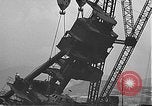
Men dismantle the foremast of USS Arizona at Pearl Harbor, Hawaii, United States.
Activities of the United States Navy at Pearl Harbor, Hawaii, United States during World War 2. The foremast of USS Arizona (BB-39) is dismantled, five months after the ship was sunk at Pearl Harbor during the Japanese attack of December 7, 1941. Men working on the ship. Blow torches being used in the dismantling of the foremast.
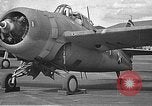
U.S. Navy Lt.Edward O'Hare and LCDR John Thach, of VF-3, prepare for flight at Kaneohe NAS, Hawaii, in World War II.
Standing in front of an F4F with its engine running and the plane captain in its cockpit, Lieutenant Commander John S. Thach, Commander of Navy Fighting Squadron Three (VF-3) discusses a planned flight with Lieutenant Edward "Butch" O'Hare, as they look over a map. (This sequence is repeated again for the camera.) LCDR Thach boards his aircraft, as plane captain steps out of cockpit and stows his map. Thach's plane has 3 Japanese victory flags painted below the cockpit. The Squadron's Felix-the-Cat logo is seen on the fuselage.The plane captain helps Thach get strapped in and settled in the cockpit. Thach gives a thumbs up indicating he is ready. Lt. O'Hare climbs aboard his F4F, which displays 5 Japanese victory flags. (O'Hare is the U.S. Navy's first air ace of World War 2.) His plane captain stows his map and O'Hare straps himself in and runs his cockpit checks. He gives a thumbs up indicating he is ready.
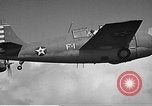
U.S. Navy Lt. Edward Henry "Butch" O'Hare and LCDR John S. Thach, in flight over Hawaii, during World War II.
LCDR John S. Thach, Commander of Navy Fighting Squadron Three (VF-3) is seen flying his F4F (number: F-1) with his wingman, Lt. Edward O'Hare,who is flying F4F number F-13. They fly over Hawaii and environs, with their canopies open. Thach is seen clearly in his cockpit. A change of sequence suddenly shows O'hare flying lead, with Thach flying on his wing. There appear to be only 4 Japanese victory flags painted on O'Hare's airplane. (Note: Lt. O'Hare was the U.S. Navy's first ace, shooting down 5 Japanese aircraft, in World War 2, and was a Medal of Honor recipient.)
F4F aircraft of Fighting Squadron Three (VF-3) demonstrate attack maneuvers during World War II, in Hawaii.
During World War 2, while stationed at NAS Kaneohe, Hawaii, U.S. Navy F4Fs of Fighting Squadron Three (VF-3) are seen making a series of attack passes for a camera mounted in an airplane in flight. They demonstrate attack maneuvers singly and in pairs.
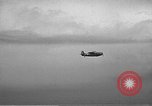
USN Lt. Edward Henry "Butch" O'Hare and LCDR James Thach, pilot F4F aircraft over Hawaii in World War II.
Lieutenant Edward O'Hare, the U.S. Navy's first ace fighter pilot of World War 2, is seen flying his F4F aircraft (number: F-13). Felix-the-Cat logo of the Navy Fighting Squadron Three (VF-3) is seen on his airplane, but only 4 Japanese victory flags are visible below his cockpit. Another F4F (number F-1) appears,flown by Lieutenant Commander John S. Thach, Commander of VF-3. Thach is flying with his canopy open. The VF-3 logo and 3 Japanese victory flags are painted on his airplane. With Thach in the lead, O'Hare maneuvers into the left wing position.
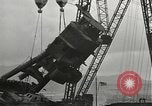
The foremast of USS Arizona is removed from the ship and put aboard a floating crane at Pearl Harbor, Hawaii, United States.
Activities of the United States Navy at Pearl Harbor, Hawaii, United States, during World War 2. The foremast of USS Arizona removed from the ship and being put aboard a floating crane.
CRITICALPAST.COM: About Us | Contact Us | FAQs - How to Order | License Agreement | My Account | My Lightboxes | Shopping Cart | Advanced Search | Featured Collections | Website Terms & Conditions | Privacy Policy ©2026 CriticalPast LLC.
License Agreement |
Terms & Conditions |
Privacy Policy
©2026 CriticalPast LLC.