


 Francais
 Deutsch
 Italiano
Refine Your Search
V2 stock footage and images
- Showing 8833 to 8838 of 9860 results more
more Hide
Hide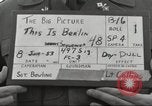
A pond and a bridge at newly renovated Tiergarten in Berlin, Germany.
Tiergarten in Berlin, Germany, eight years after the end of World War 2. A pond and a bridge in a newly renovated Tiergarten. Dome of the Reichstag House in the Zahlendorf section.
U.S. Marine Corps jet fighter bombs Viet Cong position in Quang Ngai, Vietnam during Operation Rio Grande in Vietnam War.
Opening slate reads: "Operation Rio Grande" and shows partial date of "11-2....." (The complete date is November 20-27, 1967, when this Search and Destroy mission was launched by the U.S. Marines 5th and 7th Brigades with South Vietnamese forces support during the Vietnam War.) A U.S. Marine jet aircraft dives low and drops a bomb on a Viet Cong position. View from overflying CH-46A helicopter of others maneuvering low over rice paddies, where smoke rises from some small fires, possibly from helicopter M60 machine gun fire. Helicopters parked with rotors turning on a large open field. Helicopters maneuvering low above the ground, and then climbing and departing the area.
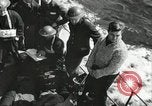
Scenes aboard a Royal Canadian Navy Anti-aircraft Destroyer on convoy duty during World War II
Canadian sailors, wearing steel helmets, aboard an Antiaircraft destroyer, in World War 2. They watch as two practice target shooting with rifles on the ship's deck. One of them wears a cap with Canadian Naval Petty Officer insignia. View of the rifle targets. Sailors hurry to a quad-mounted Mark III Vickers .50 antiaircraft machine gun position as an officer looks through a sighting device. The gunners begin firing. Another gun crew mans what appears to be a QF 3 inch 20 cwt anti-aircraft gun, while two sailors fire hand-held Lewis machine guns, skyward. View forward from the bridge of the ship. She appears to have two more forward deck-mounted 3 inch anti-aircraft guns. View astern showing the British White Ensign flying. Other warships are seen steaming on the horizon. A sailor standing near depth charges on deck, looks through binoculars. Steamships in a convoy are seen. View of a camouflaged two-stacker destroyer in the convoy. Crew members running forward on deck, followed by explosions seen in wake of the ship as depth charges she has launched detonate.
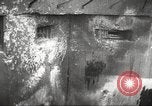
Destroyed Soviet fortifications during German invasion of the Soviet Union (Operation Barbarossa) in World War II
The German invasion of the Soviet Union in World War 2. Camera pans over battle-scarred and destroyed Soviet fortifications. A lone unarmed Soviet soldier raises his hands as he is encountered by German soldiers.among the fortifications. More views of destroyed concrete bunkers with steel reinforcing exposed. View changes to cross marking battlefield grave of a German soldier. His personal helmet and gear are placed on the cross. His comrades in arms pay their respects with helmets removed and render Nazi salutes.
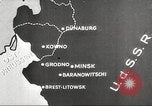
Operation Barbarossa invasion of the Soviet Union, in World War II. German Armored Group advances
German invasion of the Soviet Union. Animated map shows German advances toward Minsk and Baranowitschi (Baranavichy), after taking Grodno, Belarus, during the Operation Barbarossa invasion of the Soviet Union, in World War 2. An armored column of the German Panzer II and III tanks of the Panzer Group Kleist (Panzergruppe Kleist) move along a dirt road. (They display the letter "K" on their fenders.) Seen are Panzerkampfwagen II (Sd.Kfz. 121) and Panzerkampfwagen (Sd/Lfz/141/1 Pz.Kpfw III Ausf.L). Closeups of the tanks moving in clouds of dust. Infantrymen wave at the tanks as they pass. The tanks deployed in an open field. Burning wooden structures. Tanks speeding ahead. One drives across a field at high speed, raising a trail of dust. Houses in a village burning. A tank moving down over a berm. Tanks in a field with smoke rising in the background. Officers standing next to a camouflaged vehicle, observing the scene with binoculars. German infantry advancing in ditches alongside a dirt road. Dense smoke rising in the field. A knocked out Soviet tank burning. Two Soviet BT tanks burning in the field. Closeups of burning Soviet BT tanks. Body of a Soviet soldier in the grass. A surrendering Soviet soldier runs toward the German lines.Closeup as German crew opens hatches and climbs out of their Panzer III tank to take advantage of temporary lull in their advance while thousands of Soviet troops are surrendering. View of Soviet soldiers walking with hands behind their necks. More Panzer III tank crew members taking a break as the Soviet troop surrender. Closeup of German officer interrogating an Asian Soviet soldier, as German soldiers watch. Two captured Soviet soldiers with their gear in a field. .
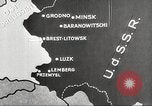
German forces attack Brest Fortress in USSR, during World War II
Map shows border of East Prussia and the Soviet Union. Arrow points to Brest-Litovsk (now Brest, Belarus) one of the first targets in Nazi operation Barbarossa, during World War 2. . German 15cm K39 (15cmKanone39) heavy artillery bombarding the Soviet fortress at Brest. Closeup of gun breech. German troops hunkered down in craters and trenches near buildings. More views of German heavy artillery firing from camouflaged positions. Smoke rising from the German bombardment. German infantry moving forward and approaching Brest Fortress. German soldiers in shell craters, observing as the shelling destroys buildings nearby. View of destroyed and burning structures. Soviet defenders of the garrison standing with hands raised, surrendering under white flags. A surrendered Soviet soldier stands on a hill waving his hat to others telling them it is safe to surrender. Other Soviet soldiers coming foreward from their defensive positions to surrender. Soviet POWs huddled together near a Soviet T-18 light tank (aka MS-1) inside part of the Brest Fortress. German officers surveying the situation. Damaged bridge over the Bug River. Surrendering Soviet troops use a rope to help cross river at bombed out section. Wounded Soviet soldiers with first aid bandages, lying on bank of river. Other Soviet POWs under German guard nearby. A soviet prisoner plays a harmonica. More views of destroyed and burning structures. German infantry running across a road, under fire from Soviet defenders. German troops entering the main part of the Brest Citadel, and fighting against stubborn Soviet snipers. Camera pans across destruction in and around the fortress. A dead Soviet soldier slumped in the seat of a vehicle. Others on the ground near a Soviet Army truck. A long line of Soviet soldiers taken prisoners of war, walking under German guard. The City Hall of Brest With German soldier standing guard. Belarussian citizens of the city going about their everyday activities, under German occupation.
CRITICALPAST.COM: About Us | Contact Us | FAQs - How to Order | License Agreement | My Account | My Lightboxes | Shopping Cart | Advanced Search | Featured Collections | Website Terms & Conditions | Privacy Policy ©2026 CriticalPast LLC.
License Agreement |
Terms & Conditions |
Privacy Policy
©2026 CriticalPast LLC.