


 Francais
 Deutsch
 Italiano
Refine Your Search
V2 stock footage and images
- Showing 8881 to 8886 of 9860 results more
more Hide
Hide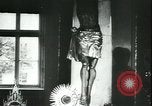
German officers visit a Catholic church in Kowel Poland during World War II (now Kovel Ukraine).
German propaganda newsreel shows German officers visiting a church in Kowel Poland, now Kovel Ukraine (possibly the Church of St. Stanislaus Bishop and Martyr in Kovel, dismantled after World War 2). A statue of Jesus Christ and many other Christian Catholic and Russian Orthodox relics and artwork are on display, purportedly saved by German forces of the 5th SS Panzer Division Wiking under Nazi General Herbert Otto Gille. Several German officers join Herbert Otto Gille in looking at the items on display. Items include a vestment or altar cloth commemorating a 1921 Gymnastic gathering of the Sokol movement in Kowel (reading Kowlu on the fabric), and featuring the Black Madonna or Black Virgin. Other relics including Crowns, candle sticks, goblets, and crucifix. The German officers discuss the relics with the Catholic priests. The officers, including Obergruppenführer Herbert Otto Gille, shake hands with the clergy before departing.

Soviet Army pursues retreating German forces in Russia during World War II
Soviet troops pursuing retreating German forces in Russia during World War 2. Soviet infantry and tanks advance through approaches to Russian city abandoned by retreating German forces. They enter the city. Damaged buildings, fires, and destruction caused by the retreating German forces and battles between Soviet and German forces. Russian soldiers advancing across a water body. A few aircraft in flight. Troops ride on tanks racing through the city. Smoke rising from explosions. Women moving with belongings. People collecting their belongings and fleeing. Several German soldiers guarded by an armed Soviet soldier walk past the site of a building with only chimneys still standing. Residents trying to contain fires by pulling burning fences and walls down. They also retrieve whatever they can from their homes and place items in places that might be protected from fire. Soviet soldiers engaged in street fighting in the city, and firing artillery piece at buildings containing German troops. Swastika and German flag dropped from a building.Two women with a soldier on a street beside damaged buildings. . Soviet cinematographer recording events on film. Soldiers and officers around a building. People waving to Red Army soldiers. A large crowd on a street greeting the soldiers. Soldiers and young people wave red Soviet flag.
Trainees advance through smoke during a gas obstacle course at the Chemical Warfare School in the Edgewood Arsenal in Maryland.
A gas obstacle course at the Chemical Warfare School in the Edgewood Arsenal in Maryland, United States. An aircraft flying low over a field leaving a thick gas obstacle course. Landing crafts arriving on a beach carrying troops. Troops on tanks during a training. A sign board reads 'C.W. (Chemical Warfare) School, Gas Obstacle Course'. A pictorial map showing the course in a woody terrain. The map shows six stations along the terrain. Each station gives trainees a specific gas combat situation. The trainees at a decontamination building where they are given protective clothing, coveralls, boots and gloves. The trainees wearing the protective clothing. Two men preparing nitrostarch explosives and other explosives and fireworks to simulate enemy fire. The trainees divided into squads. The trainee squads moving in columns. A board reads 'Station No.1, Attack thru Smoke'. The trainees advancing into the woody terrain. A man from a control tower signals and an instructor blows a whistle alerting the squad. The first mine is exploded and the squad advances on the terrain. The squad advancing among trees to a wire fenced entangle. Simulated enemy fire from bombs, fire crackers and rockets explosions. The squad advancing among the trees. The trainees moving in a trench. Simulated enemy lays down a huge envelope of smoke blown from smoke generator jets. Clouds of smoke spreading over the area. Igniting HC smoke pads and white phosphorous land mines are released adding to the density of the clouds. CN grenades are tossed by the instructor into the smoke to teach lesson that smoke masks a gas attack. Smoke in the air in the wooded terrain. The members of the squad put on masks to avoid further attacks. The squad moving through the smoke. The barbed wire entangle in view. The squad moves under a wire fence and proceed to station no.2. (World War II period).
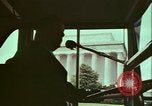
A city tour bus driver speaking about the Lincoln Memorial in Washington DC, United States.
A city tour bus in Washington DC, United States. The city tour bus driving in front of the Lincoln Memorial (2 Lincoln Memorial Cir NW, Washington, DC 20002, United States). The driver of the bus speaks into a microphone fitted on a rod beside the steering wheel. The driver says that the Lincoln Memorial had 36 columns to represent the 36 States of the United States during the Presidency of Abraham Lincoln.
Russian vessels are shelled by the Germans in the Baltic Sea during the Russian Campaign of World War II.
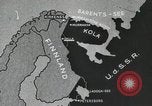
The Russian Campaign in the Baltic Sea during World War 2. A map showing locations of the Soviet Union, Finland and Kola. The bow of a Navy warship vessel advancing at sea. The German Navy cruiser ship Nurnberg following behind the camera ship. A sailor on the camera warship looking through binoculars. A deck gun on the deck of the German ship. Explosions at the sea in the distance. Light guns aft on the German ship being fired. The Russian vessel is shelled. Several explosions surrounding the vessel. Equipment on the German ship. Smoke rising from the Russian vessel. German Navy officers and sailors watching from the ship deck. Water splashing against the bow of the vessel.
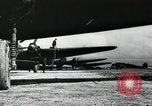
German He 111 aircraft in flight and night time bombing raid during the Russian Campaign of World War II.
German footage of Russian Campaign during World War II. German Heinkel He 111 aircraft preparing for takeoff. Dusk and night views of several German He-111 aircraft in flight. Interior cockpit view of aircraft with a German pilot controlling the aircraft. Flares and night time explosions are seen. Night time view of explosions on the ground as German bombers hit Soviet targets on eastern front in World War 2.
CRITICALPAST.COM: About Us | Contact Us | FAQs - How to Order | License Agreement | My Account | My Lightboxes | Shopping Cart | Advanced Search | Featured Collections | Website Terms & Conditions | Privacy Policy ©2026 CriticalPast LLC.
License Agreement |
Terms & Conditions |
Privacy Policy
©2026 CriticalPast LLC.