


 Francais
 Deutsch
 Italiano
Refine Your Search
V2 stock footage and images
- Showing 8947 to 8952 of 9860 results more
more Hide
Hide
Aerial view of Fire Support Base
Fire Support Base "Husky", home of Headquarters Battery, 2nd Battalion, 35th Artillery Regiment (155, SP) Xuan Loc,Vietnam. Aerial view from a UH-1 Huey helicopter, of the base and surrounding terrain. Mountains in the background. [Note: C Battery 7th Battalion, 9th Artillery (105 Howitzer) occupied the other half of the FSB. The base was attacked on the night of May 17/18, 1969, by NVA sappers, mortars, and rockets. Fourteen Americans and an estimated 80 to 90 NVA were killed.]

The wedding of Princess Marie Kinsky and Prince Hans-Adam II of Liechtenstein in Vaduz, Liechtenstein.
Crown Prince Hans-Adam of Liechtenstein marries Princess Marie Kinsky in Vaduz Cathedral. Aerial view of Vaduz Castle (Bergstrasse 2, 9490 Vaduz, Liechtenstein) in Liechtenstein. Flower girls in white dresses walk into a church. Princess Marie, escorted by her father Count Ferdinand Carl Kinsky of Wchinitz and Tettau, walks into the Vaduz Cathedral (also known as the Cathedral of St. Florin, Dompfarramt, St. Florinsgasse 17, 9490 Vaduz, Liechtenstein). Princess Marie wore an empire-style gown made of white silk and pearl beading by French couturier Jacques Heim. Princess Marie wears the Habsburg Fringe Tiara (became part of the Liechtenstein jewel collection upon the marriage of Habsburg Princess Elisabeth Amalie to Prince Alois of Liechtenstein). Liechtenstein residents in traditional costumes watch the bride from the sidewalk. People in special tents watch the wedding on television. The Bishop of Chur, Johannes Vonderach, conducts the wedding of Prince Hans-Adam II and Princess Marie in Vaduz Cathedral. The Prince presents a ring to the Princess. Noble families such as the Houses of Habsburg-Lorraine, Bavaria and Hesse are gathered at the wedding. Prince Hans-Adam II and Princess Marie wave to the people after the wedding ceremony.

U.S. Naval aircraft and warships bombard Saipan during World War II
Views from a Tennesee Class Battleship during bombardment of Saipan in the Mariana Islands during World War 2. The island being bombed by U.S. aircraft. A Broooklyn Class Light Cruiser passes. A Fletcher Class destroyer seen. It passes astern the Battleship. The stern aircraft hoist of the Battleship is visible. View of Battleship's triple 14"/45 caliber guns being turned. Explosions on the island.

Battleship firing 14-inch guns during U.S. Naval campaign against Saipan in World War II
Bombardment of Saipan in the Mariana Islands during World War 2. Tennessee class battleship fires its triple batteries of 14-inch guns. Cruisers pass in formation. Firing from ships. Soldiers near guns on a ship. Smoke columns rise from the island under bombardment.
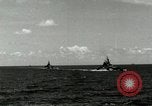
A task force leave Roi anchorage and destroyers and light aircraft carriers in Saipan, Mariana Islands.
Invasion of Saipan in the Mariana Islands during World War II.. A task force leaves Roi anchorage. Destroyers and light aircraft carriers in sea. A U.S. Navy OS2U Kingfisher floatplane on a catapult. Battleships and an Escort aircraft carrier in the sea.
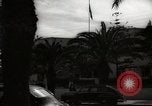
U.S. Consul in Casablanca, Morocco, meets with local leaders during World War II
Representatives of various groups meet with U.S. Consul at the American Consulate Building in Casablanca, Morocco, in World 'War 2. 1942 model cars parked in front of the consulate building. A brass plate on building reads 'American Consulate General.' Attendees stand around a conference table as U.S. Consul, Russell Mott Brooks, enters the conference room accompanied by several members of his staff.. He motions to visitors to sit, as he sits at the conference table, flanked by intelligence officer, Jerome s. Nusbaum and another staff member. The visiting leaders are seated across from him. Several persons occupy chairs away from the table. Brooks begins by making a few remarks. He then listens to what the various leaders have to say. One speaks briefly. Then a lawyer, wearing French legal robes with a white jabot round his neck hanging down the front of his robes, makes what appears to be an earnest appeal of some kind. Among others participating is a man in a robe, wearing a fez. A woman secretary makes notes during the discussions.
CRITICALPAST.COM: About Us | Contact Us | FAQs - How to Order | License Agreement | My Account | My Lightboxes | Shopping Cart | Advanced Search | Featured Collections | Website Terms & Conditions | Privacy Policy ©2026 CriticalPast LLC.
License Agreement |
Terms & Conditions |
Privacy Policy
©2026 CriticalPast LLC.