


 Francais
 Deutsch
 Italiano
Refine Your Search
V2 stock footage and images
- Showing 8971 to 8976 of 9860 results more
more Hide
Hide
U.S. Army 319th Artillery supports 101st Airborne Division defending Fire Support Base Ripcord, in the Vietnam war
U.S. Army 319th Artillery attached to 101st Airborne Division strengthens defenses of Fire Support Base Ripcord to combat North Vietnam forces in the A Shau Valley, South Vietnam, during the Vietnam War. Opening scene shows Captain David F. Rich, Commander of Battery B, 2nd Battalion, 319th Artillery, conversing with Lieutenant Brennan, in very windy conditions atop the Fire Support Base. The carriage of a 105mm towed howitzer is seen in the foreground, with two shells set on it. View of howitzers and shells stacked atop the Base. The wind whipping aross the Base. African American soldier working on a howitzer. Another fighting the wind, as he carries canisters of propellant charges. He tosses them behind the sandbagged artillery position. Other soldiers join in moving gunpowder canisters. Closeup of two soldiers as the wind blows the hat off one.
Activities aboard USS Coral Sea (CVA-43) underway in South China Sea during the Vietnam War.
The U.S. Aircraft carrier, USS Coral Sea (CVA-43) in South China Sea during the Vietnam War. Band of Sailors practice together, playing brass instruments, including trumpets and trombones. Sailors use a winch to lower a bomb onto a dolly on the ship's deck. An aircraft being moved by a tug. Two United States Navy A-4C/A-4E Skyhawk aircraft lifted to flight deck level on deck edge elevator. Mechanics work on tail section of a United States Navy UH-2A Seasprite helicopter in hanger bay.
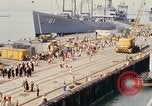
Ships at a dock along with people on pier and officers on deck of USS Coral Sea (CVA-43) in San Francisco bay.
USS Coral Sea (CVA-43) leaves the Naval Air Station Alameda in San Francisco bay. Mobile crane picks up after brow for removal. Some dependents seen on pier. USS Procyon (AF-61) tied up. Officers and men on weather deck of the Coral Sea look down on the pier. Looking down over the pier at Naval Air Station Alameda. Crowd of dependents spread out at the pier. The USS Coral Sea (CVA-43) out away from the pier. Dependents around the edge of the pier. Personnel on the flight deck area. The skyline of San Francisco framed by two crewmen manning the rail on the flight deck. Gear on deck next to the island. Some officials on the flight deck. USS Coral Sea underway. The officials on the flight deck as the ship passes underneath the Golden Gate bridge. The city of San Francisco. A part of the flight deck seen. some officers are seen on flight deck edge. A United States Navy UH-2C Seasprite helicopter comes in for a landing on the flight deck. The helicopter lands. Pleasure boat cruises past the ship. View of the San Francisco Bay. A part of the Golden Gate Bridge is seen framed by a sailor.
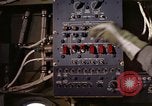
Mini guns being fired from AC-119K Gunship during training mission
View from inside an AC-119K Stinger Gunship during live fire training missions. Hand of a crewman on the fire control panel in the gunship. He flips toggle switches enabling the four GAU-2/A miniguns on the AC-119K. Views of a gun firing in broad daylight. Another view of firing in dusk with stream of tracers visible. The gunship is with the 4413th Combat Crew Training Squadron with home base at Lockbourne Air Force Base, Ohio. But the live fire gunnery training is being carried out in the vicinity of Hurlburt Field, Florida.
AC-119K Stinger gunship, of the 1st Special Operations Wing, Lockbourne AFB, firing guns during live fire training flight.
Cabin of USAF AC-119K Stinger gunship of the 1st Special Operations Wing, Lockbourne Air Force Base, on live fire training mission. Gunner adjusts Vulcan M61A1 20mm cannon aboard AC-119K. He sights and fires the cannon. Spent shells tumble down chute (including several unspent with light blue noses). View of GAU-2/A 7.62 minigun firing. Spent rounds dropping into container under the gun. Brief view of tracers streaming toward the ground.
Airman removes muzzle covers from guns and inspects jet pod of AC-119K gunship aircraft at Lockbourne Air Force Base
Airman of the U.S. 1st Special Operations Wing, Lockbourne Air Force Base, performs visual .inspection of AC-119K Stinger gunship. He removes muzzle covers from the GAU-2/A miniguns and 20mm M61A1 cannons. He inspects the left J-85 jet engine pod.The airman picks up the muzzle covers and walks away. A C-130 is parked on the ramp in the background.
CRITICALPAST.COM: About Us | Contact Us | FAQs - How to Order | License Agreement | My Account | My Lightboxes | Shopping Cart | Advanced Search | Featured Collections | Website Terms & Conditions | Privacy Policy ©2026 CriticalPast LLC.
License Agreement |
Terms & Conditions |
Privacy Policy
©2026 CriticalPast LLC.