


 Francais
 Deutsch
 Italiano
Refine Your Search
V2 stock footage and images
- Showing 9043 to 9048 of 9860 results more
more Hide
Hide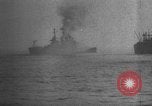
Allied Naval Task Force operations supporting Amphibian assault on Salerno, Italy, in World War II
Opening scene shows the USS Savannah (CL 42), on 11 September, 1943, after being struck by a German remotely controlled glider bomb released from a high flying German aircraft, She was supporting Allied amphibious operations at Salerno, Italy, in World War 2. Next, after fires were put out and smoke cleared, The disabled Savannah is seen sitting low in the water, making way slowly, among other Naval Task force ships in the background. (She made way to Malta under her own steam for emergency repairs.) Views of the Savannah passing as she heads for Malta. A Fletcher class destroyer fires her naval guns at the shore. Attack transports and other support ships are seen nearby. More views of support ships, including the USS Samuel Chase (APA-26). A barrage balloon seen above the convoy in some scenes. Sailors manning a Bofors 40mm anti-aircraft gun aboard a U.S. warship. A British Escort Carrier with number 337 on her bow. Sailors with a Oerlikon 20 mm cannon aboard a warship. The British Escort Carrier seen earlier, (with number 337 on her bow) passes the camera ship. Aircraft are seen on her flight deck. A Navy warship firing 40mm Bofors and 5-inch guns as it lays down a smoke screen.
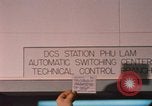
A U.S. 1st Signal Brigade soldier operates a modulator at the Regional Communications Center in Phu Lam, Vietnam.
A U.S. 1st Signal Brigade soldier operates a machine at the Regional Communications Center in Phu Lam, Vietnam during the Vietnam War. A sign reads 'DCS Station, Automatic Switching Center, Technical Control Branch'. The soldier walks in a room and attaches wires to a switch board. He checks the timing on a modulator. He rotates a button. The communication equipment. The dials, lights, oscilloscopes and flashing numbers. Another soldier operates an autodin ASC-2 simulator.
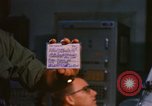
A 1st Signal Brigade soldier presses different buttons and monitors a circuit for distortion at a center in Vietnam.
A U.S. Army 1st Signal Brigade soldier operates a machine at the Regional Communications Center in Phu Lam, Vietnam during the Vietnam War. The soldier operates an autodin ASC-2 simulator. He monitors the circuit for distortion. He presses some buttons of the simulator. A dial on the machine. Wires plugged in into different switches. A screen.
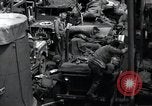
Flotilla of invasion ships assembled in United Kingdom for Normandy invasion in World War II
Several sequences related to World War 2 Normandy invasion, not all in chronological order. U.S. soldiers with tents encamped between military vehicles parked close together on deck of a Landing ship tank (LST). Higgins boats are seen on davits. Soldiers sleeping under tarps on deck. Sailors in lookout perch; one operating signal lamp. American flag flying from mast. Scene shifts to landing craft at an inlet. U.S. LST-310 moves past at low speed; a white diamond painted on her hull. Two small empty landing craft, each driven by a single sailor,seen keeping pace with the LST. Change in sequence: The LST raising her anchor via capstan. Chain moving up through hawsepipe. Another view of her deck crowded with men and vehicles. The LST maneuvers close to LST 310 and then proceeds away past other anchored assault craft.Landing craft-856 is seen. Deck of the LST, with Naval Jack flying from mast. Sailors raising anchor. The LST moves past breakwater and low fortifications. Landing Ship Tank, LST-310, with white diamond on her hull, moving past camera.Numerous other large landing craft in the harbor. View of several large transport ships.A U.S. LST, marked with white diamond on hull,moving very slowly. Higgins boats in the water.
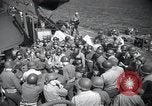
Troops on an LST crossing the English Channel on D-Day for invasion of Normandy in World War II
U.S. soldiers crowd on the deck of an LST crossing the English Channel en route to Normandy France on D-day, in World War 2.. A photographer in the background takes their pictures. Lieutenant Colonel John H. Livingston,of the 834th Engineer Aviation Battalion, refers to a map as he briefs members under his command about their mission. Army chaplain, Captain George Russell Barber, conducts an informal religious service for troops.
U.S. soldiers board military trucks and are en route to 199th Infantry Brigade base camp in Vietnam during the Vietnam War.
U.S. soldiers get off from a truck at 199th Infantry Brigade base camp in Vietnam during the Vietnam War. The soldiers carry barracks bags and board a 2 ½ ton military truck. A soldier carrying a barracks bag moves towards the truck. Other soldiers sit on barracks bags in the background. Military trucks en route to 199th Infantry Brigade base camp. Other vehicles move on the road. Trees and building in the foreground. U.S. soldiers look out from the trucks. The trucks enter the camp and the soldiers get off.
CRITICALPAST.COM: About Us | Contact Us | FAQs - How to Order | License Agreement | My Account | My Lightboxes | Shopping Cart | Advanced Search | Featured Collections | Website Terms & Conditions | Privacy Policy ©2026 CriticalPast LLC.
License Agreement |
Terms & Conditions |
Privacy Policy
©2026 CriticalPast LLC.