


 Francais
 Deutsch
 Italiano
Refine Your Search
V2 stock footage and images
- Showing 9181 to 9186 of 9860 results more
more Hide
Hide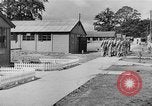
Combat Exhaustion patients receive military training at a center after the completion of treatment in the United States.
Reenactment of combat exhaustion treatment for U.S. soldiers from World War 2 combat. Patients receive military training at a training center after the completion of treatment. The patients march during the training. Rehabilitated patients pitch tents and drill. The patients receive training of sensible occupation therapy project, constructive and field projects, sports for physical coordination and team spirit. (Note: Clips deals with treatment for Combat Exahaustion, also later termed Post-traumatic Stress Disorder or PTSD)
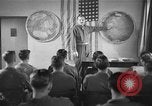
U.S. Army officers discuss treatment for combat exhaustion cases among World War II Army soldiers
Reenactment dealing with treatment for World War 2 combat exhaustion cases among U.S. soldiers. Army personnel receive training to know the reasons for exhaustion and the methods to rehabilitate the soldiers. The flag of the United States on a wall. U.S. Army officers seated at a table. The army personnel and an officer are in discussion about combat exhaustion. Personnel receive answers of their questions in the discussion. (Note: Clips deals with treatment for Combat Exahaustion, also later termed Post-traumatic Stress Disorder or PTSD)
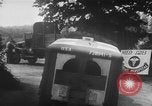
U.S. Army medic staff screen incoming patients before treatment, separating physical injury cases from combat exhaustion cases
Reenactment of treatment for combat exhaustion cases among World War 2 U.S. soldiers. A vehicle of a medical unit arrives at a field hospital carrying a combat exahusted soldier at an aid station. Medical personnel soldiers carry the agitated, traumatized soldier from the vehicle to the tent of the aid station while he yells. Soldiers lay the traumatized soldier on a stretcher. They give medicine to him. They carry his stretcher away. They give soup to another soldier. An exhausted soldier comes into the tent for treatment. He takes off his bag. A medic asks the soldier his problem. He suggests that he take rest and eat food. The medic gives him medicine. The soldier picks his bags and move out with the medics who are holding a blanket and soup for the soldier. Another exhausted soldier arrives for treatment. A Red Cross soldier examines his hand. The injured soldier goes to sleep. (Note: Clips deals with treatment for Combat Exahaustion, also later termed Post-traumatic Stress Disorder or PTSD)
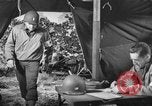
A U.S. Army psychiatric officer tries to detect signs of combat exhaustion and advises ways to prevent them
Reenactment of handling and treatment for U.S. Army World War 2 soldiers suffering combat exhaustion. A soldier gives answers to a psychiatric officer. The psychiatric officer tries to detect signs of combat exhaustion (modern equivalent Post Traumatic Stress Disorder or PTSD) like lack of physical coordination, slowing mental processes, excessive reaction off noise and inability to rest. Soldiers adjust position of artillery. The soldiers are directed to take proper meals and get sound sleep to prevent combat exhaustion and fight stress.
Paul Bebert, a former prisoner in a Nazi concentration camp, speaks to a crowd and then destroys a swastika in Hamburg, Germany.
Trade unions in a building in Hamburg, Germany. At an outdoor ceremony Colonel Armetage, British Military Government, restores free trade unions and union buildings for the people of Hamburg. Paul Bebert, formerly a prisoner in a World War 2 Nazi concentration camp, speaks to a crowd and then mounts a scaffold and with a hammer and a chisel destroys a swastika on the facade of a building.
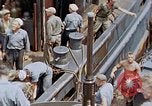
Crewmen load firefighting equipment on a landing craft and try to douse the fire on an LST in the Asiatic-Pacific Theater.
Fire fighting aboard a U.S. Landing Ship Tank (LST) in the Asiatic-Pacific Theater during World War 2. Crewmen load handy-billies, axes & other fire fighting equipment from ATL-114 to LC(FF)-370. LST-1170 on fire due to a Japanese kamikaze suicide attack. Many small boats surrounding the LST try to douse the fire using fire hoses. Men pass cans of foamite up towards fire fighting foamite generator. On the bridge of the LC (FF) an officer directs the fire fighting. A hose with a fog nozzle attached to it is passed across to assist fire fighting crew. Foam generator nozzle pours foam down a ventilator. Fire damage on the boat deck of the LST.
CRITICALPAST.COM: About Us | Contact Us | FAQs - How to Order | License Agreement | My Account | My Lightboxes | Shopping Cart | Advanced Search | Featured Collections | Website Terms & Conditions | Privacy Policy ©2026 CriticalPast LLC.
License Agreement |
Terms & Conditions |
Privacy Policy
©2026 CriticalPast LLC.